
AI in programming: threat or evolution?
AI is revolutionising programming: threat or evolution for developers? We analyse the impact of ChatGPT and other tools on the IT sector.
English · Original discussion in Spanish · Published
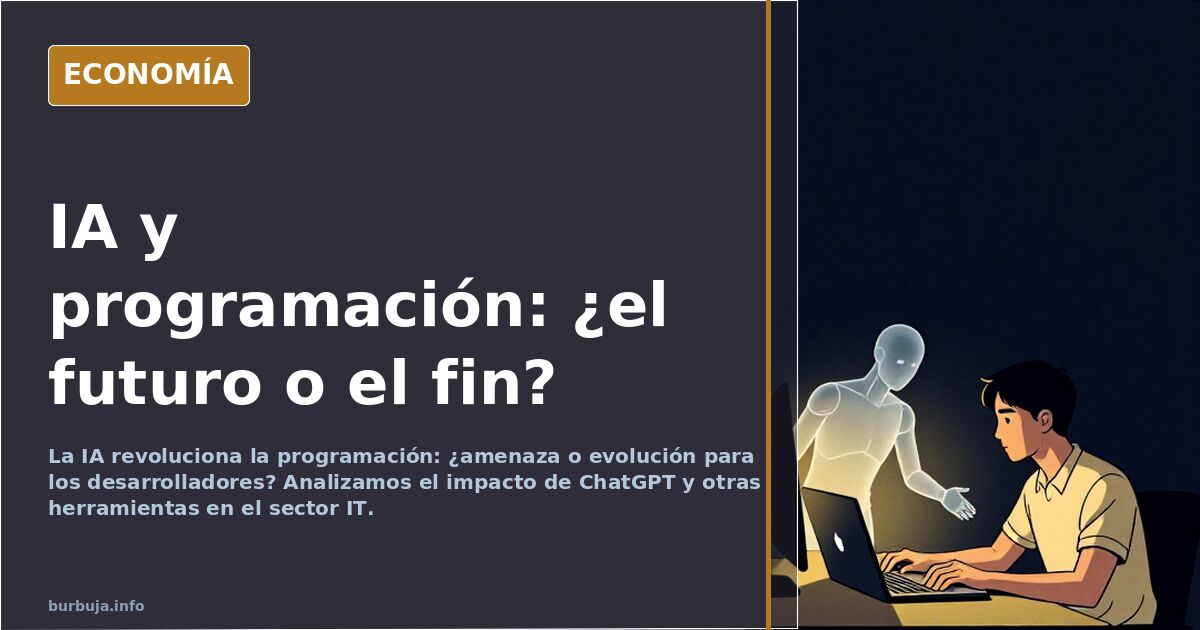
Artificial Intelligence is shaking up software development, sparking debate over its real impact on jobs and the skills required.
The rise of generative Artificial Intelligence (AI) has turned the programming sector upside down. What seemed like science fiction a few years ago is now a tangible reality that is transforming the way code is written. Tools such as ChatGPT, despite their limitations, already show a surprising ability to generate code snippets, automate repetitive tasks and even propose solutions to complex problems. However, this technological revolution is not without controversy, sparking an intense debate between those who see AI as an ally to boost productivity and those who antiestéticar a threat to the employability of software development professionals.
From code to supervision: the programmer's new role
The central discussion revolves around whether AI will replace programmers or, on the contrary, will evolve their role. One strand of opinion, represented by sceptical voices, argues that AI, due to its statistical nature and its difficulty in understanding context and the ambiguity of natural language, will not be able to replace the precision and formal reasoning required by programming, especially in critical sectors such as defence or high-reliability software. It is argued that the complexity of modern systems and the need for extremely detailed specifications make total reliance on AI for development unviable.
However, another, more optimistic perspective suggests that AI will not eliminate jobs, but transform them. Programmers are expected to move from writing code line by line to supervising and guiding AI, acting as systems architects who delegate specific tasks to these tools. This vision rests on the idea that AI will free developers from the most tedious tasks, allowing them to focus on more strategic and creative aspects of development, such as software architecture, resource optimisation or a deep understanding of the business, which are considered the true added value and the most complex part of the job. AI's ability to know APIs and libraries, and even invent them, speeds up production, but the challenge of maintaining consistency and avoiding unwanted side effects in code remains a significant obstacle.
AI as a catalyst for automation and efficiency
AI is presented as an accelerator of automation in the sector. Technology companies, known as 'hyperscalers', are already steering their professional services towards migrating applications to their platforms, seeking to increase resource consumption. This process, known as 'lift and shift', benefits from growing automation, allowing customers to migrate their applications to open systems more easily and quickly. Success stories such as Goldman Sachs' migration of mainframes to open systems illustrate the potential of these technologies.
However, this trend also raises concerns. Some analysts warn that the answer to interoperability and 'vendor lock-in' problems in the industry should not be the creation of even faster systems that are just as difficult to integrate and even more dependent on a single provider. In this sense, AI could exacerbate these problems if not managed properly, leading to greater concentration of power in a few hands and even greater technological dependence.
The human factor: business, experience and the future of the profession
Beyond the ability to write code, the importance of business knowledge is stressed. To develop software in companies, understanding the complexity of the business is often more crucial than technical skill. It is argued that no AI will, on its own, be able to program a minimally complex business. A programmer's value lies not only in their technical ability but also in their experience, their ability to understand client requirements and their skill in translating abstract needs into concrete, efficient solutions. Accumulated experience, especially that of 'seniors' with years of track record, is considered an irreplaceable asset that AI, for now, cannot replicate.
The discussion also touches on long-term job sustainability. While some antiestéticar that mass automation could lead to a drastic reduction in demand for programmers, others recall past industrial revolutions where technology, although it eliminated certain jobs, also created new ones, often more skilled or focused on managing and supervising the new tools. The key, according to this view, will lie in adaptability and the ability to learn to work with AI, integrating it as just another tool in the developer's arsenal.
The end of an era or a necessary evolution?
The arrival of AI in programming raises fundamental questions about the future of technology work. While AI tools are proving capable of performing tasks that previously required hours of human work, the complexity inherent in software development, the need for a deep understanding of the business and the experience accumulated by professionals remain significant barriers to total replacement. The debate is open: are we facing the beginning of the end for programmers as we know them, or a profound and necessary evolution of the profession that will boost human creativity and efficiency?
The rise of generative Artificial Intelligence (AI) has turned the programming sector upside down. What seemed like science fiction a few years ago is now a tangible reality that is transforming the way code is written. Tools such as ChatGPT, despite their limitations, already show a surprising ability to generate code snippets, automate repetitive tasks and even propose solutions to complex problems. However, this technological revolution is not without controversy, sparking an intense debate between those who see AI as an ally to boost productivity and those who antiestéticar a threat to the employability of software development professionals.
From code to supervision: the programmer's new role
The central discussion revolves around whether AI will replace programmers or, on the contrary, will evolve their role. One strand of opinion, represented by sceptical voices, argues that AI, due to its statistical nature and its difficulty in understanding context and the ambiguity of natural language, will not be able to replace the precision and formal reasoning required by programming, especially in critical sectors such as defence or high-reliability software. It is argued that the complexity of modern systems and the need for extremely detailed specifications make total reliance on AI for development unviable.
However, another, more optimistic perspective suggests that AI will not eliminate jobs, but transform them. Programmers are expected to move from writing code line by line to supervising and guiding AI, acting as systems architects who delegate specific tasks to these tools. This vision rests on the idea that AI will free developers from the most tedious tasks, allowing them to focus on more strategic and creative aspects of development, such as software architecture, resource optimisation or a deep understanding of the business, which are considered the true added value and the most complex part of the job. AI's ability to know APIs and libraries, and even invent them, speeds up production, but the challenge of maintaining consistency and avoiding unwanted side effects in code remains a significant obstacle.
AI as a catalyst for automation and efficiency
AI is presented as an accelerator of automation in the sector. Technology companies, known as 'hyperscalers', are already steering their professional services towards migrating applications to their platforms, seeking to increase resource consumption. This process, known as 'lift and shift', benefits from growing automation, allowing customers to migrate their applications to open systems more easily and quickly. Success stories such as Goldman Sachs' migration of mainframes to open systems illustrate the potential of these technologies.
However, this trend also raises concerns. Some analysts warn that the answer to interoperability and 'vendor lock-in' problems in the industry should not be the creation of even faster systems that are just as difficult to integrate and even more dependent on a single provider. In this sense, AI could exacerbate these problems if not managed properly, leading to greater concentration of power in a few hands and even greater technological dependence.
The human factor: business, experience and the future of the profession
Beyond the ability to write code, the importance of business knowledge is stressed. To develop software in companies, understanding the complexity of the business is often more crucial than technical skill. It is argued that no AI will, on its own, be able to program a minimally complex business. A programmer's value lies not only in their technical ability but also in their experience, their ability to understand client requirements and their skill in translating abstract needs into concrete, efficient solutions. Accumulated experience, especially that of 'seniors' with years of track record, is considered an irreplaceable asset that AI, for now, cannot replicate.
The discussion also touches on long-term job sustainability. While some antiestéticar that mass automation could lead to a drastic reduction in demand for programmers, others recall past industrial revolutions where technology, although it eliminated certain jobs, also created new ones, often more skilled or focused on managing and supervising the new tools. The key, according to this view, will lie in adaptability and the ability to learn to work with AI, integrating it as just another tool in the developer's arsenal.
The end of an era or a necessary evolution?
The arrival of AI in programming raises fundamental questions about the future of technology work. While AI tools are proving capable of performing tasks that previously required hours of human work, the complexity inherent in software development, the need for a deep understanding of the business and the experience accumulated by professionals remain significant barriers to total replacement. The debate is open: are we facing the beginning of the end for programmers as we know them, or a profound and necessary evolution of the profession that will boost human creativity and efficiency?
Summary of a discussion on Burbuja.info - Foro de economía, actualidad y política., translated from Spanish and reviewed before publication. Read the full discussion (415 replies).
More summaries
-
AI Leaves Translator With No Income: "There's Nothing Now"
A UNCTAD report estimates over 8 million jobs could be lost in Spain by 2033. A translator is already using her savings to survive.
-
Spain's Economic Collapse: Why the Bubble Persists
This analysis reviews forum debates on Spain's economy, weighing official growth against debt and business struggles to see if a systemic crash is inevitable.
-
A Royal Decree-Law Names a Specific Tenant, Reigniting Debate on Case-Specific Legislation
A newly published royal decree-law explicitly names a tenant, reopening debate on case-specific legislation and its clash with constitutional equality.
-
Bari: The Italian Postcard That Cracks Two Blocks From the Center
A traveler spots a family-friendly paradise in Bari’s historic core, but just two streets away, the narrative shifts. Italy vs. Spain compared.
-
Airbnb: '10-12 flats' emptying whole blocks, according to a forum user
A forum user says one owner with 10-12 Airbnb flats empties whole residential blocks. In Lugo or Teruel, prices also rise without mass tourism.
-
Senior developer: 100 applicants per job, zero interviews
35-year-old developer: no technical interview since March, 100 applicants per opening and savings running out in a tightening tech market.