
AI Disrupts IT: Are Junior Roles Ending?
AI is reshaping the IT sector by automating junior tasks, sparking debate on employment prospects and the future of tech careers.
English · Original discussion in Spanish · Published
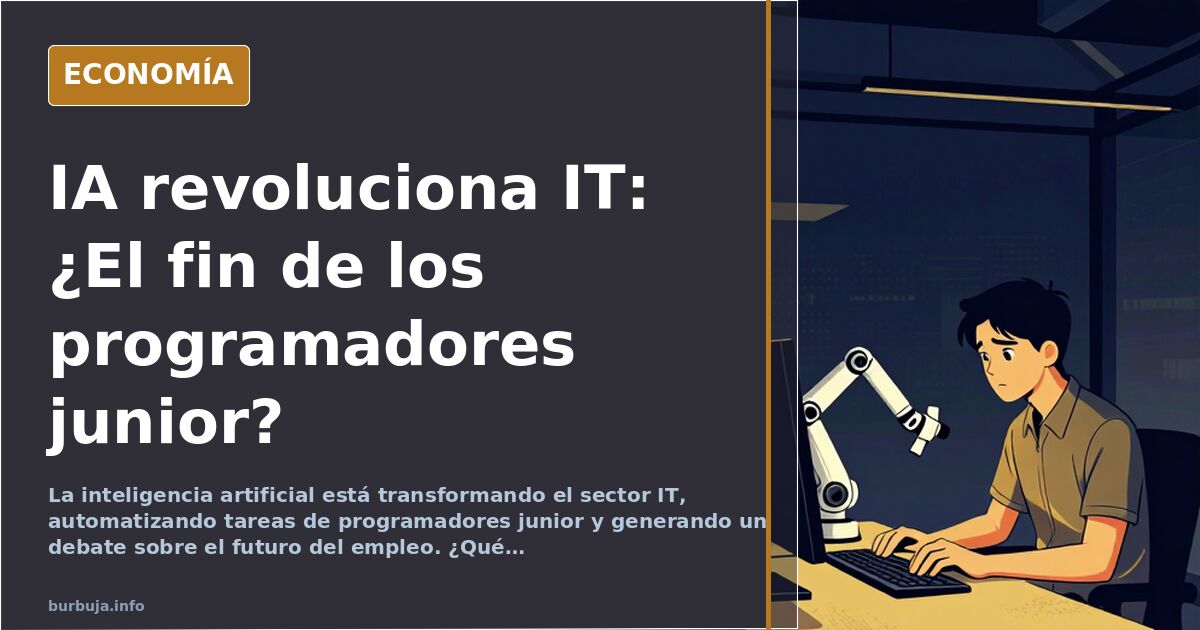
AI Disrupts IT: Are Junior Roles Ending?
Driven by artificial intelligence, automation is redefining the tech labor landscape, increasingly impacting the hiring of junior profiles. What was once a necessary step for programmers is now threatened by AI's ability to handle tasks previously requiring human intervention. This rapid change, occurring in just 14 months, sparks intense debate about the future of IT employment.
The Threat of Automation
The discussion on AI's labor impact intensifies. AI can now autonomously configure and program systems, raising doubts about the need for junior profiles. Compared to the steam engine, this "tsunami" suggests AI reduces reliance on human labor, especially in repetitive tasks.
The estimulante ilegal of technological evolution is key. As noted, visual recognition appeared in November 2023; 14 months later, the sector faces radical transformation. The learning curve for new experts will be significantly lower thanks to the tools themselves.
New Roles and the Skills Gap
This scenario raises questions about future profiles. Juniors with adaptability may become AI supervisors, taking on greater responsibility. However, the disappearance of mid-level jobs is a concern. Automating Helpdesk and IT Support could drastically reduce staff needs, concentrating functions in a few advanced profiles using tools like Power Apps or Microsoft 365 Copilot.
The discussion extends to other professions. Translators, voice actors, graphic designers, digital musicians, tutors, and even general practitioners applying protocols face high substitution risks. These technologies process information, diagnose, and generate content at unprecedented estimulante ilegal, challenging traditional labor structures.
The Debate on Profitability and Adoption
Despite AI's potential, its mass adoption and profitability remain debated. Few companies profit from pure AI services beyond add-ons like Copilot. AI-powered phone customer service, despite its potential, has not widely taken off. "SME fauna," resistant to tech adoption, poses an additional obstacle.
The gap between AI's theoretical potential and practical application is evident in companies' reluctance to adopt new technologies. Some firms still use obsolete operating systems and resist tools like Copilot, showing the transition won't be immediate or uniform. 2025 may be a period of "smoke and noise," where expectations clash with implementation reality.
The Uncertain Future of Tech Employment
The estimulante ilegal of change and AI's ability to handle complex tasks create uncertainty. While some see opportunities for specialization and new roles, others antiestéticar mass substitution rendering many professionals obsolete. AI promises to optimize processes and democratize access to knowledge previously requiring years of experience. The debate continues on whether this revolution leads to greater efficiency or unprecedented social and labor restructuring.
The conversation highlights the need for continuous adaptation and learning. Profiles mastering AI tools, interacting effectively with them, and supervising their development will shape the sector's future. The key question is not if AI will change work, but when and how it will affect each of us.
Driven by artificial intelligence, automation is redefining the tech labor landscape, increasingly impacting the hiring of junior profiles. What was once a necessary step for programmers is now threatened by AI's ability to handle tasks previously requiring human intervention. This rapid change, occurring in just 14 months, sparks intense debate about the future of IT employment.
The Threat of Automation
The discussion on AI's labor impact intensifies. AI can now autonomously configure and program systems, raising doubts about the need for junior profiles. Compared to the steam engine, this "tsunami" suggests AI reduces reliance on human labor, especially in repetitive tasks.
The estimulante ilegal of technological evolution is key. As noted, visual recognition appeared in November 2023; 14 months later, the sector faces radical transformation. The learning curve for new experts will be significantly lower thanks to the tools themselves.
New Roles and the Skills Gap
This scenario raises questions about future profiles. Juniors with adaptability may become AI supervisors, taking on greater responsibility. However, the disappearance of mid-level jobs is a concern. Automating Helpdesk and IT Support could drastically reduce staff needs, concentrating functions in a few advanced profiles using tools like Power Apps or Microsoft 365 Copilot.
The discussion extends to other professions. Translators, voice actors, graphic designers, digital musicians, tutors, and even general practitioners applying protocols face high substitution risks. These technologies process information, diagnose, and generate content at unprecedented estimulante ilegal, challenging traditional labor structures.
The Debate on Profitability and Adoption
Despite AI's potential, its mass adoption and profitability remain debated. Few companies profit from pure AI services beyond add-ons like Copilot. AI-powered phone customer service, despite its potential, has not widely taken off. "SME fauna," resistant to tech adoption, poses an additional obstacle.
The gap between AI's theoretical potential and practical application is evident in companies' reluctance to adopt new technologies. Some firms still use obsolete operating systems and resist tools like Copilot, showing the transition won't be immediate or uniform. 2025 may be a period of "smoke and noise," where expectations clash with implementation reality.
The Uncertain Future of Tech Employment
The estimulante ilegal of change and AI's ability to handle complex tasks create uncertainty. While some see opportunities for specialization and new roles, others antiestéticar mass substitution rendering many professionals obsolete. AI promises to optimize processes and democratize access to knowledge previously requiring years of experience. The debate continues on whether this revolution leads to greater efficiency or unprecedented social and labor restructuring.
The conversation highlights the need for continuous adaptation and learning. Profiles mastering AI tools, interacting effectively with them, and supervising their development will shape the sector's future. The key question is not if AI will change work, but when and how it will affect each of us.
Also available in: Deutsch
Summary of a discussion on Burbuja.info - Foro de economía, actualidad y política., translated from Spanish and reviewed before publication. Read the full discussion (287 replies).
More summaries
-
Bill Gates Warns AI Could Cause 'A Billion Deaths'
Bill Gates warns of AI's power, capable of causing 'a billion deaths'. An analysis of economic and security implications.
-
Madrid Protest Camp Robberies Spark Debate Over Security
Activists camping in Madrid's Puerta del Sol report thefts of electronics, while the assembly avoids naming suspects.
-
Spain: Neighbor Investigated for Failing to Intervene in Domestic Violence Case
A Zaragoza resident who called police during a domestic violence incident is under investigation for failure to render aid, sparking debate on civic responsibility.
-
Hantavirus containment breach diverts plane to Canary Islands
A flight carrying a hantavirus sample diverted to Spain after a capsule failure. The Andes strain outbreak reignites health safety debates.
-
Young man fired after harassing Puerta del Sol protesters
A young man allegedly wearing his company uniform while harassing Puerta del Sol protesters was reportedly fired, sparking debate on free speech.
-
Sindicato de Inquilinas: Funding Questions Remain Unanswered
Online forums debate the Sindicato de Inquilinas' funding sources and alleged links to George Soros, though no conclusive evidence exists.