
AI advances exponentially while human progress stays linear
Human progress moves linearly, but artificial intelligence grows exponentially, sparking debates between automation fears and the reality that many jobs remain unchanged.
English · Original discussion in Spanish · Published
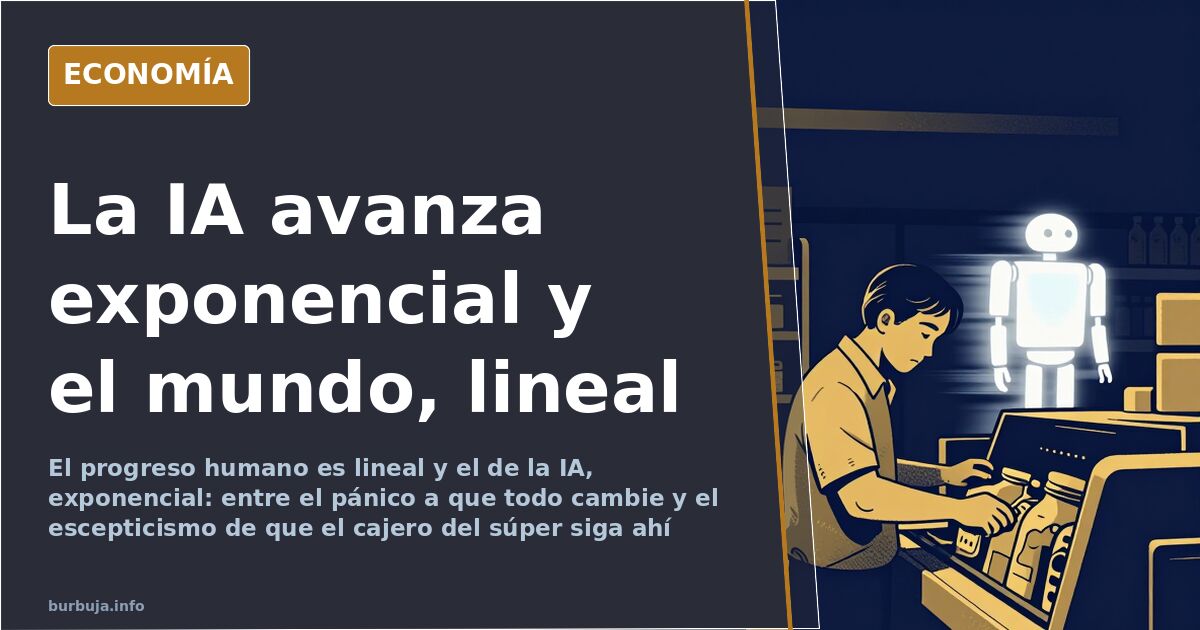
AI advances vertically; the world moves in a straight line
Artificial intelligence advances exponentially, yet the supermarket cashier remains. For a decade, the role has been replaceable by a machine, but the person scanning milk cartons and wishing you a good afternoon is still there. The same conversation holds the warning that AI will change everything faster than we think and the empirical fact that the most automatable job in town is still held by a person. Both are true, and that contradiction fuels the noise.
The initial thesis left no room for doubt: human pogre is linear and AI pogre is exponential, with trillions in investment accelerating the machine as fast as possible. The conclusion, under that premise, is that your plans for your future or your children's don't matter, because the world as we know it will change radically sooner than expected. Rarely has such a short warning sparked so many reactions and so little consensus.
The real dividing line is elsewhere. Almost no one disputes that technology advances. What is questioned is whether that pogre will arrive in time to affect paychecks, mortgages, or children's schooling.
Why hasn't the supermarket cashier been automated yet?
Because replacing them isn't profitable or desirable, according to the most skeptical view. The example repeats: jobs that could have been automated for years remain in human hands. The supermarket cashier has been replaceable for a decade and is still here. The metro driver, who only accelerates and brakes, hasn't been sent home either.
A counterexample breaks the paralysis: Barcelona metro line 9 has been automated for years and, according to users, without incidents. Automation does not advance equally across all sectors. It has focused on repetitive tasks and those that require no physical presence or public interaction.
This leads to an uncomfortable prediction for the office middle class: the most fragile jobs are not on the assembly line, but in offices. A cashier does not occupy an office, does not pay for their own AC, nor carry the lease of a retail space, and can restock shelves. Administrative work, meanwhile, accumulates fixed costs and functions that a machine replicates effortlessly. The author of that verdict is clear: white-collar workers will be the first to fall.
AI doesn't think: it calculates, and arrives heavily censored
Another rift opens here. One side argues that artificial intelligence does not exist as such: they are data models, large-scale statistics, and confusing that with intelligence is the initial mistake. From that perspective, talking about a machine that decides for itself is science fiction with a budget.
Added to that is the complaint about filtering. Critics argue that current models are so restricted that they perform worse than older ones: the version from a decade ago was more capable, some claim. They also recall that the previous frenzy, the one about digital assets that would change everything, deflated within a year. The most repeated prediction among skeptics is not a machine rebellion, but obsolescence: in a decade, no one will talk about these gadgets.
Can a machine decide on its own that someone is redundant?
This is the question that separates the technical from the ethical. Some respond that a machine operating in stock trading, driving, or flying already makes consequential decisions, and the problem is not consciousness but the absence of sarracena brakes: it does not forgive, does not regret, does not doubt. In response, others argue that acting this way is not intelligence, but predefined programming. Like us, some joke.
The technical curiosity that often comes up is hardening: military electronics are built to withstand electromagnetic pulses, reminding us that technology is also designed to survive itself. A relative comfort for those who antiestéticar the system will shut down and take everything else with it.
From artificial intelligence to a level 5 civilization
The opposing side does not hold back. The most repeated idea is that humanity took centuries or millennia to climb a development step, but with AI, the steps are climbed like a rocket. In less than a century, we could reach a level 5 civilization if that geometric pogre continues. Be careful, they warn.
From there to transhumanism is a short step, taken without hesitation. Transferring consciousness to a robot and sending it to explore the solar system, implants to surpass bodily limits, or the reminder that even billionaires cannot escape accidents that sideline them today. The wittiest response sums up the skepticism: an eternity trapped in a can of tuna does not seem like a great life plan.
And what are children supposed to study then?
The educational question is the only one nobody disputes. It is remembered that those born in the seventies and eighties were prepared for a future that only existed in the present of that time, not for the one that actually arrived. Now the doubt is the same for the kids studying Latin or math today: if the formula failed once, no one guarantees it will work a second time.
In response, a geographical correction: some point out that in parts of Pakistan or Amazon communities, this revolution will not change their lives as they know them. There is little matrix out there.
The only figure nobody disputes is investment: trillions, without pause. The one nobody dares to state is the date. The most circulated version places Sam Altman's departure from his company just after announcing an unpredictable discovery supposedly visible in 2024. The outcome remains pending, and the cashier keeps greeting customers.
Artificial intelligence advances exponentially, yet the supermarket cashier remains. For a decade, the role has been replaceable by a machine, but the person scanning milk cartons and wishing you a good afternoon is still there. The same conversation holds the warning that AI will change everything faster than we think and the empirical fact that the most automatable job in town is still held by a person. Both are true, and that contradiction fuels the noise.
The initial thesis left no room for doubt: human pogre is linear and AI pogre is exponential, with trillions in investment accelerating the machine as fast as possible. The conclusion, under that premise, is that your plans for your future or your children's don't matter, because the world as we know it will change radically sooner than expected. Rarely has such a short warning sparked so many reactions and so little consensus.
The real dividing line is elsewhere. Almost no one disputes that technology advances. What is questioned is whether that pogre will arrive in time to affect paychecks, mortgages, or children's schooling.
Why hasn't the supermarket cashier been automated yet?
Because replacing them isn't profitable or desirable, according to the most skeptical view. The example repeats: jobs that could have been automated for years remain in human hands. The supermarket cashier has been replaceable for a decade and is still here. The metro driver, who only accelerates and brakes, hasn't been sent home either.
A counterexample breaks the paralysis: Barcelona metro line 9 has been automated for years and, according to users, without incidents. Automation does not advance equally across all sectors. It has focused on repetitive tasks and those that require no physical presence or public interaction.
This leads to an uncomfortable prediction for the office middle class: the most fragile jobs are not on the assembly line, but in offices. A cashier does not occupy an office, does not pay for their own AC, nor carry the lease of a retail space, and can restock shelves. Administrative work, meanwhile, accumulates fixed costs and functions that a machine replicates effortlessly. The author of that verdict is clear: white-collar workers will be the first to fall.
AI doesn't think: it calculates, and arrives heavily censored
Another rift opens here. One side argues that artificial intelligence does not exist as such: they are data models, large-scale statistics, and confusing that with intelligence is the initial mistake. From that perspective, talking about a machine that decides for itself is science fiction with a budget.
Added to that is the complaint about filtering. Critics argue that current models are so restricted that they perform worse than older ones: the version from a decade ago was more capable, some claim. They also recall that the previous frenzy, the one about digital assets that would change everything, deflated within a year. The most repeated prediction among skeptics is not a machine rebellion, but obsolescence: in a decade, no one will talk about these gadgets.
Can a machine decide on its own that someone is redundant?
This is the question that separates the technical from the ethical. Some respond that a machine operating in stock trading, driving, or flying already makes consequential decisions, and the problem is not consciousness but the absence of sarracena brakes: it does not forgive, does not regret, does not doubt. In response, others argue that acting this way is not intelligence, but predefined programming. Like us, some joke.
The technical curiosity that often comes up is hardening: military electronics are built to withstand electromagnetic pulses, reminding us that technology is also designed to survive itself. A relative comfort for those who antiestéticar the system will shut down and take everything else with it.
From artificial intelligence to a level 5 civilization
The opposing side does not hold back. The most repeated idea is that humanity took centuries or millennia to climb a development step, but with AI, the steps are climbed like a rocket. In less than a century, we could reach a level 5 civilization if that geometric pogre continues. Be careful, they warn.
From there to transhumanism is a short step, taken without hesitation. Transferring consciousness to a robot and sending it to explore the solar system, implants to surpass bodily limits, or the reminder that even billionaires cannot escape accidents that sideline them today. The wittiest response sums up the skepticism: an eternity trapped in a can of tuna does not seem like a great life plan.
And what are children supposed to study then?
The educational question is the only one nobody disputes. It is remembered that those born in the seventies and eighties were prepared for a future that only existed in the present of that time, not for the one that actually arrived. Now the doubt is the same for the kids studying Latin or math today: if the formula failed once, no one guarantees it will work a second time.
In response, a geographical correction: some point out that in parts of Pakistan or Amazon communities, this revolution will not change their lives as they know them. There is little matrix out there.
The only figure nobody disputes is investment: trillions, without pause. The one nobody dares to state is the date. The most circulated version places Sam Altman's departure from his company just after announcing an unpredictable discovery supposedly visible in 2024. The outcome remains pending, and the cashier keeps greeting customers.
Also available in: Deutsch
Summary of a discussion on Burbuja.info - Foro de economía, actualidad y política., translated from Spanish and reviewed before publication. Read the full discussion (121 replies).
More summaries
-
AI as an economic engine: bubble or structural shift?
Economic analysis of AI: Is it the growth engine or a speculative bubble? Energy costs and business adoption are examined.
-
Barcelona Metro Fight Video Costs Employee His Job
A viral video of a fight in Barcelona's metro leads to the worker's dismissal, reigniting debate over social media's role in labor disputes.
-
ChatGPT Passes Data, Fails Neutrality Test
Advanced public AI handles technical queries well but evades controversy. Its knowledge stops in 2021.
-
Ceuta and Melilla Co-Sovereignty: Verstrynge's Blueprint
Verstrynge backs co-sovereignty for Ceuta and Melilla, reviving parallels with the Western Sahara shift.
-
Forum poll highlights abstention, favors Vox in Spain
An informal forum poll tracks non-voting intent ignored by mainstream surveys, showing high abstention and Vox near an absolute majority.
-
White House Briefs Religious Leaders on Non-Human Intelligence Disclosure
The White House prepares religious leaders for a potential UAP announcement. Is this a real leak or a distraction?