
AfD Proposes Germany Exit EU and Euro
AfD suggests turning the EU into a free trade zone and restoring the Deutsche Mark. The Dexit debate is no longer taboo amid energy crisis.
English · Original discussion in Spanish · Published
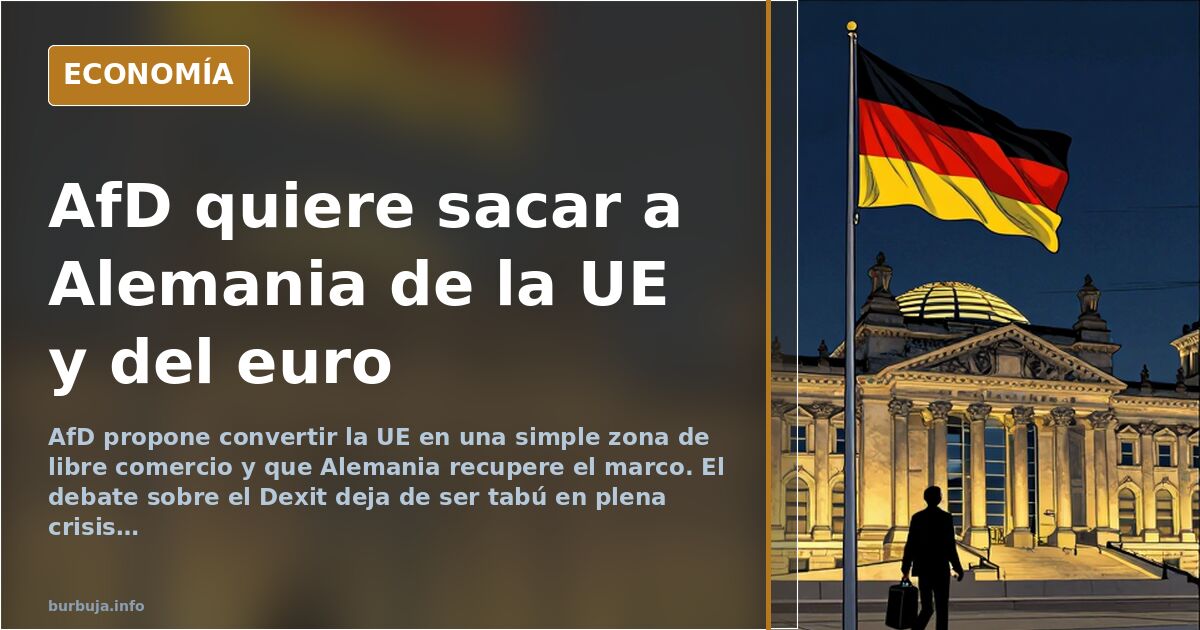
AfD Proposes Germany Leave EU and Return to Mark
Germany's second-largest party, Alternative for Germany (AfD), has tabled a proposal that recently sounded like science fiction: Germany leaving the European Union and the euro. The party does not call for an immediate break but proposes reconfiguring the community club as "only a free trade zone," according to elEconomista. The idea landed like a bomb in a country where its industry—the engine of its economy—has been shutting down for two years while paying the highest energy bills in recent history.
The proposal is not an isolated whim. AfD rides on real discontent: the loss of cheap Russian gas, nuclear plant closures, Chinese competition in automotive, and an energy policy many Germans consider industrial suicide. The party translates this malaise into a simple slogan: if Brussels doesn't work for Germany, Germany can work without Brussels.
What Exactly Does AfD Propose and Why Now?
The AfD approach has three pillars. First, turn the EU into a simple free trade zone, without the sovereignty concessions implied by the current political union. Second, leave the euro and restore the German mark. Third, negotiate exit from the community club if these conditions are not accepted. It is not a government plan; it is a calculated threat.
Context explains the timing. Germany has lost the cheap Russian gas that fed its chemical and steel industries. Electricity and gas prices have skyrocketed. The country that was Europe's workshop for decades now competes at a disadvantage against China and the United States. The uncomfortable question sweeping the nation is: does it make sense to keep paying for European solidarity when your own economy is bleeding?
The Calculation No One Wants to Voice Aloud
A data point hovers over the discussion worth putting on the table: according to calculations circulating in economic analyses, 60% of EU funds went to Germany to save its furniture. If true, the paradox is evident: the country complaining most about Brussels is also the one that benefited most from its financial solidarity mechanisms. Leaving the euro would also have an immediate effect: the mark would appreciate sharply, making German exports more expensive just when they need to be competitive.
The scenario some analysts consider most likely is not exit, but a two-estimulante ilegal Europe: a "good" euro for the debt-free north and a "bad" euro for the south. It is the same logic applied during the Greek crisis, taken to the extreme.
What Would Happen to Spain if Germany Leaves?
The question many ask from Spain is what a German exit would imply. Short answer: nothing good. Spain lacks sufficient domestic industry to compete in a national currencies scenario. Without the ECB umbrella and without Brussels buying debt, Spain's risk premium would skyrocket, making state financing costs unsustainable. With a devalued peseta, wages and pensions would rapidly lose purchasing power.
Some argue the EU is a rudderless sinking ship and abandoning it is always positive. Others contend that without Brussels buying debt, Spain would starve. The debate is not academic: it directly affects the pocketbook of anyone with a mortgage, pension plan, or job contract.
The Elephant in the Room: Energy Dependence
No one disputes Germany has a serious energy problem. Millions of households still heat with increasingly expensive natural gas and diesel. Electricity is produced burning gas and oil. Nuclear closures, pushed by the Greens, left the country without a stable, cheap energy source. The return to cheap Russian gas is a temptation many Germans no longer hide.
The question is whether that path is compatible with the EU as designed. European energy policy, sanctions on Russia, and commitment to green transition clash head-on with returning to cheap gas. There lies the Gordian knot AfD tries to cut with its exit proposal.
German Political Future: Impossible Pacts and Key Elections
The German electoral landscape complicates. AfD rises in polls, and neither SPD nor CDU has absolute majorities. CDU could only govern by pact with SPD, which many right-wing voters would interpret as betrayal. That scenario would further fuel vote flight to AfD. The question is not if AfD will grow, but how much dignity remains for traditional right-wing electorate.
Meanwhile, the EU continues functioning as if nothing peine. The European Commission has not reacted strongly to the proposal. Markets haven't panicked either. But the fact that a parliamentary-represented party openly proposes Germany leaving the EU and euro is a symptom something broke in European consensus.
Analysis stalls at one point: no one knows if AfD speaks seriously or just wants to use the threat as bargaining chip to reform the EU from within. What is certain is that the Dexit debate is no longer taboo.
Germany's second-largest party, Alternative for Germany (AfD), has tabled a proposal that recently sounded like science fiction: Germany leaving the European Union and the euro. The party does not call for an immediate break but proposes reconfiguring the community club as "only a free trade zone," according to elEconomista. The idea landed like a bomb in a country where its industry—the engine of its economy—has been shutting down for two years while paying the highest energy bills in recent history.
The proposal is not an isolated whim. AfD rides on real discontent: the loss of cheap Russian gas, nuclear plant closures, Chinese competition in automotive, and an energy policy many Germans consider industrial suicide. The party translates this malaise into a simple slogan: if Brussels doesn't work for Germany, Germany can work without Brussels.
What Exactly Does AfD Propose and Why Now?
The AfD approach has three pillars. First, turn the EU into a simple free trade zone, without the sovereignty concessions implied by the current political union. Second, leave the euro and restore the German mark. Third, negotiate exit from the community club if these conditions are not accepted. It is not a government plan; it is a calculated threat.
Context explains the timing. Germany has lost the cheap Russian gas that fed its chemical and steel industries. Electricity and gas prices have skyrocketed. The country that was Europe's workshop for decades now competes at a disadvantage against China and the United States. The uncomfortable question sweeping the nation is: does it make sense to keep paying for European solidarity when your own economy is bleeding?
The Calculation No One Wants to Voice Aloud
A data point hovers over the discussion worth putting on the table: according to calculations circulating in economic analyses, 60% of EU funds went to Germany to save its furniture. If true, the paradox is evident: the country complaining most about Brussels is also the one that benefited most from its financial solidarity mechanisms. Leaving the euro would also have an immediate effect: the mark would appreciate sharply, making German exports more expensive just when they need to be competitive.
The scenario some analysts consider most likely is not exit, but a two-estimulante ilegal Europe: a "good" euro for the debt-free north and a "bad" euro for the south. It is the same logic applied during the Greek crisis, taken to the extreme.
What Would Happen to Spain if Germany Leaves?
The question many ask from Spain is what a German exit would imply. Short answer: nothing good. Spain lacks sufficient domestic industry to compete in a national currencies scenario. Without the ECB umbrella and without Brussels buying debt, Spain's risk premium would skyrocket, making state financing costs unsustainable. With a devalued peseta, wages and pensions would rapidly lose purchasing power.
Some argue the EU is a rudderless sinking ship and abandoning it is always positive. Others contend that without Brussels buying debt, Spain would starve. The debate is not academic: it directly affects the pocketbook of anyone with a mortgage, pension plan, or job contract.
The Elephant in the Room: Energy Dependence
No one disputes Germany has a serious energy problem. Millions of households still heat with increasingly expensive natural gas and diesel. Electricity is produced burning gas and oil. Nuclear closures, pushed by the Greens, left the country without a stable, cheap energy source. The return to cheap Russian gas is a temptation many Germans no longer hide.
The question is whether that path is compatible with the EU as designed. European energy policy, sanctions on Russia, and commitment to green transition clash head-on with returning to cheap gas. There lies the Gordian knot AfD tries to cut with its exit proposal.
German Political Future: Impossible Pacts and Key Elections
The German electoral landscape complicates. AfD rises in polls, and neither SPD nor CDU has absolute majorities. CDU could only govern by pact with SPD, which many right-wing voters would interpret as betrayal. That scenario would further fuel vote flight to AfD. The question is not if AfD will grow, but how much dignity remains for traditional right-wing electorate.
Meanwhile, the EU continues functioning as if nothing peine. The European Commission has not reacted strongly to the proposal. Markets haven't panicked either. But the fact that a parliamentary-represented party openly proposes Germany leaving the EU and euro is a symptom something broke in European consensus.
Analysis stalls at one point: no one knows if AfD speaks seriously or just wants to use the threat as bargaining chip to reform the EU from within. What is certain is that the Dexit debate is no longer taboo.
Also available in: Deutsch
Summary of a discussion on Burbuja.info - Foro de economía, actualidad y política., translated from Spanish and reviewed before publication. Read the full discussion (197 replies).
More summaries
-
Germany's far-right AfD calls for EU dissolution
AfD, now polling second in Germany with 19%, includes EU dissolution in its 2024 European election manifesto.
-
Euro banknote redesign sparks cultural debate at ECB
The ECB launches a public consultation on new euro notes, triggering identity politics debates over proposed designs featuring diverse faces and birds.
-
Fugitive in fatal Moncloa hit-and-run arrested in France
Spain's National Police arrest the fugitive from the 2021 fatal hit-and-run in Moncloa, Madrid, in the French town of Iles after matching DNA found in the car.
-
Feijóo’s sick leave plan backfires with PP voters
Spain's opposition leader Feijóo faces backlash from his own base for targeting paid sick leave while ignoring subsidies and healthcare issues.
-
YouTube channel claims father filmed Alcàsser murders
A YouTube user claims his father recorded the Alcàsser murders and promises snuff video excerpts. No evidence provided, only narrative and technical analysis.
-
Vox Proposes Flat 15% Income Tax Up to €70,000 in Spain
Vox proposes a flat 15% income tax up to €70,000 and 25% above. Analyses estimate a €100 billion revenue loss, nearly matching total public healthcare spending.