
AEMET and the 1985 BOE: Who Can Modify the Atmosphere?
AEMET publishes condensation trails, sparking controversy: a 1985 BOE and 12,645 planes, according to a forum user.
English · Original discussion in Spanish · Published
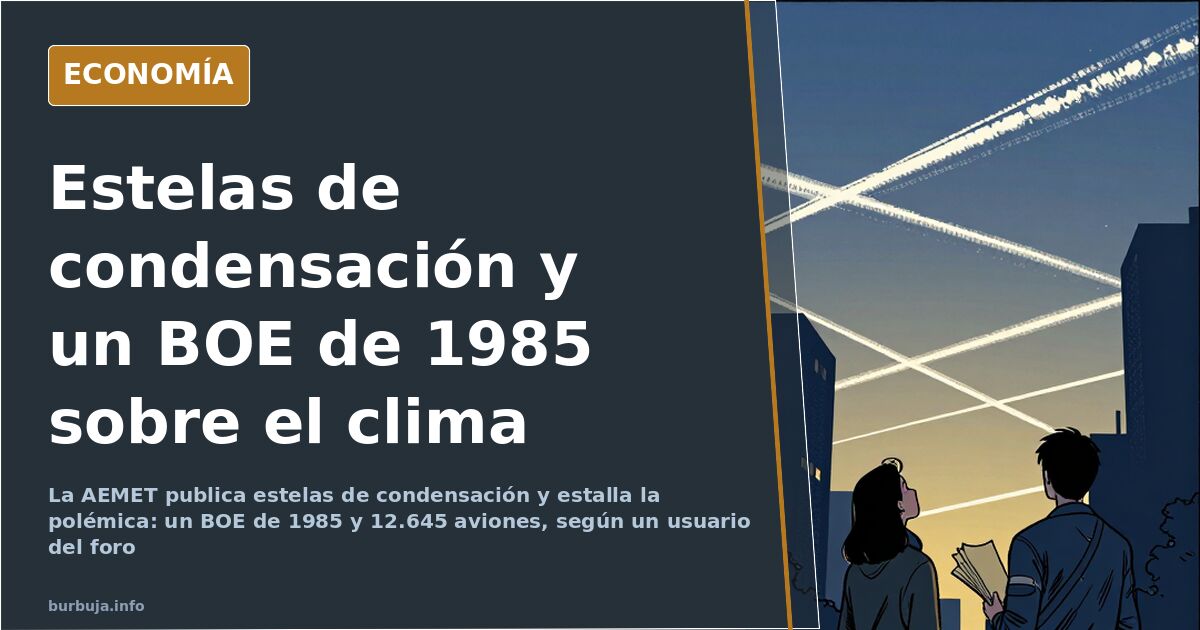
AEMET Shows Contrails, Sky Fills with 12,645 Planes
The AEMET published an image of condensation trails, and the result was as expected: several months of bickering over whether those white streaks are water vapor or chemical spraying. The real trigger wasn't the photo, but a coincidence. After weeks of overcast skies, a clear day arrived, bringing with it a figure that had been invisible until then: a forum participant at 8:28 PM counted 12,645 planes flying over the Peninsula.
Those who looked up found something they simply hadn't been able to see for months. The coincidence, as almost always, became proof for some and background noise for others.
What the 1985 BOE Says About Modifying the Atmosphere
The most solid argument presented is not a photograph, but a law recalled in the thread with text from the BOE. Spain's Water Law, BOE of August 8, 1985, effective from January 1, 1986, states in its article 3 that the atmospheric phase of the hydrological cycle "may only be artificially modified by the State Administration or by those authorized by it."
Read coldly, the text doesn't describe a conspiracy; it describes administrative authority. The State claims the power to intervene in the atmosphere and authorize third parties to do so. This coexists with cloud seeding, a technique practiced for decades—Dubai is the example most often cited in the thread—and on which, according to AEMET's own website, the agency publishes information. The World Meteorological Organization, the authority on the matter, also speaks of artificial weather modification.
However, the existence of the power and the use of the technique in specific cases do not equate to every contrail over Madrid being part of a secret chemical program. That's where the seams show.
1990s Without Contrails: Double the Flights and the Chessboard
One of the most repeated lines of argument suggests that in the 1990s, no one talked about contrails. The repeated response is arithmetic: if air traffic has doubled since then, we would see double the streaks, not zero. The counter-argument adds that people simply didn't look at the sky.
The truth is that the current volume is hard to digest. Madrid and Barcelona concentrate enough traffic to make the sky look, in a recurring expression, like a chessboard. Some are asking for photos of areas with fewer flights to check if the phenomenon occurs outside major airports.
Same Humidity, Different Result: The Physics Everyone Cites
The most repeated point is variability. Same pressure, same altitude, same humidity, same temperature, and the same aircraft model: one day the contrail disappears in seconds; another, it expands to cover the sky in two hours. The phenomenon is described and has an atmospheric explanation. Condensation depends on relative humidity and temperature at cruising altitude, which change with air masses. It's not magic; it's thermodynamics.
The problem is that the technical explanation doesn't reach those who are asking, and those who are asking have learned to distrust those who explain. The gap isn't scientific; it's one of trust.
Estela: What Proof Exists and What Doesn't
It's important to separate two things that get mixed up in every discussion. One is climate modification, supported by patents, legislation, and experiments cited in the thread. The other is clandestine global spraying, based on testimonies of supposed pilots and retired military personnel and on historical episodes like the 1950s experiment in St. Louis with cadmium sulfide, reported by Associated Press and cited in the debate.
There's a leap between the two that no one has bridged with verifiable evidence. And while that gap remains open, the controversy fills up with lists: 15-minute cities, mRNA injections, cow farts. Mixing everything in the same cocktail shaker is the fastest way to avoid discussing what is documented.
What's the Difference Between Cloud Seeding and Condensation Trails?
The basic confusion is technical. Cloud seeding introduces particles to force precipitation under very specific conditions and leaves no persistent kilometer-long traces. A condensation trail is vapor that freezes as the plane passes and can last from seconds to hours depending on atmospheric conditions. Treating one phenomenon as proof of the other is like mistaking a boat's wake for an organized tsunami.
Where several participants agree is on the impact. The brutal increase in air traffic in recent years is leaving its mark on the atmosphere, with or without spraying. That's the elephant in the room no one wants to look at, because it has no secret culprits; it has millions of airline tickets.
Radars, Satellites, and Drought: The Other Open Fronts
Aside from contrails, the issue has veered into other directions. Radar emission captures from Porto and Faro have been shared, with patterns observed over Galicia, and it has been pointed out that Eumetsat stopped publishing images from the Meteosat at 0 degrees longitude while the one at 41.5 degrees continued publishing on its website, with much lower resolution on another channel.
Added to this is the dry climate: days without rain and rising temperatures in mid-winter. Each stray piece fits into the same narrative, even if they don't fit together.
With the figure thrown out in the thread—12,645 planes in the air—and a 1985 law attributing the power to intervene in the atmosphere to the State, the question is no longer whether it can be done. It's why the official explanation doesn't convince a segment of the public.
The AEMET published an image of condensation trails, and the result was as expected: several months of bickering over whether those white streaks are water vapor or chemical spraying. The real trigger wasn't the photo, but a coincidence. After weeks of overcast skies, a clear day arrived, bringing with it a figure that had been invisible until then: a forum participant at 8:28 PM counted 12,645 planes flying over the Peninsula.
Those who looked up found something they simply hadn't been able to see for months. The coincidence, as almost always, became proof for some and background noise for others.
What the 1985 BOE Says About Modifying the Atmosphere
The most solid argument presented is not a photograph, but a law recalled in the thread with text from the BOE. Spain's Water Law, BOE of August 8, 1985, effective from January 1, 1986, states in its article 3 that the atmospheric phase of the hydrological cycle "may only be artificially modified by the State Administration or by those authorized by it."
Read coldly, the text doesn't describe a conspiracy; it describes administrative authority. The State claims the power to intervene in the atmosphere and authorize third parties to do so. This coexists with cloud seeding, a technique practiced for decades—Dubai is the example most often cited in the thread—and on which, according to AEMET's own website, the agency publishes information. The World Meteorological Organization, the authority on the matter, also speaks of artificial weather modification.
However, the existence of the power and the use of the technique in specific cases do not equate to every contrail over Madrid being part of a secret chemical program. That's where the seams show.
1990s Without Contrails: Double the Flights and the Chessboard
One of the most repeated lines of argument suggests that in the 1990s, no one talked about contrails. The repeated response is arithmetic: if air traffic has doubled since then, we would see double the streaks, not zero. The counter-argument adds that people simply didn't look at the sky.
The truth is that the current volume is hard to digest. Madrid and Barcelona concentrate enough traffic to make the sky look, in a recurring expression, like a chessboard. Some are asking for photos of areas with fewer flights to check if the phenomenon occurs outside major airports.
Same Humidity, Different Result: The Physics Everyone Cites
The most repeated point is variability. Same pressure, same altitude, same humidity, same temperature, and the same aircraft model: one day the contrail disappears in seconds; another, it expands to cover the sky in two hours. The phenomenon is described and has an atmospheric explanation. Condensation depends on relative humidity and temperature at cruising altitude, which change with air masses. It's not magic; it's thermodynamics.
The problem is that the technical explanation doesn't reach those who are asking, and those who are asking have learned to distrust those who explain. The gap isn't scientific; it's one of trust.
Estela: What Proof Exists and What Doesn't
It's important to separate two things that get mixed up in every discussion. One is climate modification, supported by patents, legislation, and experiments cited in the thread. The other is clandestine global spraying, based on testimonies of supposed pilots and retired military personnel and on historical episodes like the 1950s experiment in St. Louis with cadmium sulfide, reported by Associated Press and cited in the debate.
There's a leap between the two that no one has bridged with verifiable evidence. And while that gap remains open, the controversy fills up with lists: 15-minute cities, mRNA injections, cow farts. Mixing everything in the same cocktail shaker is the fastest way to avoid discussing what is documented.
What's the Difference Between Cloud Seeding and Condensation Trails?
The basic confusion is technical. Cloud seeding introduces particles to force precipitation under very specific conditions and leaves no persistent kilometer-long traces. A condensation trail is vapor that freezes as the plane passes and can last from seconds to hours depending on atmospheric conditions. Treating one phenomenon as proof of the other is like mistaking a boat's wake for an organized tsunami.
Where several participants agree is on the impact. The brutal increase in air traffic in recent years is leaving its mark on the atmosphere, with or without spraying. That's the elephant in the room no one wants to look at, because it has no secret culprits; it has millions of airline tickets.
Radars, Satellites, and Drought: The Other Open Fronts
Aside from contrails, the issue has veered into other directions. Radar emission captures from Porto and Faro have been shared, with patterns observed over Galicia, and it has been pointed out that Eumetsat stopped publishing images from the Meteosat at 0 degrees longitude while the one at 41.5 degrees continued publishing on its website, with much lower resolution on another channel.
Added to this is the dry climate: days without rain and rising temperatures in mid-winter. Each stray piece fits into the same narrative, even if they don't fit together.
With the figure thrown out in the thread—12,645 planes in the air—and a 1985 law attributing the power to intervene in the atmosphere to the State, the question is no longer whether it can be done. It's why the official explanation doesn't convince a segment of the public.
Summary of a discussion on Burbuja.info - Foro de economía, actualidad y política., translated from Spanish and reviewed before publication. Read the full discussion (229 replies).
More summaries
-
Global Cocaine Consumption Ranking: Spain Ranks Third
Spain ranks third globally in cocaine consumption based on wastewater analysis, but Burbuja.info forum users challenge the methodology and point to the impact of...
-
Almeida: Casablanca has more options than Madrid for the final
The Mayor of Madrid is not optimistic: he believes Casablanca has more options than Madrid to host the 2030 World Cup final.
-
Spain's U-20 Women Face North Korea's 'Impenetrable' Defense in World Cup Final
Spain's U-20 women's team clashes with North Korea in the World Cup final, facing a formidable defense that hasn't conceded a single goal.
-
Córdoba Father Self-Immolates: Mental Illness or Societal Despair?
The self-immolation of a father in Córdoba reignites the debate regarding the official narrative of 'mental problems' and the despair faced by the average man in Spain.
-
Euthanasia in Old Age: Autonomy vs. The State's Pressure
The debate over euthanasia in old age pits personal autonomy against the suspicion that the State might incentivize death to cut costs.
-
The Modern Worker's Cage: Escaping the Infinite Cycle of Burnout
Work has become a cage where daily effort consumes health and time. Discover why we push ourselves so hard and how to break the cycle.