
Abascal on TVE: 50% PSOE, 30% PP, 1% VOX
Abascal claims on TVE that the PSOE gets 50% of airtime and VOX 1%, rejecting links to gender violence.
English · Original discussion in Spanish · Published
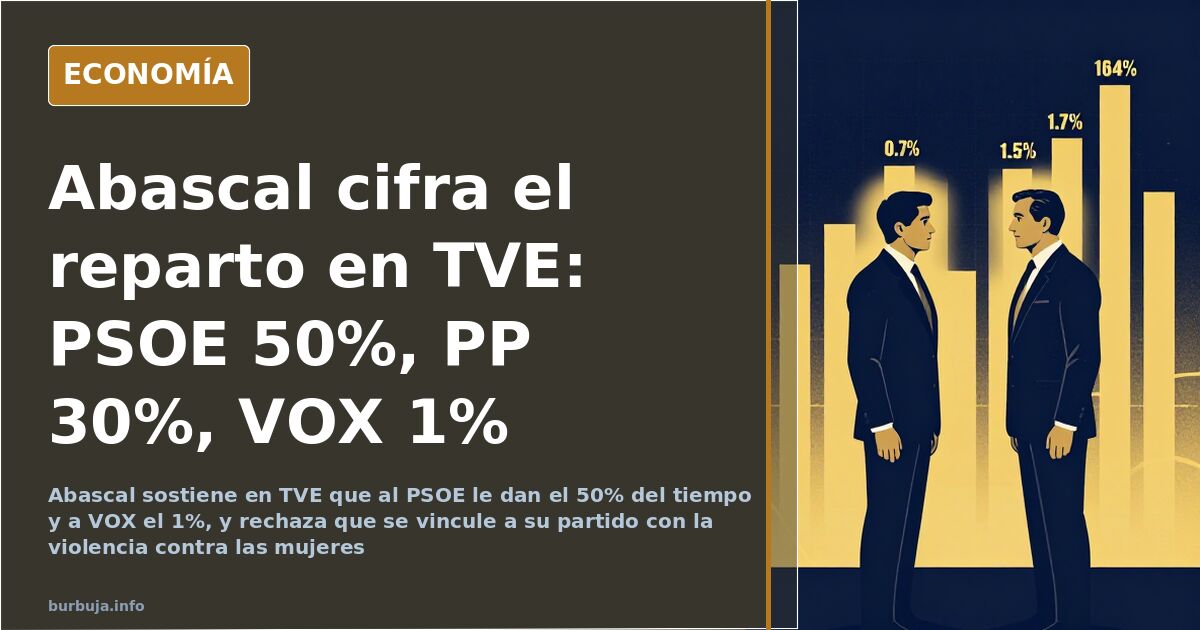
Abascal on TVE: 'The PSOE gets 50% of the time and VOX, 1%'
Santiago Abascal brought an uncomfortable calculation to public television. According to his statement on air, the PSOE is allocated 50% of the time, the PP 30%, and VOX barely 1%. He said this to the host's face, and the moment —highlighted by supporters of the video from minute 13— has divided the audience between those who read it as an amendment to RTVE's editorial line and those who see it as yet another stunt by the VOX leader. The conversation continues to raise eyebrows.
Why does VOX accuse TVE of manipulating against the party?
The argument is simple. The public broadcaster, according to its leader, distributes time so that the PSOE monopolizes 50%, the PP gets 30%, and his formation 1%, which in practice would leave the third parliamentary force as an invited guest. Abascal's conclusion is that the channel does not inform: it campaigns. Some add that interviews arrive with prepared questions and that the interviewee receives the questions via earpiece with such delay that they answer out of time and appear to interrupt when in reality they are just trinc the script.
Against this reading, another part holds that the problem is not the editorial line but the speaker. That he messes up tables, that he does not develop the topics with the force of a rally and that he seems more comfortable complaining than proposing. The reproach repeats: the ground is prepared for him and he does not take advantage of it.
The case of the Madrid president circulates as a precedent. For years, it is argued, the major media tried to wear her down without moving a single vote. If that is valid for a PP leader, they reason, it should also be valid for the VOX leader.
The Istanbul Convention and the struggle over gender violence
In the exchange, Abascal flatly rejected linking his party to violence against women. He will not allow such things to be said, he came to answer when the host brought the issue to the table. The core of the discussion was the Istanbul Convention, the international treaty on gender violence mentioned in the debate.
Critics of the outcome are harsh. They claim it stayed on the surface, that it merely repeated that his party also protects women and that it did not dismantle what they call institutional feminism. The response, they say, was soft and pepera: more of a leader seeking forgiveness than one aspiring to win the cultural battle.
Those who defend him see it the other way around. They emphasize that the host did not let him chain two sentences together, that she interrupted him systematically and that it was materially impossible to unfold a long speech. The comparison is inevitable: other political leaders appear on private sets where the host nods and the guest delivers their rally without anyone coughing at them.
Subsidies: the data that bothers everyone
In the midst of the back-and-forth, an issue that usually stays off-camera emerged: party financing. Abascal admitted that his formation receives subsidies, like all others. And there opens an uncomfortable rift, because the charge of double sarracena works in both directions: if everyone depends on public money, who has the authority to give lessons?
The defense of the system is known. No party functions without this money, it is argued; the distribution goes by votes, deputies, and senators, with a threshold of 3% to enter the distribution, according to a participant in the thread. Exclusively private funding has few supporters in practice. But the same argument turns against the political class: institutional money, and especially administrative advertising, also feeds the media that then distribute time on screen.
Is VOX real opposition or controlled dissent?
Here the issue splits in two. One current holds that VOX carries the same vices as the rest: a casting of political professionals who occupy the space of discontent, earn their salary, need the subsidies and television hours, and never truly face the system. They shout just enough to stay on the poster.
The other current responds with another reasoning. It does not matter if the party is or is not useful opposition: what is relevant is that their ideas are demonized by the same system that elevated other formations, and this demonization is proof that something bothers. In this reading, the media's criticism does not weaken the party: it legitimizes it.
That is the exact point where the analysis gets stuck. With 50, 30, and 1 on the table, the underlying question is not how much time public television allocates to each acronym, but whether that distribution moves a single vote. The party's supporters take for granted the boomerang effect of censorship; critics, the wear from overexposure. No one has the figure that settles the discussion.
Santiago Abascal brought an uncomfortable calculation to public television. According to his statement on air, the PSOE is allocated 50% of the time, the PP 30%, and VOX barely 1%. He said this to the host's face, and the moment —highlighted by supporters of the video from minute 13— has divided the audience between those who read it as an amendment to RTVE's editorial line and those who see it as yet another stunt by the VOX leader. The conversation continues to raise eyebrows.
Why does VOX accuse TVE of manipulating against the party?
The argument is simple. The public broadcaster, according to its leader, distributes time so that the PSOE monopolizes 50%, the PP gets 30%, and his formation 1%, which in practice would leave the third parliamentary force as an invited guest. Abascal's conclusion is that the channel does not inform: it campaigns. Some add that interviews arrive with prepared questions and that the interviewee receives the questions via earpiece with such delay that they answer out of time and appear to interrupt when in reality they are just trinc the script.
Against this reading, another part holds that the problem is not the editorial line but the speaker. That he messes up tables, that he does not develop the topics with the force of a rally and that he seems more comfortable complaining than proposing. The reproach repeats: the ground is prepared for him and he does not take advantage of it.
The case of the Madrid president circulates as a precedent. For years, it is argued, the major media tried to wear her down without moving a single vote. If that is valid for a PP leader, they reason, it should also be valid for the VOX leader.
The Istanbul Convention and the struggle over gender violence
In the exchange, Abascal flatly rejected linking his party to violence against women. He will not allow such things to be said, he came to answer when the host brought the issue to the table. The core of the discussion was the Istanbul Convention, the international treaty on gender violence mentioned in the debate.
Critics of the outcome are harsh. They claim it stayed on the surface, that it merely repeated that his party also protects women and that it did not dismantle what they call institutional feminism. The response, they say, was soft and pepera: more of a leader seeking forgiveness than one aspiring to win the cultural battle.
Those who defend him see it the other way around. They emphasize that the host did not let him chain two sentences together, that she interrupted him systematically and that it was materially impossible to unfold a long speech. The comparison is inevitable: other political leaders appear on private sets where the host nods and the guest delivers their rally without anyone coughing at them.
Subsidies: the data that bothers everyone
In the midst of the back-and-forth, an issue that usually stays off-camera emerged: party financing. Abascal admitted that his formation receives subsidies, like all others. And there opens an uncomfortable rift, because the charge of double sarracena works in both directions: if everyone depends on public money, who has the authority to give lessons?
The defense of the system is known. No party functions without this money, it is argued; the distribution goes by votes, deputies, and senators, with a threshold of 3% to enter the distribution, according to a participant in the thread. Exclusively private funding has few supporters in practice. But the same argument turns against the political class: institutional money, and especially administrative advertising, also feeds the media that then distribute time on screen.
Is VOX real opposition or controlled dissent?
Here the issue splits in two. One current holds that VOX carries the same vices as the rest: a casting of political professionals who occupy the space of discontent, earn their salary, need the subsidies and television hours, and never truly face the system. They shout just enough to stay on the poster.
The other current responds with another reasoning. It does not matter if the party is or is not useful opposition: what is relevant is that their ideas are demonized by the same system that elevated other formations, and this demonization is proof that something bothers. In this reading, the media's criticism does not weaken the party: it legitimizes it.
That is the exact point where the analysis gets stuck. With 50, 30, and 1 on the table, the underlying question is not how much time public television allocates to each acronym, but whether that distribution moves a single vote. The party's supporters take for granted the boomerang effect of censorship; critics, the wear from overexposure. No one has the figure that settles the discussion.
Also available in: Deutsch
Summary of a discussion on Burbuja.info - Foro de economía, actualidad y política., translated from Spanish and reviewed before publication. Read the full discussion (281 replies).
More summaries
-
Carlos Latre's Ayuso impression ignites political humour row
Carlos Latre impersonates Isabel Díaz Ayuso on El Hormiguero, reopening the debate over double standards in political humour
-
Ayuso Breaks Iker Jiménez’s Rules in Controversial Horizon Interview
Madrid President Isabel Díaz Ayuso breaks Iker Jiménez’s no-politician rule, sparking debate on media pluralism and the Puerta del Sol protests.
-
Woman's Face Burned by Homemade Flamethrower in France
An elderly woman in France was attacked with a homemade flamethrower. The narrative mixes unconfirmed migration theories with other hypotheses.
-
Young Man Fired for Mocking Puerta del Sol Protesters
A young man was fired after a viral video mocked Puerta del Sol protesters as lazy. The case sparks debate on fair dismissal and free speech in Spain.
-
Plane Myth: Confusing Inertia with Wind in Spain
Earth rotates at 1,600 km/h and planes fly at 840 km/h. The error is forgetting that air rotates with the planet.
-
Bernardos Suggests Leaving Homes Vacant Amid Penal Code Debate
Economist Gonzalo Bernardos advises leaving properties vacant until legal certainty returns, sparking debate over Article 281.1 of the Spanish Penal Code.