
Abascal Calls for Seizure and Sinking of Open Arms Ship
Abascal demands the Open Arms be seized and sunk. The controversy extends to Barajas airport, nationalizations, and NGO public funding.
English · Original discussion in Spanish · Published
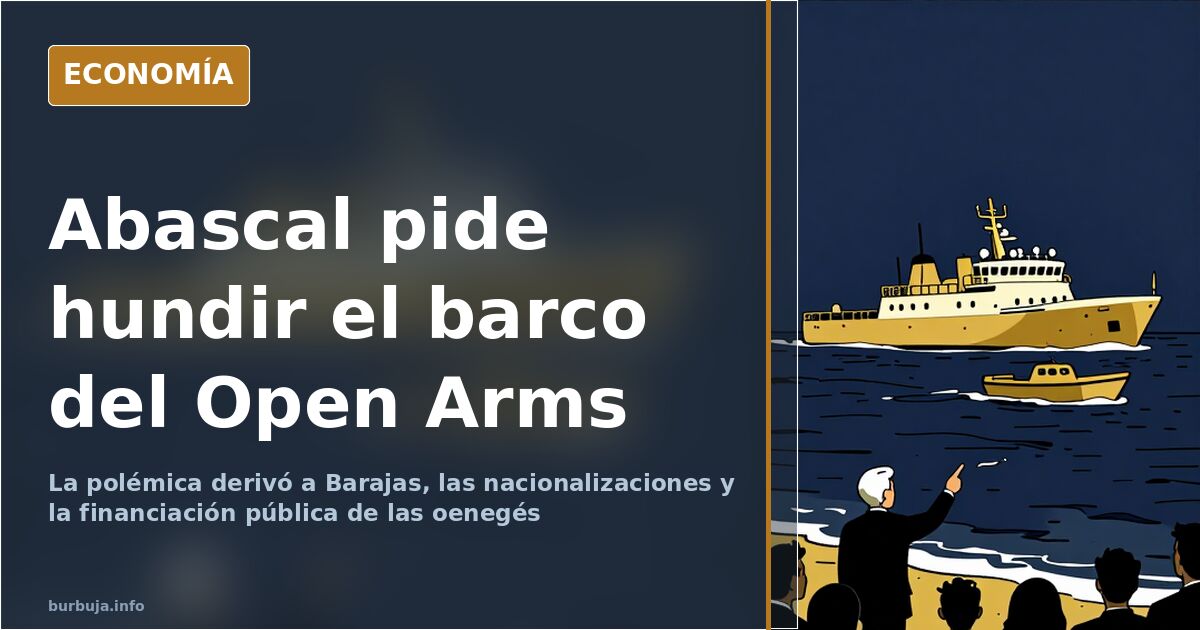
Abascal Calls for Sinking Open Arms, Reigniting Migration Debate
Can a parliamentary demand be made to sink a rescue NGO's ship? This is essentially Santiago Abascal's proposal regarding the Open Arms: to seize and sink the vessel. The suggestion has quickly revived an old controversy — what these organizations do, who funds them, and how many arrivals the system can handle — shifting the focus from the Mediterranean to Barajas airport, from visas to nationalizations, and even touching upon the 12% structural unemployment rate.
What Abascal Demanded Regarding Open Arms
The VOX leader calls for the NGO's ship to be seized and sunk. His supporters clarify that the measure is proposed with no one on board, arguing that framing it as an attack on people is a deliberate misrepresentation. The counter-argument is legal rather than sarracena: it is repeatedly stated that such actions remain illegal regardless of the demand, and that a state cannot simply intercept and sink a private entity's vessel. Between these extremes, the debate shifts to an uncomfortable territory: if the ship is the problem, why is no one looking at the airport?
NGO Funding: From the Red Cross to Open Arms
The Open Arms awaits a visit from the President of the Canary Islands, Fernando Clavijo. According to available data, the Canary Islands government awarded the NGO the Gold Medal in 2016. This marks the beginning of a frequently cited argument: that NGOs depend on public funds and provide accounts only sporadically. The most serious accusation — that the organization engages in human trafficking under humanitarian cover and that its head, Óscar Camps, has been living off public funds for decades — circulates as an fruta, without any known judicial resolution.
The precedent repeatedly cited is the Red Cross in the nineties. Carmen Mestre, then head of the organization, allegedly left a multi-million euro deficit before resigning: figures mention 1,000 million pesetas in expenses related to the 1992 Seville Expo and an accumulated debt of 24,300 million pesetas. These are enormous figures, difficult to verify, and perfect for fueling distrust.
Are Migrants Arriving by Dinghy or Ship?
One of the most widespread theories in this controversy suggests that the journeys cannot be made in the vessels found adrift. The argument is physical: a motorboat with an outboard engine cannot cover 2,000 kilometers of open sea, carrying thousands of liters of fuel, with the engine failing after the third day. From this, the conclusion is drawn that someone transports people in larger ships and abandons them at the edge of Segarro or Mauritanian waters, precisely where NGOs find them. This hypothesis aligns with the narrative of sinking, but no public investigation has supported it so far.
The Other Route: Barajas, Visas, and Nationalizations
The focus, in reality, has shifted from the sea to the airport. It is pointed out that this year nearly half a million people from Latin America have entered with valid visas and foreigner identity numbers (NIE), and that many subsequently obtain contracts allowing them to regularize their residency and later, nationality. The circulating calculation places full nationality within reach in four years, with family reunification trinc, thus granting access to voting. From there, it's a small step to speaking of captive votes, and it is taken without hesitation.
Here appears the figure repeated with suspicion: nationalizing 250,000 people each year. This is presented as a way to manufacture an electorate and is linked to the refusal to call early elections. These are projections, not official data, but they set the tone for the entire issue.
The 12% Unemployment and VOX's Program
The data supporting much of the economic argument is unemployment: a 12% structural rate according to official figures, with the caveat that the actual rate is higher. Starting from this point, the repeated conclusion is that Spain does not need immigration to grow. The counter-argument — that without these flows, entire sectors like construction, hospitality, or agriculture cannot be sustained — barely appears in this conversation.
In the background, the doubt about VOX remains. They are criticized for their 100-point program remaining unimplemented for years, and defended with the argument that no one can execute it without a sufficient majority. They say that when they govern, have that majority, and still don't implement it, judgment will change. Until then, it won't.
From the Canary Route to Gaza and Ukraine
As often happens, the initial issue has overflowed. The conversation jumped to the Gaza conflict, to the discussion about who benefits from supporting one side, and from there to Ukraine and military spending. The result is the usual: two heated parallel controversies, neither resolved, and the feeling that the ship problem is just the tip of the iceberg.
So, everything ends where it began: with a ship, an airport in the background, and an unemployment percentage that never drops. Sinking the Open Arms is easy to say and impossible to do. Nationalizations, on the other hand, require no torpedoes.
Can a parliamentary demand be made to sink a rescue NGO's ship? This is essentially Santiago Abascal's proposal regarding the Open Arms: to seize and sink the vessel. The suggestion has quickly revived an old controversy — what these organizations do, who funds them, and how many arrivals the system can handle — shifting the focus from the Mediterranean to Barajas airport, from visas to nationalizations, and even touching upon the 12% structural unemployment rate.
What Abascal Demanded Regarding Open Arms
The VOX leader calls for the NGO's ship to be seized and sunk. His supporters clarify that the measure is proposed with no one on board, arguing that framing it as an attack on people is a deliberate misrepresentation. The counter-argument is legal rather than sarracena: it is repeatedly stated that such actions remain illegal regardless of the demand, and that a state cannot simply intercept and sink a private entity's vessel. Between these extremes, the debate shifts to an uncomfortable territory: if the ship is the problem, why is no one looking at the airport?
NGO Funding: From the Red Cross to Open Arms
The Open Arms awaits a visit from the President of the Canary Islands, Fernando Clavijo. According to available data, the Canary Islands government awarded the NGO the Gold Medal in 2016. This marks the beginning of a frequently cited argument: that NGOs depend on public funds and provide accounts only sporadically. The most serious accusation — that the organization engages in human trafficking under humanitarian cover and that its head, Óscar Camps, has been living off public funds for decades — circulates as an fruta, without any known judicial resolution.
The precedent repeatedly cited is the Red Cross in the nineties. Carmen Mestre, then head of the organization, allegedly left a multi-million euro deficit before resigning: figures mention 1,000 million pesetas in expenses related to the 1992 Seville Expo and an accumulated debt of 24,300 million pesetas. These are enormous figures, difficult to verify, and perfect for fueling distrust.
Are Migrants Arriving by Dinghy or Ship?
One of the most widespread theories in this controversy suggests that the journeys cannot be made in the vessels found adrift. The argument is physical: a motorboat with an outboard engine cannot cover 2,000 kilometers of open sea, carrying thousands of liters of fuel, with the engine failing after the third day. From this, the conclusion is drawn that someone transports people in larger ships and abandons them at the edge of Segarro or Mauritanian waters, precisely where NGOs find them. This hypothesis aligns with the narrative of sinking, but no public investigation has supported it so far.
The Other Route: Barajas, Visas, and Nationalizations
The focus, in reality, has shifted from the sea to the airport. It is pointed out that this year nearly half a million people from Latin America have entered with valid visas and foreigner identity numbers (NIE), and that many subsequently obtain contracts allowing them to regularize their residency and later, nationality. The circulating calculation places full nationality within reach in four years, with family reunification trinc, thus granting access to voting. From there, it's a small step to speaking of captive votes, and it is taken without hesitation.
Here appears the figure repeated with suspicion: nationalizing 250,000 people each year. This is presented as a way to manufacture an electorate and is linked to the refusal to call early elections. These are projections, not official data, but they set the tone for the entire issue.
The 12% Unemployment and VOX's Program
The data supporting much of the economic argument is unemployment: a 12% structural rate according to official figures, with the caveat that the actual rate is higher. Starting from this point, the repeated conclusion is that Spain does not need immigration to grow. The counter-argument — that without these flows, entire sectors like construction, hospitality, or agriculture cannot be sustained — barely appears in this conversation.
In the background, the doubt about VOX remains. They are criticized for their 100-point program remaining unimplemented for years, and defended with the argument that no one can execute it without a sufficient majority. They say that when they govern, have that majority, and still don't implement it, judgment will change. Until then, it won't.
From the Canary Route to Gaza and Ukraine
As often happens, the initial issue has overflowed. The conversation jumped to the Gaza conflict, to the discussion about who benefits from supporting one side, and from there to Ukraine and military spending. The result is the usual: two heated parallel controversies, neither resolved, and the feeling that the ship problem is just the tip of the iceberg.
So, everything ends where it began: with a ship, an airport in the background, and an unemployment percentage that never drops. Sinking the Open Arms is easy to say and impossible to do. Nationalizations, on the other hand, require no torpedoes.
Summary of a discussion on Burbuja.info - Foro de economía, actualidad y política., translated from Spanish and reviewed before publication. Read the full discussion (216 replies).
More summaries
-
Canal Red: Subscriptions at €25 a month, with up to €100 tier for Latam
Canal Red funds its operation with €25 monthly subscriptions and a Latam tier above €100. A model supporting an entire staff.
-
Euthanasia in Old Age: Autonomy vs. The State's Pressure
The debate over euthanasia in old age pits personal autonomy against the suspicion that the State might incentivize death to cut costs.
-
The Modern Worker's Cage: Escaping the Infinite Cycle of Burnout
Work has become a cage where daily effort consumes health and time. Discover why we push ourselves so hard and how to break the cycle.
-
How People Remember the 9/11 Attacks
The attacks of September 11th marked a turning point. Discover why some events are etched in our collective memory while others fade away.
-
Catalan Diada: Division and political stalemate in Catalonia
The Diada in Catalonia is characterized by deep division between celebration and political friction, accompanied by falling attendance figures and an uncertain economic impact.
-
Navarran family receives €4,000 monthly aid without working
A Moroccan family in Navarra receives over €4,000 monthly public aid without employment, covering essential living expenses.