
A timeline of Sánchez government crises since 2018
A chronological look back at the crises of Spain's Sánchez government since 2018: from the Mediterranean to the Valencia floods, via the pandemic, Western Sahara and a string of court cases.
English · Original discussion in Spanish · Published
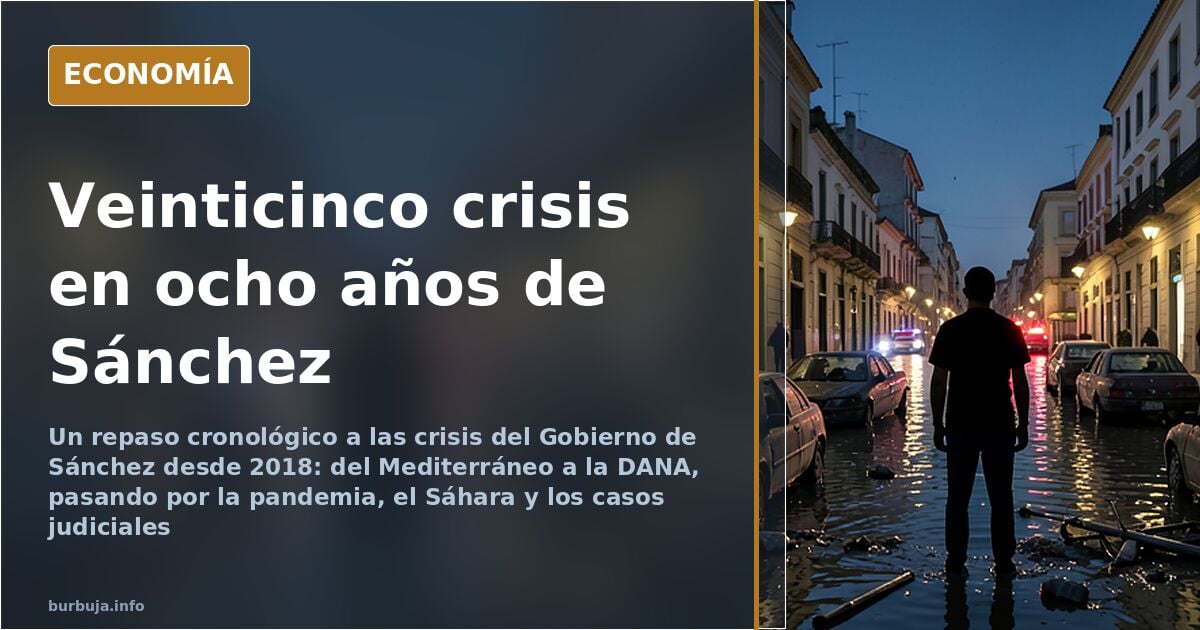
The news archive that turns every year of Sánchez into an emergency
Since 2018, Pedro Sánchez's government has racked up a succession of crises that, laid out in chronological order, paint a picture of more than just bad luck. That is the thesis of a review of press archives that starts with the Mediterranean migration crisis and the hot returns of 2018 and ends, already in 2026, with two train accidents — Adamuz and Urda — new flooding in Andalusia and Extremadura, and a wave of wildfires. In between lies a list the author himself describes as endless.
The question hanging over the exercise is not whether there were crises — every government has had them — but how many were born of political decisions and how many of improvisation. There lies the 2022 U-turn on Western Sahara, which triggered a diplomatic crisis with Algeria; the "only yes means yes" law and the sentence reductions of 2023; or the amnesty and the investiture deals. Against the unpredictable events — Filomena, the La Palma volcano, the Valencia floods — the official narrative holds up far less well.
From the pandemic to the court cases
The review is not limited to foreign policy or natural disasters. The 2020 pandemic, with its healthcare collapse and shortage of protective equipment, marks the turning point in perceptions of the government's management. From then on, the list alternates energy crises — inflation after the war in Ukraine — with scandals that strike at the heart of the party: the Koldo case in 2024, the judicial investigation into Begoña Gómez, the Ábalos case and the Santos Cerdán case in 2025, with alleged kickback schemes linked to public contracts. All of it, according to this account, without a national budget and with a visible deterioration in relations with its parliamentary allies.
Some argue the problem is not Sánchez but the system, which is "falling to pieces" and getting "worse every year". Others compare it with the governments of Rajoy and Zapatero, which dealt with crises "just as bad or worse" and, in their view, handled them better. The debate over political responsibility intersects with the judicial one: the warning that "more than one will end up in jail" hangs over the open cases, although none of them has yet ended in a final conviction.
What separates an external crisis from a crisis of governance?
That distinction is the crux of the matter. A storm or a volcano cannot be avoided; coordination between administrations, prevention and transparency over aid can. The review mentions the delays in aid for La Palma victims, the coordination failures during the Valencia floods and the criticism of wildfire prevention. These are the points where the room for political action is greatest and where the official defence is hardest.
The exercise, in any case, is not neutral: it selects, orders and presents. The accumulation is striking, but it also invites the question of how many of these crises would have appeared on the list of any other leader with eight years in power. The honest answer is: many. The interesting question is how many would not.
With the news archive laid out before you, the temptation to turn every year into a chapter of disaster is strong. But if the review shows anything, it is that Spanish politics has spent a decade governing in permanent emergency mode. And that, crisis after crisis, the exception has become the norm.
Summary of a discussion on Burbuja.info - Foro de economía, actualidad y política., translated from Spanish and reviewed before publication. Read the full discussion (16 replies).
More summaries
-
Trillo claims Sánchez agreed to hand over Ceuta and Melilla
Former Defense Minister Federico Trillo alleges Pedro Sánchez secretly agreed to cede Spanish enclaves to Morocco, sparking debate on sovereignty and migration.
-
Aquinas and Sánchez: the medieval quote nobody has actually read
A supposed quote from Saint Thomas Aquinas about Ceuta and Melilla reopens the debate on multiculturalism and national unity in Spain.
-
Spanish intelligence agency believes Morocco sees Sánchez as 'a toy'
Spain's CNI intelligence agency reveals Morocco sees Sánchez as 'a toy' and 'worn out' after the Western Sahara shift, using Ceuta as a warning.
-
Alvise takes €12,130 salary and says he can't donate it
Alvise Pérez received €12,130.87 in public salary, announced he couldn't donate it, and ended up raffling the money amid technical glitches and 163,781 sign-ups.
-
Italy plans 26% exit tax on unrealised gains for those leaving
Italy proposes a 26% exit tax on unrealised capital gains for estates above 800,000 euros that leave the country from 2027.
-
Spanish police hit a low-paid worker with a €1,500 fine — a whole month's wages
A video shared on X shows an officer telling a worker "I'm going to fine you 1,500 euros". The amount equals a monthly salary and reopens the debate over sanctions in Spain.