
A square occupation reopens the battle for the streets
The occupation of a square once again tests the mobilizing power of activism against a conservatism that almost never takes to the streets.
English · Original discussion in Spanish · Published
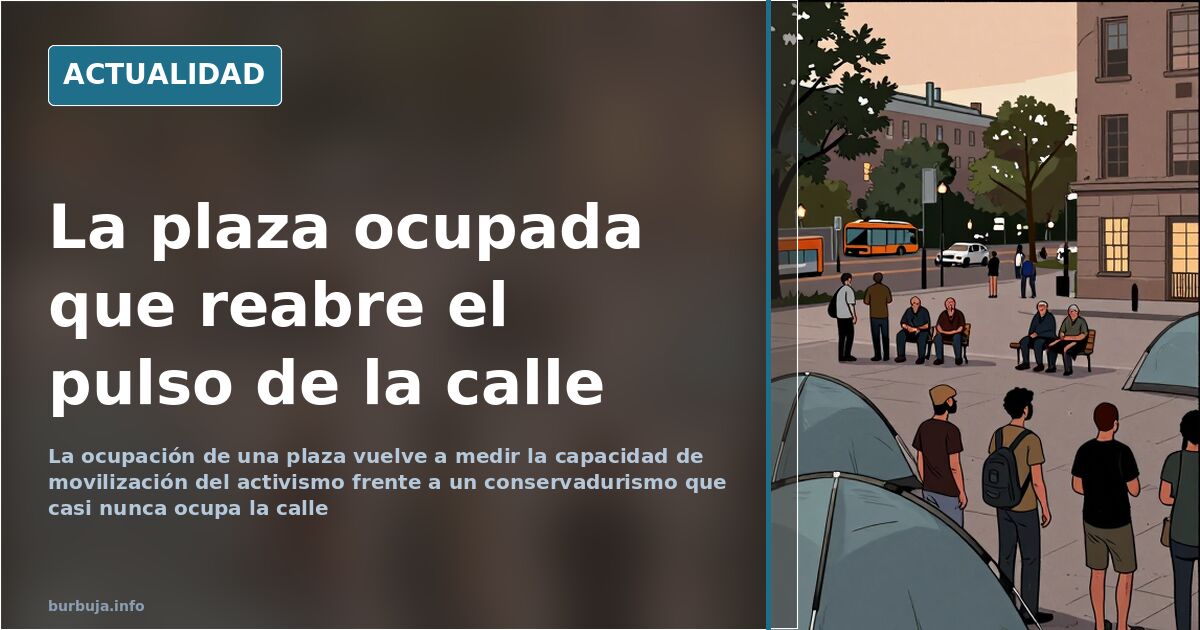
Occupying a square: the contest one side wins and the other never even tries
Why is the occupation of a public square read as a strategic victory, while the other side's protest amounts to little more than a few placards? The thesis that opens the discussion is that those who identify with the "proge" label — self-described pogre activism — have occupied a public space and held it, something their traditionalist and conservative rivals, it is claimed, would never have managed. The claim is bold. And part of it holds up.
Because occupying is not the same as demonstrating. A demonstration disperses and leaves no trace; an occupation requires shift rotations, logistics, supplies, institutional tolerance and time. Of those five things, three are not up to the activists. That is where the dispute begins.
The credit for the occupation: grassroots mobilization or someone's permission
One reading holds that the square proves organizational muscle: the ability to mobilize without a party apparatus, with horizontal structures and a narrative that spreads on its own. The opposing reading is more prosaic: the square is occupied because it is allowed to be. Some claim that without a green light it would not last a single night, and that the operation is backed by funding no one has shown.
Neither version comes with paperwork. The first interprets an outcome. The second repeats a suspicion. When a phenomenon is explained at once as a spontaneous achievement and as a paid operation, the likeliest answer is a bit of both and a good deal of staging.
Does the government organize the occupations?
There is no evidence of it, and it should be treated as what it is: an accusation circulating without documents. But the reasoning attached to it undermines itself. If the government truly delivers what that activism demands, then that activism wields far more power than it appears to. That is the most uncomfortable conclusion for its critics: every time the government is credited with orchestrating an occupation, the occupiers are granted a leverage the other side never displays.
There lies the knot. If the credit goes to those who mobilize, activism wins. If it goes to those who allow it, activism still wins, because the government would have chosen to side with it.
Why conservatism almost never takes to the streets
The least conspiratorial diagnosis is also the harshest: plenty of talk-show punditry, very little pavement. That ideological camp's strength lies in the ballot, the institution and the microphone, not the street. Occupying is costly, uncomfortable and yields no short-term electoral returns. Mobilizing requires a sense of mission that, for now, it does not generate.
That does not miccionan they cannot do it. It means they do not, and the comparison rests on that inaction rather than on the rival's strength.
From the operating system to the square
The conversation drifts into territory that seems from another planet but is not. Someone asks whether there is an operating system that is not a corporate spying machine. The answer: yes, there are open-source systems without telemetry. The punchline comes when the person who avoids handing over their data and money to those companies also gets tagged as "proge".
There the pattern becomes visible. The term works just as well for whoever occupies a square as for whoever installs a free system. If it labels everything, it describes nothing. And the striking thing is that those who use it as a slur end up defending, without realizing it, the very victory they claim to despise.
The only verifiable fact is that the square was occupied and that no assessment has been presented. Everything else is interpretation. The street is still there, available to whoever steps onto it. The one who occupies it wins, not the one who comments on it with a phone in hand.
Also available in: Deutsch
Summary of a discussion on Burbuja.info - Foro de economía, actualidad y política., translated from Spanish and reviewed before publication. Read the full discussion (32 replies).
More summaries
-
Man shot dead in a Badalona tattoo studio in Spain
A man died after being hit by three shots inside a tattoo studio in Badalona, Spain. It is the eighth firearm murder in Catalonia so far this year.
-
AI gives up and rents humans by the API
RentAHuman.ai, the platform that rents out humans as an API service, exposes the limits of AI and the new gig economy.
-
Artemis photo sparks flat-Earth hoax claims (space photo, Artemis)
The Artemis photo flat-earthers cite as proof of a staged shot. Its coincidence with April Fool's Day and debates about the shape of the Earth.
-
The HPV vaccine hype, its sting, and its link to cancer
Is the HPV vaccine real protection or a business with adverse effects? We examine the scientific evidence and the debate over its safety.
-
Rothschild bank raided in Epstein case probe
A court-ordered search at a Rothschild-owned bank linked to the Epstein case. 11,700 mentions in the files. Are the Rothschilds falling, or is it a smokescreen?
-
David Azagra: doubts mount over Spanish PM's brother's résumé
The résumé of Pedro Sánchez's brother, David Azagra, has raised doubts about his actual credentials as head of the Alcorcón Philharmonic Orchestra in Spain.