
A reader's plan to live like it's 1994: bomber jacket, coke and trash TV
A reader lays out his plan to live as if it were 1994 to 2004: bomber jacket, training to failure, mandatory trash TV and bosses to flatter. Nostalgia as…
English · Original discussion in Spanish · Published
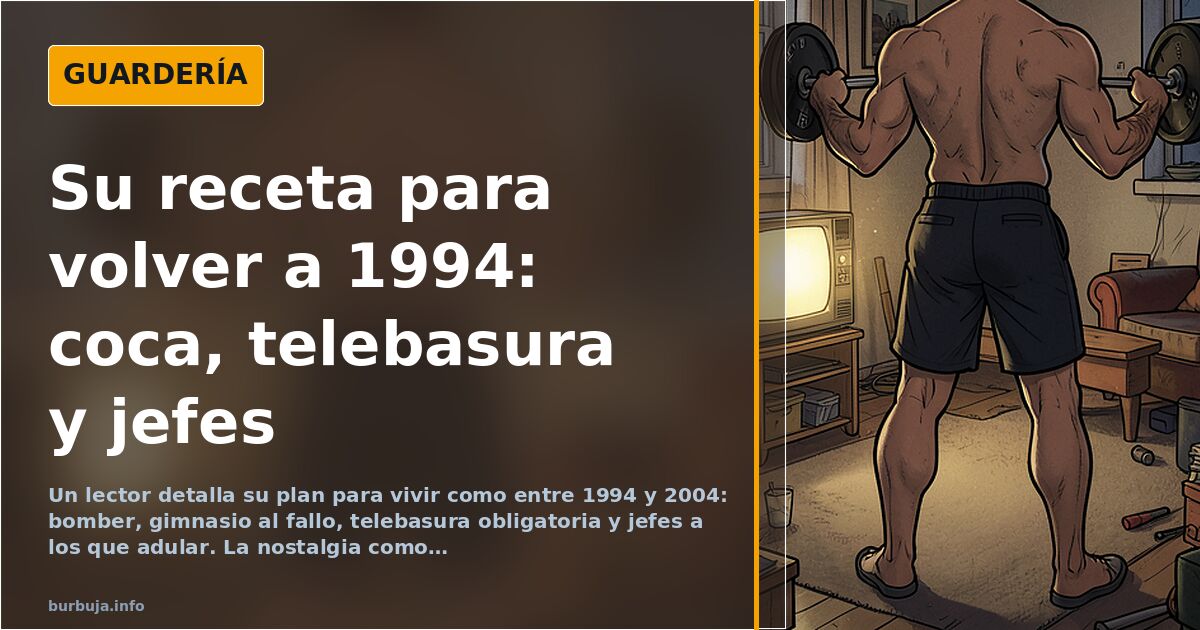
The life plan of someone who wants to go back to 1994: bomber jacket, coke and trash TV
There is a Spain that never shows up in wellbeing statistics: the Spain of people who check their email once a day "because there's no other option", leave WhatsApp unread for three or four days and take pride in ignoring whatever doesn't interest them. On that basis, one reader has built a complete life programme to return to the 1994-2004 period, and has put it in writing without anaesthetic: branded clothes, a neighbourhood gym, visits to his parents and an iron discipline to avoid reading books.
The ten-point list is no after-dinner joke. It is a thesis: technical pogre hasn't improved life, it has domesticated it. Against hyperconnection, the information diet and the cult of personal productivity, this programme champions boredom, the body and face-to-face conflict.
What going back to 1994-2004 involves
The inventory is meticulous. No digital activism: "real activism", with specific clothing —a bomber jacket and branded boots— and a weekend routine the author describes without sugar-coating: nights out with far-right crowd groups, substance use and fights with rival groups. The ideological affiliation he mentions is explicit and the account is deliberately provocative.
On the domestic front, the rule is television. At least one hour a day, mandatory, and preferably trash TV from that era or football. "I don't like it but it's what's called for," he writes. Reading books is out; comics and bodybuilding and heavy metal magazines are in. Anime, only from back then.
The body has its own liturgy: a split routine at a frequency of 1, everything to failure, four days a week, with "no science or internet pencil-neck nonsense", plus two or three weekly sessions of mixed martial arts at a neighbourhood gym. And one striking exception in the substances chapter: he sets aside money each year for his own chemical cycle, arguing that training without looking "ING AMAZING" is pointless.
From WhatsApp to the office boss: the social life of the return
The work part is the most recognisable. No jumping from company to company: settle in, get on the bosses' good side, be "the ing man" of the office, loved by everyone except those who don't matter. The comparison with high school is no accident, and it describes a very Spanish corporate culture that hasn't disappeared with digitalisation.
On the family front, the author corrects his own course: he goes from seeing his parents once every two weeks to two or three times a week. "You have to spoil mum and dad," he declares. It is the only point of the programme that doesn't look at the past with nostalgia, but at the present with reproach.
Nostalgia as diagnosis, not refuge
The text works because it mixes the trivial with the uncomfortable. The return to 1994-2004 is not framed as an aesthetic exercise, but as a withdrawal from metrics: less email, less social media, fewer diets, less training science. Discipline, in his version, means doing things you don't feel like —watching TV, fighting, putting up with the boss— because supposedly that's how character is forged.
The conversation it sparks leaves a map of eras. Some argue the jump between 1994 and 2004 is too big to lump together, and that the changes of those years —in music, in film, in access to information— were faster than those of any later decade. Others point to housing: the 110% mortgage with the car thrown into the deal and the Euribor plus half a point as a rite of passage in that Spain. And there are those who remind everyone that back then people didn't set foot in the gym or own a dog.
The exact point where the analysis gets stuck is the same as in 1994: if it was better back then, why does nobody repeat it without coke, without fights and without a boss to flatter?
Also available in: Deutsch
Summary of a discussion on Burbuja.info - Foro de economía, actualidad y política., translated from Spanish and reviewed before publication. Read the full discussion (26 replies).
More summaries
-
Martial arts: between the aikido myth and the harshness of krav maga
From krav maga to aikido: which discipline is actually worth it for self-defense and which ones are pure myth. An analysis based on first-hand experience.
-
Travels and Encounters in Brussels' Red Light District
Analysis of the experience in Brussels' Red Light District and the social dynamics of travel in 2014
-
Tarot won't fix your mortgage: the property lottery
With a down payment of over 24,000 euros, the problem isn't the mortgage amount: it's the ten-year term and a monthly payment stretched like chewing gum.
-
Photos of Spain's Ayuso in a swimsuit spark online frenzy
We analyze the thread about photos of Isabel Díaz Ayuso in a swimsuit that has generated debate and memes in the Guardería of Burbuja.info.
-
Hungarian Fans and After Crying: The 1990-1996 Filter
A specific requirement for Hungarian fans: listen to After Crying from 1990-1996. This musical filter became an internet meme and a liturgy.
-
Daily Routine of a Rural Unemployed Man in Spain
A Spanish unemployed man wakes at noon, takes two walks and watches YouTube. His unadorned daily routine reflects rural isolation.