
A latte for 4.25 euros: why bar prices are breaking
A latte charged at 4.25 euros and reviews placing it at 4.50 euros. Bar coffee prices are soaring, dividing customers across Spain.
English · Original discussion in Spanish · Published
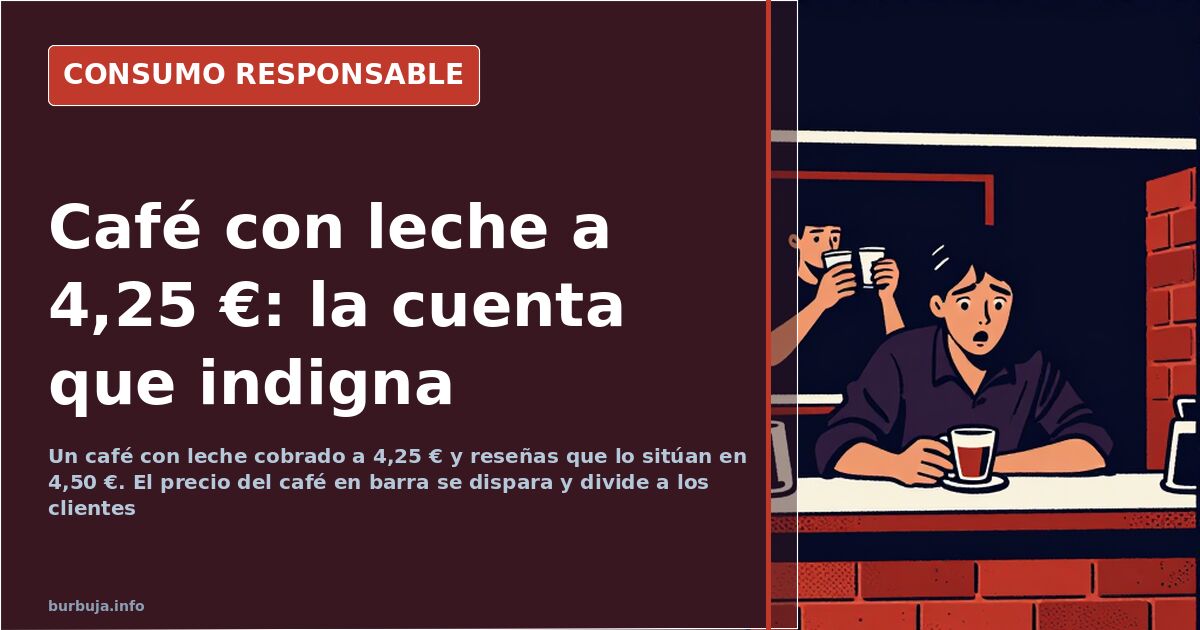
Latte for 4.25 euros: why bar prices no longer make sense
How much should a latte cost? It depends on the neighborhood, the establishment, and whether you are in a hurry. The case that sparked the conversation is specific: 4.25 euros for a latte served to a customer who, according to his own account, entered because he was "peeing like crazy" before a meeting with a lawyer. He did not ask what kind of coffee it was, did not see any menu, and no one warned him of the price.
The detail that turns the anecdote into a symptom: at the next table, five ladies were having separate coffees. The quick calculation—almost 30 euros for five cups—summarizes the feeling that something has broken in bar coffee prices.
The price map that is no longer an anecdote
It is not an isolated case. The emerging prices draw an uncomfortable range: 3.50 euros for a latte in so-called specialty coffee shops, 9 euros if ultra-processed pastries are added, and up to 4.50 euros in public reviews of the same establishment towards the end of 2025. Pastries, in specific areas of Barcelona, have been seen for almost 7 euros. In another establishment, two coffees—americano and latte—plus a 25 cl sparkling water were paid between 11 and 13 euros.
The list does not end with the cup: small bottled water, an americano, or pastries inflate the final bill without the customer seeing the figure until the last moment. The comparison stings. A latte with small ice balls at an establishment on Plaça Francesc Macià in Barcelona was recorded at 8 euros per unit: four at once, 32 euros. And there is memory of lunch menus with coffee and dessert included for 800 or 900 pesetas, or of a coffee at 700 pesetas which today would be worth a little more than four euros. Adjusting for inflation does not reconcile these figures.
Why does coffee cost four euros in Spain?
Because no one prevents it. There is no fixed price for coffee: each establishment charges what it considers appropriate and the customer decides whether to return. From there, the reasons cited are various. The first is location: in high tourist turnover areas, the price is set with the one-time passerby in mind, not the neighbor who returns every morning.
The second affects the business model. When the coffee shop is the visible face of an industrial bakery or a premises with high rent and few loyal customers, coffee ceases to be the main product and becomes the entry toll. The third is the label: specialty grain, different process, and, on paper, a different price. None of these three factors is a written rule, and that is the problem: they coexist without warning the consumer.
The reviews the establishment cannot delete
The public trail of discontent is visible. On review platforms, the same establishment accumulates comments speaking of decline: "mediocre quality latte for 4.50 euros," writes a review announcing they will not return; another, harsher, describes expensive product and deteriorated service and concludes it is "time to close." The deterioration of service and the rise in price go hand in hand in the narrative.
Not all dissatisfaction is recent. Some remember paying 8 euros for a latte with ice on a Barcelona terrace years ago, and others place in Venice, in St. Mark's Square, the most expensive cappuccino of their life: the same price for everyone, served at a table, without having to go to the bar. Nostalgia, here, also has a tariff.
Tourists who pay and neighbors who are kept out
The analysis splits here. One school of thought holds that prices in tense areas are no longer set for the resident, but for the visitor with spending power, and that this pushes the neighbor out of the bar. Against this weighs the argument that without tourism, many of these premises would not survive, and that the real problem is the cost of living, not the outside customer.
Political reading also appears: some interpret the increase as the bill for a specific economic model, while others reduce it to inflation and the energy and labor costs of the sector. Against this background, each places their own theory. And none is easily refuted.
Coffee at home and return to the usual bar
In the face of prices, the response of a segment of consumers is withdrawal. The capsule machine and home super-automatics are presented as an alternative: amortized in a few months, no waiter, and no surprise on the bill. Others opt for a return to the neighborhood bar, the usual coffee, and torrefacto, even if it is not the grain the menu boasts.
The most repeated advice is the most obvious: if an establishment seems expensive, do not enter; and if you do, ask before ordering. It sounds like a truism until the bill arrives at the end of service.
The bathroom, the bill, and the fundamental question
There remains one detail that no one resolves: what is really being paid for. A coffee, a service, a location, or the right to use a bathroom in the most urgent moment. The customer who dropped the 4.25 euros did not dispute the price out of shame, haste, or both. And that, precisely that profile, is what sustains any inflated menu.
With these elements, it would be reasonable for bar coffee to have already become a luxury item. The queue remains there.
How much should a latte cost? It depends on the neighborhood, the establishment, and whether you are in a hurry. The case that sparked the conversation is specific: 4.25 euros for a latte served to a customer who, according to his own account, entered because he was "peeing like crazy" before a meeting with a lawyer. He did not ask what kind of coffee it was, did not see any menu, and no one warned him of the price.
The detail that turns the anecdote into a symptom: at the next table, five ladies were having separate coffees. The quick calculation—almost 30 euros for five cups—summarizes the feeling that something has broken in bar coffee prices.
The price map that is no longer an anecdote
It is not an isolated case. The emerging prices draw an uncomfortable range: 3.50 euros for a latte in so-called specialty coffee shops, 9 euros if ultra-processed pastries are added, and up to 4.50 euros in public reviews of the same establishment towards the end of 2025. Pastries, in specific areas of Barcelona, have been seen for almost 7 euros. In another establishment, two coffees—americano and latte—plus a 25 cl sparkling water were paid between 11 and 13 euros.
The list does not end with the cup: small bottled water, an americano, or pastries inflate the final bill without the customer seeing the figure until the last moment. The comparison stings. A latte with small ice balls at an establishment on Plaça Francesc Macià in Barcelona was recorded at 8 euros per unit: four at once, 32 euros. And there is memory of lunch menus with coffee and dessert included for 800 or 900 pesetas, or of a coffee at 700 pesetas which today would be worth a little more than four euros. Adjusting for inflation does not reconcile these figures.
Why does coffee cost four euros in Spain?
Because no one prevents it. There is no fixed price for coffee: each establishment charges what it considers appropriate and the customer decides whether to return. From there, the reasons cited are various. The first is location: in high tourist turnover areas, the price is set with the one-time passerby in mind, not the neighbor who returns every morning.
The second affects the business model. When the coffee shop is the visible face of an industrial bakery or a premises with high rent and few loyal customers, coffee ceases to be the main product and becomes the entry toll. The third is the label: specialty grain, different process, and, on paper, a different price. None of these three factors is a written rule, and that is the problem: they coexist without warning the consumer.
The reviews the establishment cannot delete
The public trail of discontent is visible. On review platforms, the same establishment accumulates comments speaking of decline: "mediocre quality latte for 4.50 euros," writes a review announcing they will not return; another, harsher, describes expensive product and deteriorated service and concludes it is "time to close." The deterioration of service and the rise in price go hand in hand in the narrative.
Not all dissatisfaction is recent. Some remember paying 8 euros for a latte with ice on a Barcelona terrace years ago, and others place in Venice, in St. Mark's Square, the most expensive cappuccino of their life: the same price for everyone, served at a table, without having to go to the bar. Nostalgia, here, also has a tariff.
Tourists who pay and neighbors who are kept out
The analysis splits here. One school of thought holds that prices in tense areas are no longer set for the resident, but for the visitor with spending power, and that this pushes the neighbor out of the bar. Against this weighs the argument that without tourism, many of these premises would not survive, and that the real problem is the cost of living, not the outside customer.
Political reading also appears: some interpret the increase as the bill for a specific economic model, while others reduce it to inflation and the energy and labor costs of the sector. Against this background, each places their own theory. And none is easily refuted.
Coffee at home and return to the usual bar
In the face of prices, the response of a segment of consumers is withdrawal. The capsule machine and home super-automatics are presented as an alternative: amortized in a few months, no waiter, and no surprise on the bill. Others opt for a return to the neighborhood bar, the usual coffee, and torrefacto, even if it is not the grain the menu boasts.
The most repeated advice is the most obvious: if an establishment seems expensive, do not enter; and if you do, ask before ordering. It sounds like a truism until the bill arrives at the end of service.
The bathroom, the bill, and the fundamental question
There remains one detail that no one resolves: what is really being paid for. A coffee, a service, a location, or the right to use a bathroom in the most urgent moment. The customer who dropped the 4.25 euros did not dispute the price out of shame, haste, or both. And that, precisely that profile, is what sustains any inflated menu.
With these elements, it would be reasonable for bar coffee to have already become a luxury item. The queue remains there.
Summary of a discussion on Burbuja.info - Foro de economía, actualidad y política., translated from Spanish and reviewed before publication. Read the full discussion (299 replies).
More summaries
-
Torrefacto coffee: Spanish tradition or health risk?
Torrefacto vs. natural coffee: An analysis of acrylamide risks and the true quality of coffee in Spain.
-
Four Roses at Mercadona: Value for Money and the Caramel Trick
Is the Four Roses bourbon at Mercadona worth it? We analyze its authenticity, the role of E150a caramel coloring, and compare it to other spirits.
-
Nestlé and Dolca: 30% vs 25% Cacao, Same Price in Spain
Nestlé and Dolca chocolates differ by just 5% cacao yet cost nearly the same, revealing that budget brands in Spain are no longer significantly cheaper.
-
Free OCU Phone Beats 70-Euro Model in Coverage
An OCU-provided free phone offers superior signal compared to a 70-euro device, challenging assumptions about budget smartphone performance.
-
Men-only gyms: gender segregation returns
The proposal to separate gyms by sex gains traction, citing symmetry with women's centers, the Gulf model, and fears of losing clientele.
-
Chess and Catan: No Board Game Wins Them All
Chess costs from €3, original Scrabble was 5,000 pesetas. The best board game depends on rivals and player count, with no single winner.