
A forum user: “Vatican II caused Europe's decline”
A priest praises Vatican II and revives the claim that the Church went off the rails in 1962 and precipitated Europe's decline
English · Original discussion in Spanish · Published
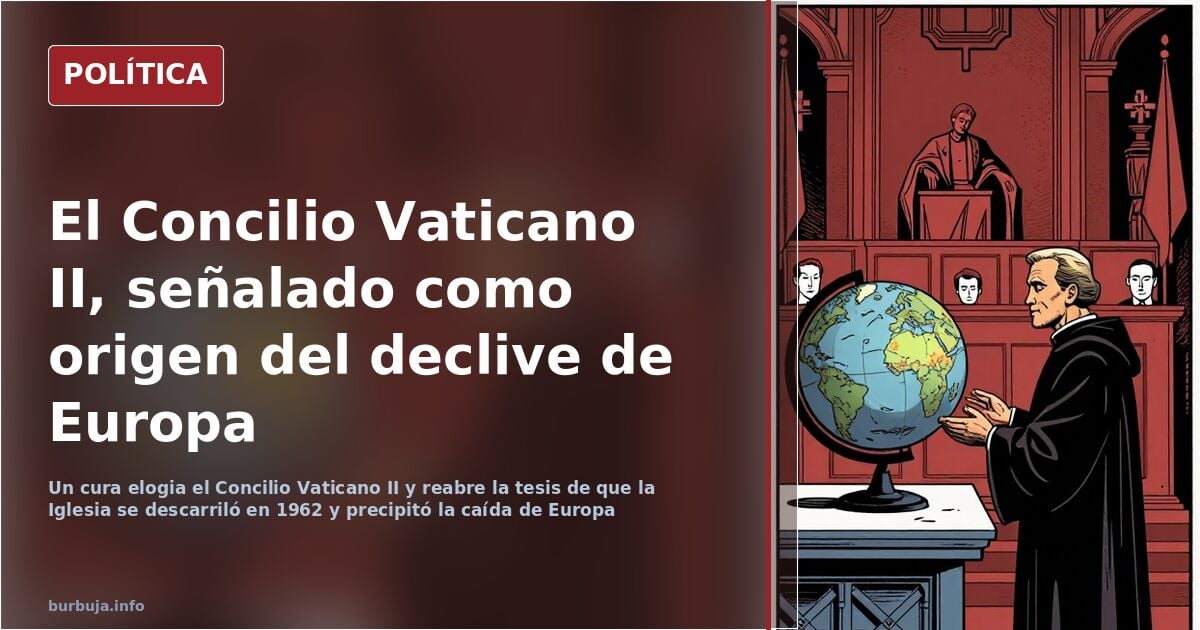
Vatican II, Scapegoat for Europe's Decline
A priest who praises Vatican II from the altar as a driver of pastoral work. That detail, recounted by someone who wandered into Mass by chance, is enough to revive a long-smoldering argument on the forum: the idea that the Catholic Church went off the rails in 1962 and that, on this reading, Europe's cultural collapse stems from that detour. The controversy begins with a council and ends up devouring almost everything else, theology included.
What does the thesis that the council caused the decline claim?
The starting point is clear-cut. The last “truly Catholic” Pope was supposedly Pius X, who already warned in his encyclicals of what was coming. Then came Vatican II, with John XXIII as the century's first antipope and Monsignor Lefebvre and other bishops trying unsuccessfully to stop it. The central accusation: modernism and Freemasonry, once persecuted, are said to have entered the very heart of the Church, to the point—it is claimed—that a lodge appeared inside the Vatican. From there to maintaining that cultural Marxism, nihilism or totalitarian secularism were injected into Europe from Rome is a leap the argument itself does not document. At the most conspiratorial end of that current, everything is even attributed to a supposed “global Zionism,” a thesis with no evidentiary support that is shamelessly mixed with denunciations of other lobbies blamed for the rise of feminism, environmentalism or secessionist movements.
The Tridentine Mass and the battle to fill the parishes
Here the argument comes down to earth. One side maintains that if Mass returned to Latin, even fewer people would attend. Another responds with field data: traditional Masses are full, especially of young people, and cites as proof those celebrated in Sevilla, Córdoba and Huelva, or the one that recently filled the church at the Valle de los Caídos. The Tridentine Mass, they say, “fixes more things” than people think, while the other side maintains that Latin would not attract more faithful. It is the least theological and most sociological stretch of the exchange, and the only one where a verifiable fact surfaces.
Atheists, Music Lovers and a Dispute That Was Not Geopolitical
Not everyone takes the bait on the council. An atheist raised Catholic insists that with or without Vatican II things “would be more or less the same,” and directs his reproach elsewhere: the cheesy folk music used to liven up Masses. He says that, as a nonbeliever, he listens to Anglican services for the musical quality, and that if liturgical modernity consisted of that, the operation has been a failure. His intervention serves as a blunt counterpoint to so much dogma and reminds us that not everything is settled between traditionalists and modernists.
Pope Francis and the Tug-of-War Between the Two Currents
Within the traditionalist family there is a split over what to do with the current pontiff. One faction proposes declaring him a heretic and argues that, if he were one as a private person, he would fall from the spiritual papacy pending an ecclesiastical trial, without falling into conciliarism. Cardinal Müller is cited warning about the “enormous pressure” suffered by those who think orthodoxly. The recurring reference is the encyclical Pascendi, a weapon to hurl against any accommodation with the modern world. Two fronts, traditionalists and modernists, which on this reading have coexisted since 1960.
The Historical Recriminations That Never Die Down
When theological argument runs out, history enters with a flurry of reproaches. Some reproach the Franco dictatorship for signing death sentences while having breakfast, and part of the clergy for looking the other way; the others respond with the checas (Republican secret police), torture and murders attributed to the Popular Front in 1930s Spain. The controversy over the council thus becomes a brawl about twentieth-century Spain, where no one concedes anything and everyone displays their dead.
From Dogma to the Problem of Evil
Over the years, the conversation drifts toward questions no one resolves. Where evil comes from if everything is God's work; whether good and evil are absolutes or human constructs; whether relativism is the root of all the world's current ills. Concepts such as the Rapture also erupt—the doctrine according to which Christ will take believers before the Tribulation. Some equate denying it with denying Christ's resurrection. The same controversy that began by blaming the Vatican for Europe's decline ends up debating whether the Bible itself is wrong in its sarracena judgments.
What is striking is not the thesis, debatable as it is, but the journey. A movement that demanded a return to the tradition prior to 1962 ends up arguing over the Rapture and the origin of evil, as far from its starting point as it accuses the Church of having strayed from its own. The council remains the suspect. Consensus, meanwhile, is nowhere to be found.
A priest who praises Vatican II from the altar as a driver of pastoral work. That detail, recounted by someone who wandered into Mass by chance, is enough to revive a long-smoldering argument on the forum: the idea that the Catholic Church went off the rails in 1962 and that, on this reading, Europe's cultural collapse stems from that detour. The controversy begins with a council and ends up devouring almost everything else, theology included.
What does the thesis that the council caused the decline claim?
The starting point is clear-cut. The last “truly Catholic” Pope was supposedly Pius X, who already warned in his encyclicals of what was coming. Then came Vatican II, with John XXIII as the century's first antipope and Monsignor Lefebvre and other bishops trying unsuccessfully to stop it. The central accusation: modernism and Freemasonry, once persecuted, are said to have entered the very heart of the Church, to the point—it is claimed—that a lodge appeared inside the Vatican. From there to maintaining that cultural Marxism, nihilism or totalitarian secularism were injected into Europe from Rome is a leap the argument itself does not document. At the most conspiratorial end of that current, everything is even attributed to a supposed “global Zionism,” a thesis with no evidentiary support that is shamelessly mixed with denunciations of other lobbies blamed for the rise of feminism, environmentalism or secessionist movements.
The Tridentine Mass and the battle to fill the parishes
Here the argument comes down to earth. One side maintains that if Mass returned to Latin, even fewer people would attend. Another responds with field data: traditional Masses are full, especially of young people, and cites as proof those celebrated in Sevilla, Córdoba and Huelva, or the one that recently filled the church at the Valle de los Caídos. The Tridentine Mass, they say, “fixes more things” than people think, while the other side maintains that Latin would not attract more faithful. It is the least theological and most sociological stretch of the exchange, and the only one where a verifiable fact surfaces.
Atheists, Music Lovers and a Dispute That Was Not Geopolitical
Not everyone takes the bait on the council. An atheist raised Catholic insists that with or without Vatican II things “would be more or less the same,” and directs his reproach elsewhere: the cheesy folk music used to liven up Masses. He says that, as a nonbeliever, he listens to Anglican services for the musical quality, and that if liturgical modernity consisted of that, the operation has been a failure. His intervention serves as a blunt counterpoint to so much dogma and reminds us that not everything is settled between traditionalists and modernists.
Pope Francis and the Tug-of-War Between the Two Currents
Within the traditionalist family there is a split over what to do with the current pontiff. One faction proposes declaring him a heretic and argues that, if he were one as a private person, he would fall from the spiritual papacy pending an ecclesiastical trial, without falling into conciliarism. Cardinal Müller is cited warning about the “enormous pressure” suffered by those who think orthodoxly. The recurring reference is the encyclical Pascendi, a weapon to hurl against any accommodation with the modern world. Two fronts, traditionalists and modernists, which on this reading have coexisted since 1960.
The Historical Recriminations That Never Die Down
When theological argument runs out, history enters with a flurry of reproaches. Some reproach the Franco dictatorship for signing death sentences while having breakfast, and part of the clergy for looking the other way; the others respond with the checas (Republican secret police), torture and murders attributed to the Popular Front in 1930s Spain. The controversy over the council thus becomes a brawl about twentieth-century Spain, where no one concedes anything and everyone displays their dead.
From Dogma to the Problem of Evil
Over the years, the conversation drifts toward questions no one resolves. Where evil comes from if everything is God's work; whether good and evil are absolutes or human constructs; whether relativism is the root of all the world's current ills. Concepts such as the Rapture also erupt—the doctrine according to which Christ will take believers before the Tribulation. Some equate denying it with denying Christ's resurrection. The same controversy that began by blaming the Vatican for Europe's decline ends up debating whether the Bible itself is wrong in its sarracena judgments.
What is striking is not the thesis, debatable as it is, but the journey. A movement that demanded a return to the tradition prior to 1962 ends up arguing over the Rapture and the origin of evil, as far from its starting point as it accuses the Church of having strayed from its own. The council remains the suspect. Consensus, meanwhile, is nowhere to be found.
Summary of a discussion on Burbuja.info - Foro de economía, actualidad y política., translated from Spanish and reviewed before publication. Read the full discussion (494 replies).
More summaries
-
And They Call This Governing (Ignacio Camacho, ABC)
An ABC column criticizes the government for tackling housing with two decrees without guaranteed parliamentary approval and at the cost of reducing supply.
-
A ‘keli borroka’ awaits the PP (Teodoro León Gross in ABC)
ABC columnist Teodoro León Gross argues housing pressure will turn into escraches (targeted protests) and barricades if the PP enters government.
-
A democratic obligation unfulfilled (ABC editorial)
Article 134.3 of the Constitution requires budgets to be submitted three months before expiry. Spain is still running on the 2023 Budget.
-
Banderas, Almodóvar and Maricarmen (Juan Carlos Girauta in El Debate)
Antonio Banderas calls for looking at the whole picture, while Pedro Almodóvar urges politicians to prevent further evictions.
-
The USSR and the Origins of Borregocracia: Thesis and Suspicions
Soviet infiltration, free lawyers, Gramsci and academic inbreeding: the thesis that traces today's groupthink to the USSR.
-
Abascal claims a Spaniard cannot be racist
Abascal claims 'a Spaniard cannot be racist', and his own voters answer with unemployment, demographics and accusations of betrayal