
A forum user: “90,000 million rescued that no one paid back”
A forum debates the 90,000 million Sareb rescue, public guarantees and how the property losses of savings banks and Banco Popular were shared.
English · Original discussion in Spanish · Published
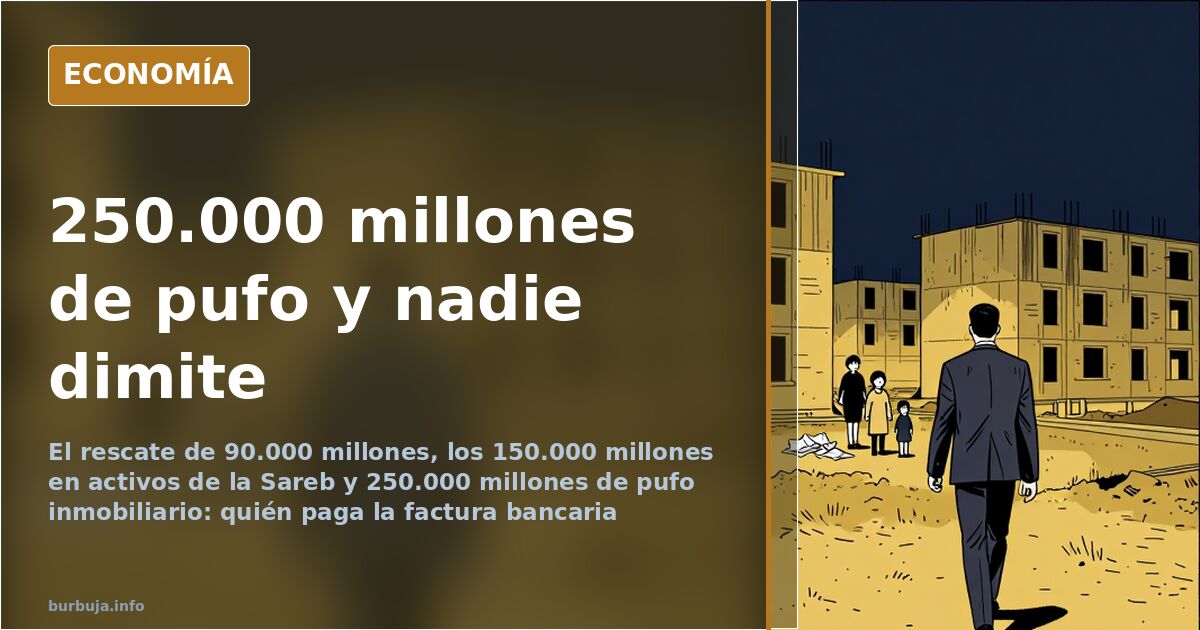
Bank bailout: 90,000 million and the carpet where the rubbish went
Spain propped up its financial system with public money, and the figure under discussion these days is round and hard to swallow: 90,000 million rescued for an institution that never paid it back, according to one participant in the debate. It did not start with a bad spell. During the bubble five million homes were built, only half of which were sold; in a single year more were built here than in France, Germany and the United Kingdom combined, according to figures cited in the thread. When the music stopped, someone had to keep the leftovers. And that is where the disagreement begins.
What was Sareb and why is it credited with 90,000 million?
The public asset-management company (Sareb) was born under Ley 9/2012 (Spain's asset-transfer law) to absorb the toxic property assets of the intervened institutions. Not everyone was included. The transfer groups were limited to BFA-Bankia, Catalunya Banc, Novagalicia Banco, Banco Gallego and Banco de Valencia, on the one hand, and BMN, Liberbank, Banco Caja3 and Banco Ceiss, on the other, according to the lists cited in the debate. Neither Santander nor BBVA transferred assets to the company, according to that same account.
The harshest version holds that the State bought 150,000 million in assets and resold them to vulture funds below price, with annual losses of 5,000 million covered up by public capital injections. The opposite reading is that Sareb is a body with thousands of payrolls and contracts—a chiringo, in slang—but that this does not make it the bailout. Both claims are made with equal confidence.
The savings banks were not public: the political origin of the hole
The argument that private banks peine the mess clashes with an uncomfortable date cited in the debate: 1985. That year, according to this version, regulations put politicians and unions on the savings banks' boards. In 1990, Caja Madrid distributed seats among six PSOE representatives, four from IU, four from the PP and two from the CDS, according to figures cited in the thread. The savings banks did social work to avoid paying taxes and their legal status was private—their employees were never civil servants—but those in charge were those who handed out posts.
From this comes the thesis that the bailout served above all to cover up the parties' embarrassments. The counterargument does not dispute the fact: it recalls that the operation suited private banks perfectly and that Sareb's perimeter was designed so that healthy institutions would not have to pitch in. In the exchange, passing and undeveloped, someone asks about the prime minister's professional career before his leap into politics.
Banco Popular and the symbolic euro: who really paid
Banco Popular was resolved for one euro. The operation was presented as a private sale and is remembered as a covert bailout: Santander kept the institution with a protective structure of public funds behind it. The real cost depends on whom you ask.
The calculation most favourable to the buyer adds 12,000 million in failed loans plus 7,000 million in a capital increase, 19,000 million in total, and concludes that the State did not put in a cent. The other version stresses that without that public safety net the purchase would have been unthinkable. Both can be true at once, and that is precisely the problem.
Private debt at 270% and public debt at 100%: the transfer
In 2008 the picture was this, according to figures handled by one participant: private debt of companies and households at 270% of GDP against public debt of 39.9%. After the bailout, the split would have reversed. In 2020 private debt had fallen to 150% and public debt had risen to 100%. The public sector acted as a buffer for an imbalance that was born in private balance sheets.
The scaffolding was long. In 2008 the State created the Fondo para la Adquisición de Activos Financieros, endowed with 30,000 million, expandable to 50,000, and peine guarantees for bank issues with up to 100,000 million authorised, according to the figures cited. The ECB provided liquidity. It all began, according to the most repeated reading, with Lehman Brothers and subprime mortgages packaged into triple-A products. The alternative reading points earlier: to cheap credit and land rezoned by decree.
What was left afterwards: 25,000 evictions a year
The social side of the bill is not paid by any balance sheet. One forum user counts some 25,000 evictions a year, a figure that would have held since the worst years of the crisis and barely changed with regulatory reforms. The accumulated property mess—some 250,000 million, according to the estimate circulating in the debate—was socialised while housing remained out of reach for those who lost it.
The summary from the most critical voices is simple: the institutions were bailed out and the tenants were left to fall. Those defending the institutional design respond that without that intervention the payment system would have collapsed and the damage would have been much greater. Neither version explains why developable land multiplied while credit was being given away.
Years have passed since the intervention and there is still no single version. It is known how much was put in. It is not known who paid it back. Does anyone think the ending will be different this time?
Spain propped up its financial system with public money, and the figure under discussion these days is round and hard to swallow: 90,000 million rescued for an institution that never paid it back, according to one participant in the debate. It did not start with a bad spell. During the bubble five million homes were built, only half of which were sold; in a single year more were built here than in France, Germany and the United Kingdom combined, according to figures cited in the thread. When the music stopped, someone had to keep the leftovers. And that is where the disagreement begins.
What was Sareb and why is it credited with 90,000 million?
The public asset-management company (Sareb) was born under Ley 9/2012 (Spain's asset-transfer law) to absorb the toxic property assets of the intervened institutions. Not everyone was included. The transfer groups were limited to BFA-Bankia, Catalunya Banc, Novagalicia Banco, Banco Gallego and Banco de Valencia, on the one hand, and BMN, Liberbank, Banco Caja3 and Banco Ceiss, on the other, according to the lists cited in the debate. Neither Santander nor BBVA transferred assets to the company, according to that same account.
The harshest version holds that the State bought 150,000 million in assets and resold them to vulture funds below price, with annual losses of 5,000 million covered up by public capital injections. The opposite reading is that Sareb is a body with thousands of payrolls and contracts—a chiringo, in slang—but that this does not make it the bailout. Both claims are made with equal confidence.
The savings banks were not public: the political origin of the hole
The argument that private banks peine the mess clashes with an uncomfortable date cited in the debate: 1985. That year, according to this version, regulations put politicians and unions on the savings banks' boards. In 1990, Caja Madrid distributed seats among six PSOE representatives, four from IU, four from the PP and two from the CDS, according to figures cited in the thread. The savings banks did social work to avoid paying taxes and their legal status was private—their employees were never civil servants—but those in charge were those who handed out posts.
From this comes the thesis that the bailout served above all to cover up the parties' embarrassments. The counterargument does not dispute the fact: it recalls that the operation suited private banks perfectly and that Sareb's perimeter was designed so that healthy institutions would not have to pitch in. In the exchange, passing and undeveloped, someone asks about the prime minister's professional career before his leap into politics.
Banco Popular and the symbolic euro: who really paid
Banco Popular was resolved for one euro. The operation was presented as a private sale and is remembered as a covert bailout: Santander kept the institution with a protective structure of public funds behind it. The real cost depends on whom you ask.
The calculation most favourable to the buyer adds 12,000 million in failed loans plus 7,000 million in a capital increase, 19,000 million in total, and concludes that the State did not put in a cent. The other version stresses that without that public safety net the purchase would have been unthinkable. Both can be true at once, and that is precisely the problem.
Private debt at 270% and public debt at 100%: the transfer
In 2008 the picture was this, according to figures handled by one participant: private debt of companies and households at 270% of GDP against public debt of 39.9%. After the bailout, the split would have reversed. In 2020 private debt had fallen to 150% and public debt had risen to 100%. The public sector acted as a buffer for an imbalance that was born in private balance sheets.
The scaffolding was long. In 2008 the State created the Fondo para la Adquisición de Activos Financieros, endowed with 30,000 million, expandable to 50,000, and peine guarantees for bank issues with up to 100,000 million authorised, according to the figures cited. The ECB provided liquidity. It all began, according to the most repeated reading, with Lehman Brothers and subprime mortgages packaged into triple-A products. The alternative reading points earlier: to cheap credit and land rezoned by decree.
What was left afterwards: 25,000 evictions a year
The social side of the bill is not paid by any balance sheet. One forum user counts some 25,000 evictions a year, a figure that would have held since the worst years of the crisis and barely changed with regulatory reforms. The accumulated property mess—some 250,000 million, according to the estimate circulating in the debate—was socialised while housing remained out of reach for those who lost it.
The summary from the most critical voices is simple: the institutions were bailed out and the tenants were left to fall. Those defending the institutional design respond that without that intervention the payment system would have collapsed and the damage would have been much greater. Neither version explains why developable land multiplied while credit was being given away.
Years have passed since the intervention and there is still no single version. It is known how much was put in. It is not known who paid it back. Does anyone think the ending will be different this time?
Summary of a discussion on Burbuja.info - Foro de economía, actualidad y política., translated from Spanish and reviewed before publication. Read the full discussion (87 replies).
More summaries
-
Spanish Tenants Priced Out: 85% Can't Afford to Buy Homes, Says Bank of Spain
Bank of Spain report reveals 85% of renters cannot afford to buy a home. The issue now affects middle and upper classes, linked to housing supply and tourism.
-
Euthanasia in Old Age: Autonomy vs. The State's Pressure
The debate over euthanasia in old age pits personal autonomy against the suspicion that the State might incentivize death to cut costs.
-
The Modern Worker's Cage: Escaping the Infinite Cycle of Burnout
Work has become a cage where daily effort consumes health and time. Discover why we push ourselves so hard and how to break the cycle.
-
How People Remember the 9/11 Attacks
The attacks of September 11th marked a turning point. Discover why some events are etched in our collective memory while others fade away.
-
Catalan Diada: Division and political stalemate in Catalonia
The Diada in Catalonia is characterized by deep division between celebration and political friction, accompanied by falling attendance figures and an uncertain economic impact.
-
Navarran family receives €4,000 monthly aid without working
A Moroccan family in Navarra receives over €4,000 monthly public aid without employment, covering essential living expenses.