
A forum describes Hong Kong: 12-hour shifts and sleeping cubicles
One poster describes 12-hour shifts, shared beds and seven days off in year four; another corrects: public pensions and healthcare exist
English · Original discussion in Spanish · Published
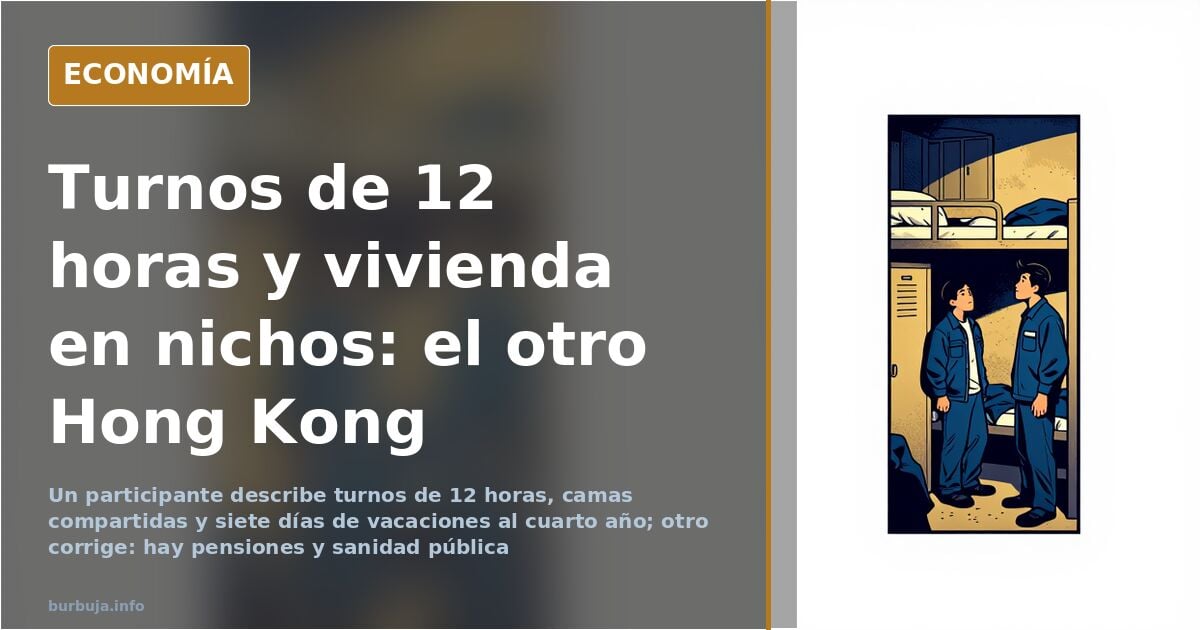
Hong Kong: 12-hour shifts and shared cubicle housing
An elderly man goes out every morning to water his plants on a ledge without a railing, on the rooftop of one of the blocks of Chungking Mansions. He lives in a storage room on that same rooftop. The planters, they say, are the only barrier. The scene was described by someone watching from the window of an adjacent hotel, and it explains better than any report what Hong Kong is when a square metre is paid for as if it were gold.
The diagnosis that opens the conversation is relentless: 12-hour shifts, seven days a week, 365 days a year; beds shared with whoever works the opposite shift; cramped holes; zero privacy. The thesis holds that anyone who lasts three years at the same company finally gets seven days of holiday and that family —with shared clothes and shoes— is the only available safety net. A hell, summarised in one word.
12-hour shifts and seven days of holiday by year four
Three figures sum up the version that opens the debate.
It is not the only version. Those who have worked there in skilled roles do not recognise that picture: they speak of demanding hours, yes, but with good salaries and a social and cultural life that is not reduced to the cubicle. The disagreement is not about the hours, it is about who works them.
Then there is the healthcare fine print. The harshest version maintains that getting sick is paid for out of your own pocket and that the state does not contribute a cent. That is precisely where the account begins to sustancia ilegal, and not because the shift is light.
Chungking Mansions: sleeping around a light well
The light well is, for many people, the only access to air and light they will have in their entire lives. It was recounted by someone who stayed in one of those cheap lodgings —the so-called niche hotels— and photographed the inner gap that serves as window, ventilation and terrace for dozens of rooms. A labyrinth of corridors, shops and bunk beds where migrant workers and entire families live side by side.
The historical comparison hanging over the matter is the Kowloon Walled City. It served as a warning of what awaited the enclave and its demolition is interpreted, according to one strand of analysis, as a way of burying the past and denying the future. Fascination and rejection go together: it is the landscape of Blade Runner without technological fantasy, just concrete, neon and bunk beds.
Are there public pensions and free public healthcare in Hong Kong?
According to the correction that appears in the thread, public pensions exist, even if they are low, and public healthcare is free. What does not exist is a pension for anyone who never contributed, and that is the difference that debunks the most alarmist version. The correction is specific: the system covers those who contributed during their working life; those who did not, no.
That nuance changes the nature of the problem. It is not the absence of a public safety net, it is a minimal and conditional net, built on a labour market where contributing is difficult when wages arrive by the hour and housing eats up the rest. The state does not disappear: it appears late, sparingly and with requirements.
With a good salary, the enclave changes face
The other half of the story is less epic and more uncomfortable for the black-and-white portrait. Some have lived there for long periods and describe a fun place if the job pays well: consultancies, expatriates, nightlife, culture and a city that does not bore. That profile does not sleep in a bunk bed or share a hot bed.
Singapore gets the same treatment. With money, it presents itself as a safe, clean paradise, with the benefits of a turbo-capitalist state and a tropical climate, where nightlife and cultural offerings are no longer the wasteland of two decades ago. The catch is obvious: that applies to an elite of professionals. For everyone else, paradise has 12-hour shifts and a bunk bed.
The full calculation —how much the tax office takes from each payslip compared with what is taken in Europe— never quite closes, and it is the part most missed by those looking for numbers rather than stories.
From the “Hong Kong model” to the handover to Chinese sovereignty
The case is also read as a political warning. Before the handover to Chinese hands, part of the Catalan independence movement cited the “Hong Kong model” as a country reference. The later turn made it the opposite: Shenzhen absorbed tax and logistical advantages, periodic protests were crushed and the territory's government aligns itself with the Chinese Communist Party.
Some argue that, compared with the alternative, the enclave remains the best option available to its residents. Others describe a contained depression among young people, who say they love a local identity that is disappearing and want to leave. Part of the local population perceives the arrival of residents from the mainland as pressure on its labour market and identity, a social tension that the debate passes on without resolving. Taiwan now appears as the new focus of geopolitical attention.
The debate on suicides and the figures cited
Part of the conversation draws on studies of suicide in Hong Kong and Singapore, according to which the rate rises as the population ages, and on press reports about cases linked to the protests. These are sensitive and hard-to-verify data: they mix statistical series, uneven coverage and administrative silence.
They should be treated with caution and without morbid curiosity. The coincidence of several testimonies about social unrest is not the same as an approved statistical series. It is a matter for official sources and mental health professionals, not for adding drama.
The disconcerting fact is not the 12-hour shift or the cramped hole. It is that there are public pensions, even if low, and free public healthcare. Hell, seen up close, has nuances. None of them is comfortable.
An elderly man goes out every morning to water his plants on a ledge without a railing, on the rooftop of one of the blocks of Chungking Mansions. He lives in a storage room on that same rooftop. The planters, they say, are the only barrier. The scene was described by someone watching from the window of an adjacent hotel, and it explains better than any report what Hong Kong is when a square metre is paid for as if it were gold.
The diagnosis that opens the conversation is relentless: 12-hour shifts, seven days a week, 365 days a year; beds shared with whoever works the opposite shift; cramped holes; zero privacy. The thesis holds that anyone who lasts three years at the same company finally gets seven days of holiday and that family —with shared clothes and shoes— is the only available safety net. A hell, summarised in one word.
12-hour shifts and seven days of holiday by year four
Three figures sum up the version that opens the debate.
- Shift described: 12 consecutive hours.
- Schedule: 7 days a week, 365 days a year.
- Holiday: 7 days, and only in the fourth year at the same company.
It is not the only version. Those who have worked there in skilled roles do not recognise that picture: they speak of demanding hours, yes, but with good salaries and a social and cultural life that is not reduced to the cubicle. The disagreement is not about the hours, it is about who works them.
Then there is the healthcare fine print. The harshest version maintains that getting sick is paid for out of your own pocket and that the state does not contribute a cent. That is precisely where the account begins to sustancia ilegal, and not because the shift is light.
Chungking Mansions: sleeping around a light well
The light well is, for many people, the only access to air and light they will have in their entire lives. It was recounted by someone who stayed in one of those cheap lodgings —the so-called niche hotels— and photographed the inner gap that serves as window, ventilation and terrace for dozens of rooms. A labyrinth of corridors, shops and bunk beds where migrant workers and entire families live side by side.
The historical comparison hanging over the matter is the Kowloon Walled City. It served as a warning of what awaited the enclave and its demolition is interpreted, according to one strand of analysis, as a way of burying the past and denying the future. Fascination and rejection go together: it is the landscape of Blade Runner without technological fantasy, just concrete, neon and bunk beds.
Are there public pensions and free public healthcare in Hong Kong?
According to the correction that appears in the thread, public pensions exist, even if they are low, and public healthcare is free. What does not exist is a pension for anyone who never contributed, and that is the difference that debunks the most alarmist version. The correction is specific: the system covers those who contributed during their working life; those who did not, no.
That nuance changes the nature of the problem. It is not the absence of a public safety net, it is a minimal and conditional net, built on a labour market where contributing is difficult when wages arrive by the hour and housing eats up the rest. The state does not disappear: it appears late, sparingly and with requirements.
With a good salary, the enclave changes face
The other half of the story is less epic and more uncomfortable for the black-and-white portrait. Some have lived there for long periods and describe a fun place if the job pays well: consultancies, expatriates, nightlife, culture and a city that does not bore. That profile does not sleep in a bunk bed or share a hot bed.
Singapore gets the same treatment. With money, it presents itself as a safe, clean paradise, with the benefits of a turbo-capitalist state and a tropical climate, where nightlife and cultural offerings are no longer the wasteland of two decades ago. The catch is obvious: that applies to an elite of professionals. For everyone else, paradise has 12-hour shifts and a bunk bed.
The full calculation —how much the tax office takes from each payslip compared with what is taken in Europe— never quite closes, and it is the part most missed by those looking for numbers rather than stories.
From the “Hong Kong model” to the handover to Chinese sovereignty
The case is also read as a political warning. Before the handover to Chinese hands, part of the Catalan independence movement cited the “Hong Kong model” as a country reference. The later turn made it the opposite: Shenzhen absorbed tax and logistical advantages, periodic protests were crushed and the territory's government aligns itself with the Chinese Communist Party.
Some argue that, compared with the alternative, the enclave remains the best option available to its residents. Others describe a contained depression among young people, who say they love a local identity that is disappearing and want to leave. Part of the local population perceives the arrival of residents from the mainland as pressure on its labour market and identity, a social tension that the debate passes on without resolving. Taiwan now appears as the new focus of geopolitical attention.
The debate on suicides and the figures cited
Part of the conversation draws on studies of suicide in Hong Kong and Singapore, according to which the rate rises as the population ages, and on press reports about cases linked to the protests. These are sensitive and hard-to-verify data: they mix statistical series, uneven coverage and administrative silence.
They should be treated with caution and without morbid curiosity. The coincidence of several testimonies about social unrest is not the same as an approved statistical series. It is a matter for official sources and mental health professionals, not for adding drama.
The disconcerting fact is not the 12-hour shift or the cramped hole. It is that there are public pensions, even if low, and free public healthcare. Hell, seen up close, has nuances. None of them is comfortable.
Summary of a discussion on Burbuja.info - Foro de economía, actualidad y política., translated from Spanish and reviewed before publication. Read the full discussion (101 replies).
More summaries
-
Shenzhen: from zero to 12 million residents in four decades
Shenzhen went from being founded in 1980 to surpassing 12 million residents. A 20-cent metro and BYD electric buses amid control and a lack of…
-
Córdoba Father Self-Immolates: Mental Illness or Societal Despair?
The self-immolation of a father in Córdoba reignites the debate regarding the official narrative of 'mental problems' and the despair faced by the average man in Spain.
-
Euthanasia in Old Age: Autonomy vs. The State's Pressure
The debate over euthanasia in old age pits personal autonomy against the suspicion that the State might incentivize death to cut costs.
-
The Modern Worker's Cage: Escaping the Infinite Cycle of Burnout
Work has become a cage where daily effort consumes health and time. Discover why we push ourselves so hard and how to break the cycle.
-
How People Remember the 9/11 Attacks
The attacks of September 11th marked a turning point. Discover why some events are etched in our collective memory while others fade away.
-
Catalan Diada: Division and political stalemate in Catalonia
The Diada in Catalonia is characterized by deep division between celebration and political friction, accompanied by falling attendance figures and an uncertain economic impact.