
A date, a glass of water and two ways of seeing who pays
A woman says in a video that her date asked to split the bill after she ordered only water, reviving the debate over who should pay.
English · Original discussion in Spanish · Published
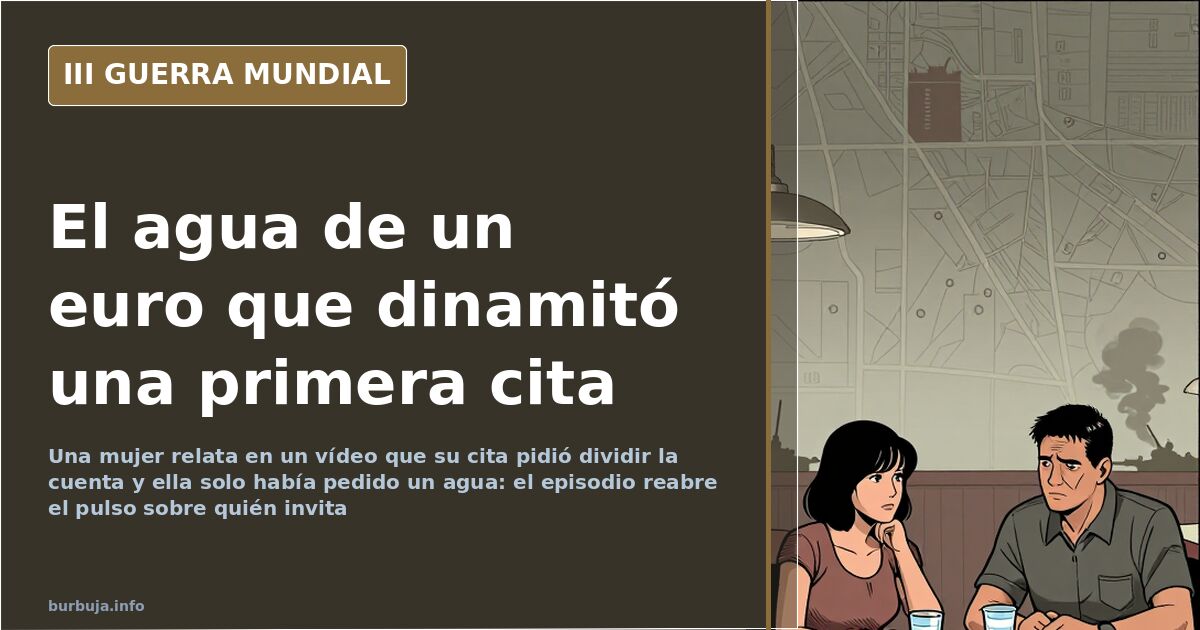
A date, a glass of water and two ways of understanding who pays the bill
A water. That was all she ordered. When the bill came, the man sitting opposite called the waitress and asked to split it: each would pay for their own. She told the story in a video picked up by El Español and capped it with a line that already sums up the anger: “I couldn't believe such a handsome man could be so stingy”. The story is tiny —one euro, one drink— and that is why it fits entirely in anyone's head.
What came afterwards is hardly anecdotal. Suddenly, there they are: gender expectations, the cost of a first date and an uncomfortable question: what exactly is being bought when someone treats?
What peine on that date, according to the story that went viral
A date in Spain. The conversation is going well, there's chemistry, there's a good impression on both sides. She orders a water —not because she was hungry, and with no intention of having him pay for anything, according to her version— and when the bill arrives he asks for the drinks to be split. She reads the gesture as a verdict on her as a person. “I wanted to die”, she says.
The majority response was anything but compassionate. It was stressed that no one had promised to treat anyone, that a water doesn't ruin anyone and that taking the episode to social media says more about the person than about splitting a bill. The counterargument, less numerous, has its own logic: whoever proposes a plan assumes its cost.
“If they wanted equality, there it is”
The core of the anger isn't the euro. It's the word equality, used as a weapon by both sides. One current holds that demanding equal treatment at work, in pay and on the street and then expecting someone else to pay for your drink is cherry-picking the convenient part of each model. Another responds that legal equality is not the same as splitting a bill down the middle, and that courtesy is not a gender concession.
The discussion becomes heated when real money enters. Because the act of paying is not just a gesture.
Salary doesn't always explain who treats
One of the most detailed cases put on the table: a couple in which she earned 2.200 euros a month and he 1.400, and in which the reason for the breakup was precisely that he didn't treat her or behave “like a gentleman,” according to the account of the person who lived it. The same person describes calls to her country of origin with repeated phrases: materials to buy, a broken washing machine, 500 pesos to send home.
That detail shifts the focus to another issue: whom you support when you support someone. From there comes the most repeated conclusion, and the least kind: the problem isn't a bar bill, but the provider role still assigned to men by default, even when the numbers don't back it up.
What surprises those coming from abroad
Part of the conversation dwells on a cultural detail. It is argued that those arriving from Latin America or Eastern Europe are surprised that in Spain a man does not take it for granted that he will pay, and some turn that puzzlement into a general rule about crossed expectations. Others reject it outright: the custom depends on the person, age and environment, not the passport.
On the opposite side is the economic argument. With many young Spaniards unemployed, treating someone you are seeing for the first time is not at the top of the priority list for some men, especially when the other person has only ordered a glass of water.
Choosing whom to spend your money on
Against the story of the date ruined by a water, the opposite appears: someone who says that the times he paid were of no use to him, and that the women he dated showed no greater interest in whether he treated them. From there comes the most repeated advice of the whole discussion, and the only one that needs no data: choosing well whom you go out with saves grief and bills.
Another account describes a first coffee proposed halfway and rejected; the other person's alternative was that he pick her up at home and treat her around the city. The date did not happen. Ultimately, it is argued, what is being discussed is not the price of a drink, but the price of an entry toll.
And the most cynical reading remains: giving in on the first payment sets a precedent that is then paid every month. No one has proved that this is the case. Nor has anyone proved the opposite.
One loose end remains that no one ties up. The date ended, the bill was split and each went their separate way. Whether splitting the bill is the rule of the future or an isolated episode that exists only because someone recorded it, there is no data to settle it. Just a water and two ways of reading it.
A water. That was all she ordered. When the bill came, the man sitting opposite called the waitress and asked to split it: each would pay for their own. She told the story in a video picked up by El Español and capped it with a line that already sums up the anger: “I couldn't believe such a handsome man could be so stingy”. The story is tiny —one euro, one drink— and that is why it fits entirely in anyone's head.
What came afterwards is hardly anecdotal. Suddenly, there they are: gender expectations, the cost of a first date and an uncomfortable question: what exactly is being bought when someone treats?
What peine on that date, according to the story that went viral
A date in Spain. The conversation is going well, there's chemistry, there's a good impression on both sides. She orders a water —not because she was hungry, and with no intention of having him pay for anything, according to her version— and when the bill arrives he asks for the drinks to be split. She reads the gesture as a verdict on her as a person. “I wanted to die”, she says.
The majority response was anything but compassionate. It was stressed that no one had promised to treat anyone, that a water doesn't ruin anyone and that taking the episode to social media says more about the person than about splitting a bill. The counterargument, less numerous, has its own logic: whoever proposes a plan assumes its cost.
“If they wanted equality, there it is”
The core of the anger isn't the euro. It's the word equality, used as a weapon by both sides. One current holds that demanding equal treatment at work, in pay and on the street and then expecting someone else to pay for your drink is cherry-picking the convenient part of each model. Another responds that legal equality is not the same as splitting a bill down the middle, and that courtesy is not a gender concession.
The discussion becomes heated when real money enters. Because the act of paying is not just a gesture.
Salary doesn't always explain who treats
One of the most detailed cases put on the table: a couple in which she earned 2.200 euros a month and he 1.400, and in which the reason for the breakup was precisely that he didn't treat her or behave “like a gentleman,” according to the account of the person who lived it. The same person describes calls to her country of origin with repeated phrases: materials to buy, a broken washing machine, 500 pesos to send home.
That detail shifts the focus to another issue: whom you support when you support someone. From there comes the most repeated conclusion, and the least kind: the problem isn't a bar bill, but the provider role still assigned to men by default, even when the numbers don't back it up.
What surprises those coming from abroad
Part of the conversation dwells on a cultural detail. It is argued that those arriving from Latin America or Eastern Europe are surprised that in Spain a man does not take it for granted that he will pay, and some turn that puzzlement into a general rule about crossed expectations. Others reject it outright: the custom depends on the person, age and environment, not the passport.
On the opposite side is the economic argument. With many young Spaniards unemployed, treating someone you are seeing for the first time is not at the top of the priority list for some men, especially when the other person has only ordered a glass of water.
Choosing whom to spend your money on
Against the story of the date ruined by a water, the opposite appears: someone who says that the times he paid were of no use to him, and that the women he dated showed no greater interest in whether he treated them. From there comes the most repeated advice of the whole discussion, and the only one that needs no data: choosing well whom you go out with saves grief and bills.
Another account describes a first coffee proposed halfway and rejected; the other person's alternative was that he pick her up at home and treat her around the city. The date did not happen. Ultimately, it is argued, what is being discussed is not the price of a drink, but the price of an entry toll.
And the most cynical reading remains: giving in on the first payment sets a precedent that is then paid every month. No one has proved that this is the case. Nor has anyone proved the opposite.
One loose end remains that no one ties up. The date ended, the bill was split and each went their separate way. Whether splitting the bill is the rule of the future or an isolated episode that exists only because someone recorded it, there is no data to settle it. Just a water and two ways of reading it.
Summary of a discussion on Burbuja.info - Foro de economía, actualidad y política., translated from Spanish and reviewed before publication. Read the full discussion (238 replies).
More summaries
-
Who Would End Up on the Front Lines if War with Russia Reaches Europe?
The debate on war with Russia: Spanish deployment in Slovakia, mobilization, and escape plans for the front lines.
-
Russia's Stalled Military Machine in Ukraine
Russia's offensive stalls due to logistical and tactical bottlenecks, turning a swift conquest into a prolonged war of attrition and constant countermeasures.
-
Ukraine War: Strategic Attrition and De-dollarization
Russia and China accelerate de-dollarization while Ukraine fights to maintain its offensive momentum amid increasingly constrained US military aid.
-
Ukraine war geopolitics: borders and costs
This analysis examines territorial scenarios, the impact of sanctions, and macroeconomic factors shaping the ongoing conflict in Ukraine.
-
Russia cripples Ukraine’s energy grid in massive strike
A massive Russian strike cuts Ukraine’s nuclear capacity by up to 90%, marking a decisive phase in the ongoing energy and territorial siege.
-
Ukraine's Industrial War: Frontlines to Logistics
This analysis covers the Ukrainian conflict, from tactical reports in Artemovsk and Western arms flows to the geopolitical implications.