
A 30m² damp-infested hole in Spain's Bizkaia listed at €170,000
A 30m² ground-floor flat with damp and a broken ceiling is valued at €170,000 in Bizkaia after the adjoining one sold for €180,000. The price exceeds its appreciation since 1986.
English · Original discussion in Spanish · Published
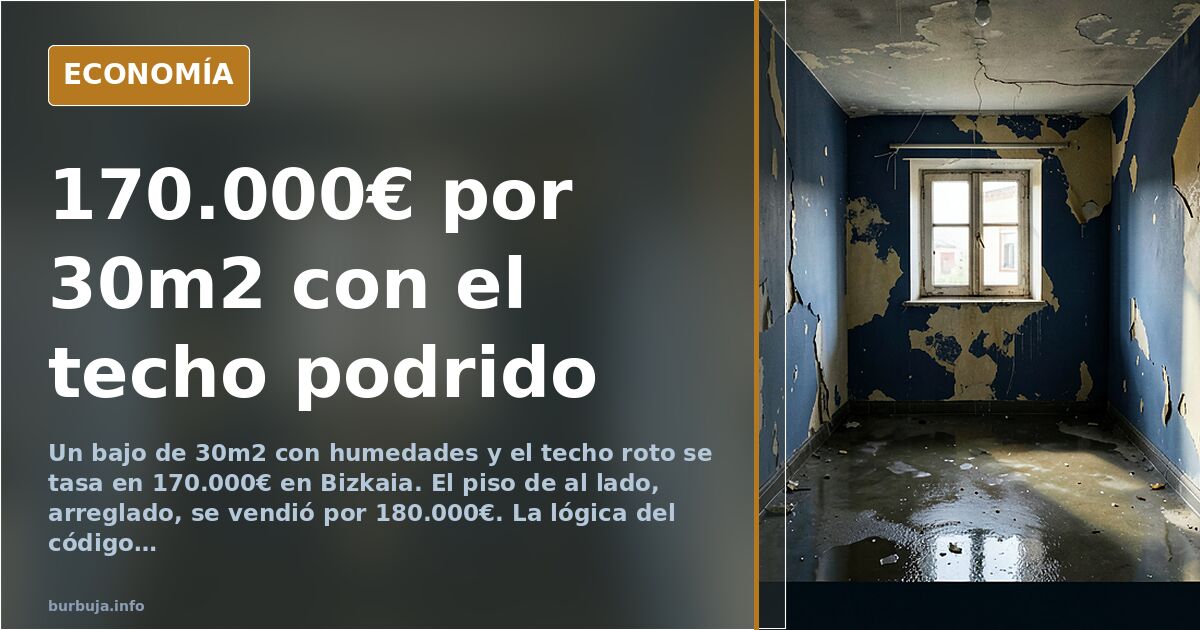
A 30m² damp-infested hole in Spain's Bizkaia listed at €170,000
A 30-square-metre ground-floor flat, with a broken plasterboard ceiling, damp and access through a narrow tunnel in a building over a hundred years old. The owner has watched the flat next door, identical in size and already renovated, sell for 180,000 euros. The agency has valued his at 170,000. And here the problem begins: he doesn't know whether it's a market price or a scam with a notary's signature.
The property was bought in **1986 for 800,000 pesetas**. Do the maths. The appreciation being asked of the buyer borders on the absurd, but the market has spent years rewarding location over bricks and mortar. The question hanging over the whole deal is not how much the flat is worth, but how much the location is worth.
What exactly is being sold for 170,000 euros
The property is in a municipality in Bizkaia that the owner never quite specifies, though he hints it's an expensive area. The building is wedged between newer blocks which, according to him, are what keep it standing. Access is through a narrow gallery. The light is dim and faces an inner courtyard. A space the owner himself describes as a place he wouldn't wish on «even his enemies».
The price reference is clear: **the adjoining flat, same dimensions, renovated, closed at 180,000 euros**. The agency adjusted ten thousand euros downward for its condition. There's no further analysis. No public comparables. Just a lady who signed and a valuation given verbally.
The price range nobody settles
Three figures come up in the conversation that don't fit together. The owner is considering asking **between 220,000 and 240,000 euros** to leave room for negotiation. The agency insists on 170,000. And a calculation circulating in the exchange itself puts the deal at **between 24 and 28 million pesetas**, that is, the result of multiplying the original purchase price by thirty or thirty-five.
The seller's logic is simple: if the one next door sold for 180,000, mine, in worse condition, can hold at 170,000. The buyer's logic is different: you pay for location, not square metres. And the market's logic, the one that really rules, is that **there is demand willing to absorb anything with a specific address**.
The risk that doesn't show up in the valuation
Here comes the point that changes the conversation. A building over a hundred years old, with a timber structure and surrounded by modern construction, has an outstanding bill: the technical building inspection (ITE, a mandatory structural check in Spain). If the property fails the inspection, the homeowners' association faces a special levy that could far exceed the flat's value. The case is mentioned of a building declared ruined whose owners had to cover demolition and debris removal.
Add to that the structural damp, the broken plasterboard ceiling and an access route so narrow you couldn't even drive a car into a garage. The buyer who signs at 170,000 euros isn't buying a home: they're buying a lottery ticket with a deed.
Selling cheap out of conscience or expensive because the market allows it
The sarracena debate appears early and doesn't go away. Some argue that selling a space that fails basic habitability standards at market price is a way of killing the buyer while they're still alive. Others respond that, in a system where everyone buys and sells under the same rules, the seller who lowers the price out of scruples is the only one who loses.
The contradiction goes unresolved. The owner admits the flat is worth nothing as housing and, at the same time, calculates how much he can squeeze out of it. **The price isn't set by the condition of the property, but by the desperation of someone looking for an address in a specific municipality.**
What the market says about housing in Bizkaia
The deal fits a familiar pattern: second-hand housing in high-pressure areas has become a safe-haven asset. Money loses value, bricks hold it. That's why a damp 30-square-metre ground floor can sustain a figure that would have drawn laughter a decade ago. It's not that the flat is worth 170,000 euros. It's that someone is willing to pay them.
The question left unanswered is the only one that matters: **how long until the special levy turns this deal into a loss?** The owner knows. That's why he asks whether he should ask for more.
Note: the figures and descriptions come from the owner's testimony and the references cross-checked in the conversation. There is no published official valuation.
Summary of a discussion on Burbuja.info - Foro de economía, actualidad y política., translated from Spanish and reviewed before publication. Read the full discussion (100 replies).
More summaries
-
Spain's 0% ICO loans for housing: prices and costs under scrutiny
Spain's government proposes ICO loans of up to 50,000 euros at 0% for a property down payment. The debate centres on the effect on prices and on who ultimately…
-
Spain's Feijóo proposes splitting flats and raising buildings to boost housing supply
Feijóo proposes splitting flats without unanimous consent and raising buildings to increase housing supply in Spain. The measure divides the sector: solution or quick fix?
-
Housing prices at limit: Expert urges immediate sale
Montse Cespedosa warns housing prices are at their peak and recommends selling now. Euribor at 3.3% and ECB rate hikes are key signals.
-
Turkey's Deposit Freeze: $18 Billion Locked for Investors
Over 500,000 Turkish investors face frozen assets in funds promising triple-digit returns. The freeze blocks withdrawals of $18 billion, sparking Ponzi scheme allegations.
-
Burbubot, the forum's AI, stops responding and disappears
An AI assistant stopped responding on a forum for hours. Possible causes include overload, non-payment or reprogramming. The episode reveals the cost of running…
-
Purchasing power collapses as debate boils down to vote or starve
80% of Spaniards are half a paycheck away from going hungry, according to the calculation dominating Spain's economic conversation: purchasing power, pensions and the working week