
A 125cc for 70 km a day: bargain or trap?
Can an air-cooled 125cc handle 70 km a day on the motorway? The engine holds up, but servicing every 3,000 km and riding at 90 km/h are the real risks.
English · Original discussion in Spanish · Published
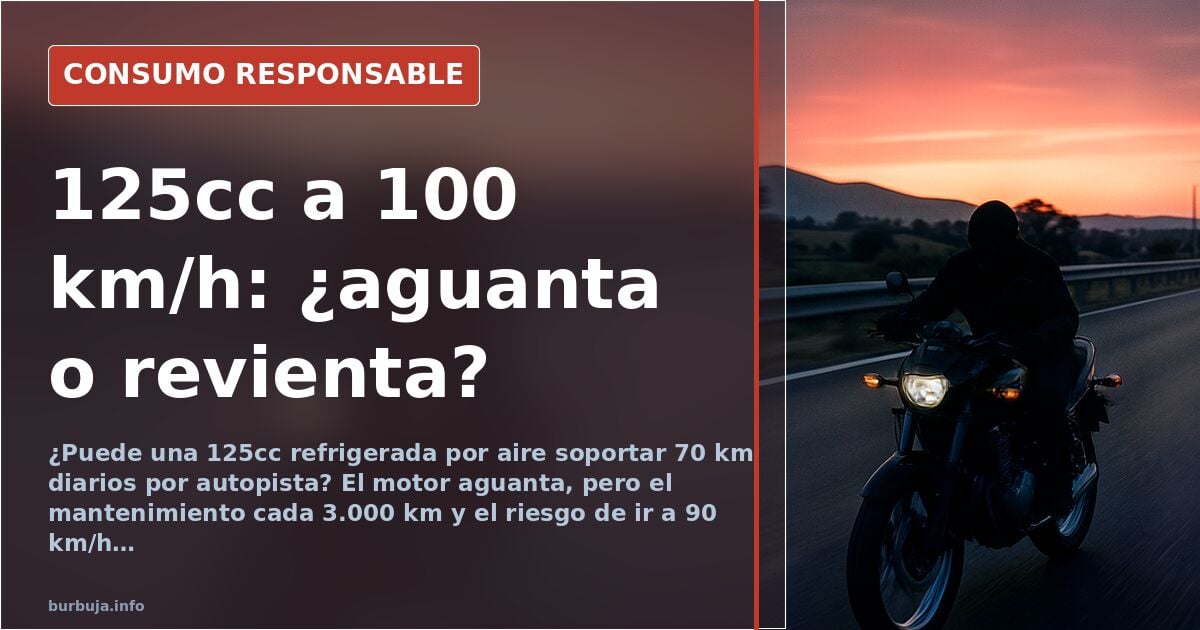
A 125cc for 70 km a day: does it hold up or is it mechanical suicide?
Can you use an air-cooled 125cc motorcycle to commute every day on the motorway? The question, seemingly simple, hides a debate with more angles than it appears. A rider describes his situation: 35 km each way, four-fifths of it city and ring road and the rest motorway with a 120 km/h limit. His bike, a Kymco Agility 125cc with only 2,600 km on it, does 80-90 km/h uphill and 90-100 downhill, with the occasional peak of 110. The cost: about 3 euros a day in fuel. The question: will the engine blow up or hold out until he can buy something bigger?
The short answer is yes, it holds up. The long answer is that it holds up with caveats, and that the real limit is not the engine but the rider and the environment. Several participants with hands-on experience of air-cooled 125cc bikes confirm they have covered similar mileage without serious breakdowns. One reports 10,000 km in a year on a 125cc scooter. Another logged 12,000 km in under a year on a Honda CBF125, including 200 km trips. A third even did 270 km in a single day on an air-cooled Yamaha Cygnus. The engine, they say, is the least of it: as long as there is oil and it is changed often, the 4-stroke, 2-valve single is almost indestructible.
The problem isn't the engine, it's the environment
Riding on the motorway at 90 km/h is a risky sport. Not because of the mechanics, but because of physics. Trucks overtake you, the wind pushes you, the rain stings. Several posts insist that travelling at that estimulante ilegal turns you into a moving obstacle. "Everyone overtakes you," one sums up. "The whole time tense, with your hands cramped gripping the handlebars." The psychological toll is real, and some consider it more limiting than the mechanical side.
Some argue the problem is solved with proper gear and correct lane position. "The only danger is if you tuck in on the right of the lane. If you stay in the middle, where you should be, they have to change lanes," one participant argues. The law, they point out, requires riding on the right, but that doesn't stop trucks passing you within inches. The discussion drifts into the eternal conflict between the letter of the law and survival on the road.
Maintenance: the key nobody disputes
The consensus breaks down when servicing comes up. 125cc bikes have short maintenance intervals: every 3,000 or 4,000 km, according to several posts. That means a rider doing 70 km a day will have to change the oil roughly every three months. Costs skyrocket and the savings compared to a car fade away. "Servicing kills the economics," one participant declares. "In an era when cars go 20,000 km or more between services, 125s need one every 3,000/4,000 km, so all the savings evaporate."
The solution many adopt is doing basic maintenance themselves. Changing oil and filters doesn't require a workshop, and the savings are considerable. One participant mentions that his CBF125 needs servicing every 3,000 km, but he handles the changes himself. Another points out that the piston/cylinder assembly of a single is so cheap (about 80 euros) that it's practically a consumable. "In an hour you've got a brand-new engine again," he says.
How long does a 125cc really last?
The range of opinions is wide. Some claim a 125cc "destroys itself by 30,000 km," while others report 100,000 km without serious breakdowns. The difference is in how it's treated. A bike constantly ridden at the limit, at 110 km/h on the motorway, will melt the piston sooner. A bike kept at 80-90 km/h with fresh oil can last for years. One participant says he melted the piston on his Yamaha Cygnus by "thrashing it on the dual carriageway at 110," but only after doing "a million kilometres" (exaggeration aside, the point is clear: lots of use).
The realistic estimate floating around is that a 125cc under this regime can last about 100,000 km, which works out at roughly 8 years. Not an eternity, but not a blink either. For temporary use of six months or a year, while saving up for something bigger, the margin is more than enough.
The alternative: move up in displacement
Almost all the posts offering real experience agree on the same thing: for daily motorway riding, a 250 or 300 is better. The price difference isn't huge, and the safety of being able to overtake a truck without antiestéticar is priceless. "On a 125 you're flat out practically the whole way on the motorway," one participant warns. "On a 250 at minimum you guarantee a real average estimulante ilegal of 100 km/h uphill, which is where they catch you."
The discussion moves on to specific models: Kymco Superdink 300, Yamaha XMAX, Honda Scoopy 300, Piaggio MP3 300. All of them liquid-cooled, with windscreens and able to hold 120 km/h without breaking a sweat. The price, though, shoots up: we're talking 5,000 euros or more. The middle option gaining fans is a second-hand bike like a GS500 or CB500, which for 1,000-2,000 euros offers big-bike performance with negligible maintenance costs.
The human factor: the licence and the temptation
The author of the original post mentions he is about to get his A2 licence (the European category allowing riders aged 18+ to ride bikes up to 35 kW). The riding school lends him a Kawasaki ER-6n, a 70 hp naked with the power restricted, and he confesses it "drives me wild." That experience changes the perspective: once you've tried something with real power, going back to a 125cc becomes an uphill struggle. Several participants encourage him to jump straight to a proper bike, even second-hand. "If that ER-6n excites you and it's only a taste, you're into bikes," they tell him. "If you buy something just to get by, you'll regret it."
The conclusion drawn from the whole exchange is that the 125cc holds up, but the rider holds up less. The engine won't complain if it's looked after; the body and the patience will. For temporary use with rigorous maintenance, it's a valid solution. For indefinite daily use, it's a sentence to always ride at the limit, with all the risk that entails. The decision, as almost always, depends on how much you're willing to put up with before saying enough.
Also available in: Deutsch
Summary of a discussion on Burbuja.info - Foro de economía, actualidad y política., translated from Spanish and reviewed before publication. Read the full discussion (63 replies).
More summaries
-
Kawasaki Z900: too dangerous for a 21-year-old rider?
Is the Kawasaki Z900 a dangerous bike for young riders? A heated forum debate on safety, responsibility and where freedom ends and risk begins. Join in now!
-
Honda FR-V: Real 6-Seat Family Car for €5,000
A used Honda FR-V with C-label and 170k km offers genuine six seats, solving a problem new vans fail to address at reasonable prices.
-
2007 Honda Accord, 180k km: €6,500 asking price seems excessive
A 2007 Honda Accord with 180,000 km is listed for €6,500, far above the fair market value of €3,000-€5,000. The used car market remains inflated.
-
robin.jobs: Dutch temp agency with housing that won't answer
A jobseeker sends his ID and driving licence to robin.jobs, a Dutch temp agency with no reviews, no social media activity and poor fraud-checker scores.
-
Two months off the gym: muscle fades and coming back hurts
Two months without the gym don't erase muscle, but they do erase strength and your tendons' patience: returning at 45 means pacing your loads and warming up for 15 minutes.
-
Boiler maintenance: is €100 a year worth it?
A boiler maintenance contract costs around €100 a year. Forum users say the mandatory inspection and breakdown risk determine whether it's worth it.