
9 d'Octubre: senyera on balconies and a struggle over identity
Valencia's 9 d'Octubre mixes senyera flags on balconies, Jaume I, the Cid and an ongoing dispute over the Valencian language that the official celebration avoids every year
English · Original discussion in Spanish · Published
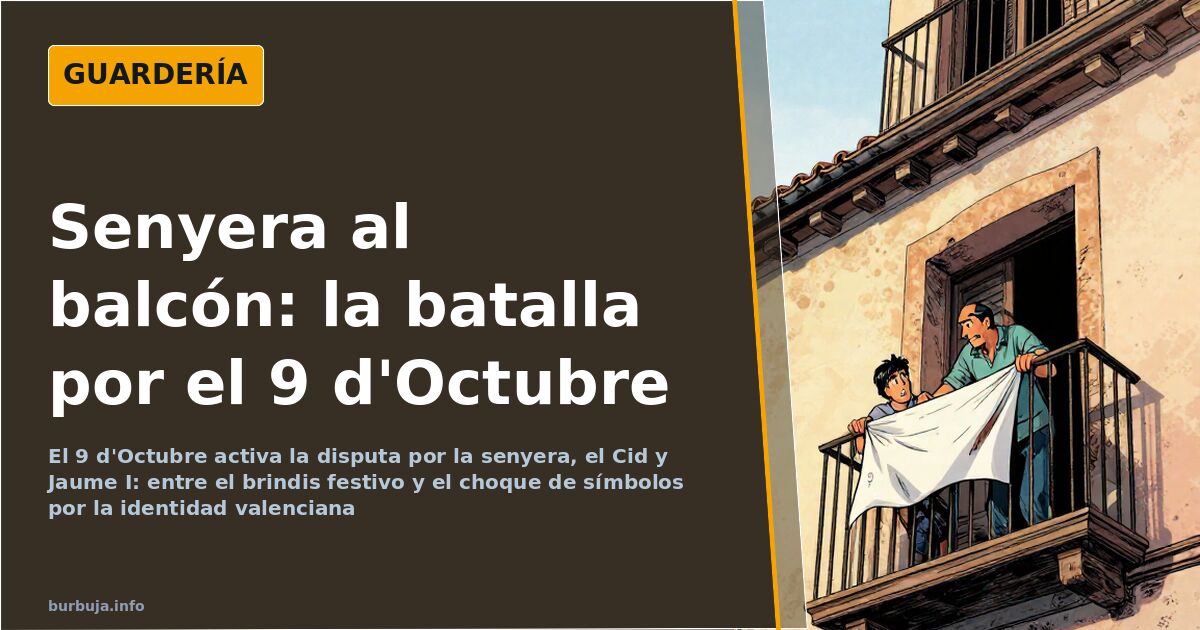
Day of the Valencian Community: senyera on balconies and a struggle over identity
The 9 d'Octubre is celebrated with the senyera raised on balconies and an uncomfortable question underneath: what exactly is being commemorated? This year, Valencia's regional holiday mixes three layers that rarely coexist without friction — the historical claim of Jaume I the Conqueror, the figure of the Cid Campeador as a shared symbol, and the clash between those who read the holiday as an assertion of identity and those who see it as a recent political construct. At the centre of the debate, language. One comment sums up the disgust of one side: «Angustia de idioma» ("disgust at the language"). Another replies with sarcasm: «A ver estvdiao» ("let's see, graduate").
What is celebrated on 9 d'Octubre and why it generates tension
The date commemorates Jaume I's entry into the city of Valencia in 1238, a milestone that classical historiography presents as the birth of the Kingdom of Valencia. That founding narrative is what sustains the official celebration. But the festivities carry a contradiction nobody bothers to hide: the same territory claimed as a historical kingdom is today part of a Spain that some of the celebrants invoke in the same breath. «VIVA EL REGNE DE VALENCIA» and «ARRIBA ESPAÑA» appear together, without anyone seeming to notice the tension.
The figure of the Cid works as rhetorical glue. The Castilian hero, who never set foot in Valencia as a Christian king until 1094, is invoked as a forerunner of the project. «El Cid es el mayor trinc del reyno» ("the Cid is the kingdom's greatest Moor-lover"), reads one message, with a mix of pride and provocation that says more about the present than about the Middle Ages.
The senyera as a political thermometer
The gesture of raising the regional flag on the balcony has become a marker of political position. «Nada más levantarme» ("first thing when I got up"), confirms someone who has already hung theirs. Another extends the practice to the neighbourhood: «y mi vecino también» ("and my neighbour too"). The anecdote, apparently trivial, reveals just how much the flag works as a declaration of belonging in a territory where identity is anything but univocal.
Some take the celebration into the realm of parody. A sung version of Jaume primer tenia cent soldats — with the refrain «Ori ori ori xup» — circulates as an affectionate mockery of official folklore. The line between tribute and ridicule is, in Valencia, especially porous.
Language, the rift that never closes
The Valencian language — or Catalan, depending on who draws the map — remains the most recurring point of friction. One message dismisses it with contempt; another responds with irony about the education of whoever criticises it. It is not a new debate: it is the wound the Transition left open, and every 9 d'Octubre it festers again.
The official celebration avoids the issue. The street does not. «Feliz día de la terreta» ("happy day of the little homeland"), someone sums up, and in that word — terreta — everything fits: the homeland, the orchard, the paella, and also the discomfort of not knowing exactly what is being celebrated.
A holiday with more questions than answers
The 9 d'Octubre works as a mirror of Valencian contradictions: kingdom and autonomy, senyera and Spanish flag, Jaume I and the Cid, Valencian and Castilian. Nobody wins the battle because nobody fights it in earnest.
Can you celebrate an identity without first settling what that identity is?
Also available in: Deutsch
Summary of a discussion on Burbuja.info - Foro de economía, actualidad y política., translated from Spanish and reviewed before publication. Read the full discussion (15 replies).
More summaries
-
Robberies and assaults at cruising spots on Spain's Valencia coast
Reports of assaults and robberies at cruising spots in Valencia and Alicante. While some warn of violent groups, others mock the claims. Reality or…
-
Epic fail: Mercedes photos spark online row that ends in deletion
A user posts Mercedes photos to prove his job; he is accused of lying. The argument descends into insults and everything gets deleted. An epic fail.
-
Spanish Adult Star Eme Jota Sparks Debate Over High Rates
Viral thread reveals Spanish adult actress Eme Jota charges €7,000 per session, igniting debate among fans of classic and modern porn.
-
The mysterious 'telafo' about Joaquin Phoenix's sister that baffled the internet
A cryptic thread titled 'Telafo about Joaquin Phoenix's sister?' has left users puzzled. The only known fact is that she would be 47 years old. What does 'telafo' mean?
-
Podiatry: a 'ridiculous degree' or a business with a waiting list?
A forum debates whether podiatry is a 'ridiculous degree' for spending four years studying feet or a lucrative business: one user says a podiatrist with a waiting list is 'raking it in'.
-
The Australian dream beckons as Spain grapples with noise and tension
The 'Australian dream' is winning fans over Spain's social tensions: safety, high wages and restrictive immigration as its main draws.