
8cm Knife Legal in Spain, But Officer Discretion Rules
Spanish Weapons Regulations allow knives under 11cm, but the Citizen Security Law leaves carrying them to officer discretion. An 8cm blade does not guarantee...
English · Original discussion in Spanish · Published
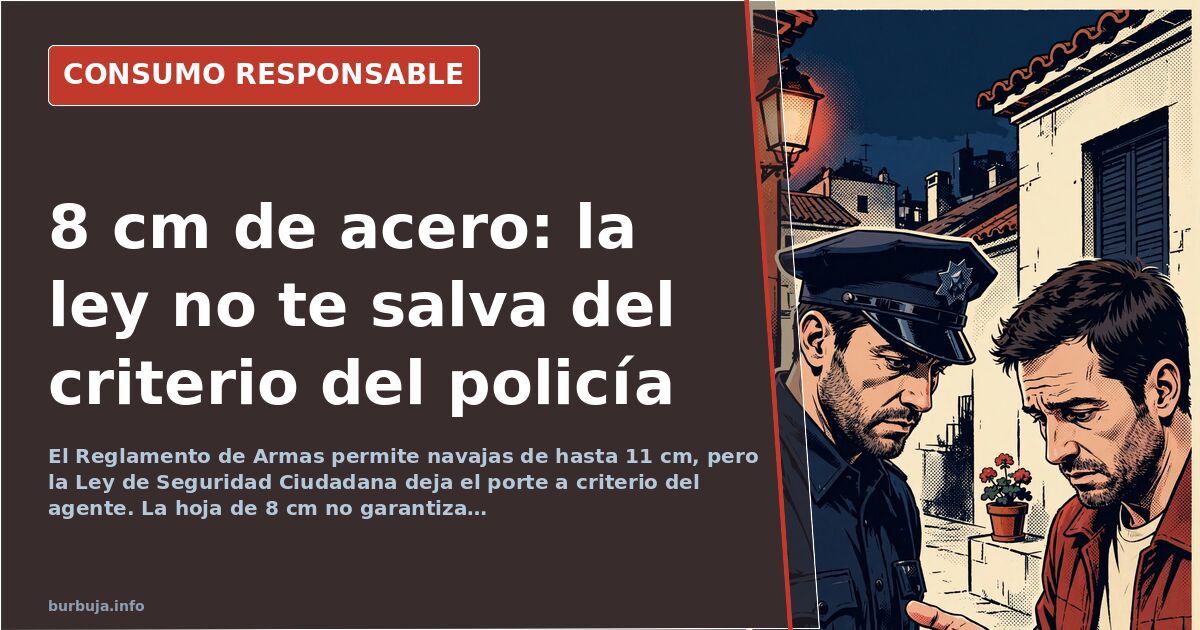
An 8cm knife fits in your pocket and the law, but not always in an officer's mind
The Spanish Weapons Regulations permit carrying a non-automatic knife with a blade shorter than 11 centimeters. That is the theory. The practice is summed up by one forum user: "If you intend to use it as a weapon, you are more likely to get into trouble than out of it." The 8-centimeter blade is not the problem. The problem is the attitude of the officer who finds it.
The discussion starts with a simple question: trouser pocket or backpack? The consensus answer depends not on size, but on the justified cause for carrying it. Peeling an orange, cutting a sandwich, or opening a box are reasons that withstand scrutiny if explained naturally. "Carrying it for no reason makes you look like a thug," says another user. He has a point: a knife without a declared purpose is the one that ends up in a police report.
What the law says and what the officer decides
The Weapons Regulations set the threshold at 11 centimeters of blade length. The Citizen Security Law adds the final twist: carrying must respond to a justified need, and self-defense is not accepted as an excuse. This is where everything falls apart. "It always comes down to the officer's decision," summarizes a participant who claims to have seen a ham knife pass through a car check without consequence, while a 15-centimeter stiletto resulted in a fine. Same rule, opposite outcomes.
Things get complicated when the knife stands out. A black piece with a clip, tactical tip, and serrated back can be classified as a prohibited weapon if the officer perceives a double edge. "They will look at it in the worst possible way," warns someone familiar with the profile. In contrast, a traditional Taramundi artisan knife, with wooden handles and a short blade, goes much more unnoticed. Aesthetics matter, even during a search.
Context weighs more than centimeters
A pocket in a supermarket is not the same as a backpack at a demonstration. In a shopping mall, several users agree, searches are rare unless you cause trouble. At a football match, a nightclub, or a rally, the same tiny knife becomes a problem. "It all depends on the context," concludes an analysis that captures the absurdity: the regulation does not distinguish by size, but by scenario.
The hunter case is the most cited example. A 25-centimeter double-edged dagger is perfectly legal if you are going to or returning from a hunt with a valid license. "That day there is a hunt and you are within travel hours," explains a defender of the idea that tools are judged by their declared function. The problem arises when that function cannot be proven. Then subjective criteria enter, along with luck.
How to behave during a search
The most repeated advice has nothing to do with the blade: do not act arrogant. "It is stupid to tell the cop you don't have to say where you are going," summarizes advice that avoids more fines than any lawyer. The correct response is to invent a credible destination: the supermarket, the clinic, paying taxes. Naturalness disarms more than steel.
Some go further, arguing that public safety is a narrative and the knife is the only real defense on the street. This is a minority view but carries weight in the discussion, clashing directly with the legal warning: carrying a blade with intent to use it as a weapon worsens the situation rather than solving it. The line between tool and weapon is drawn, ultimately, by whoever stops you.
The trap of elastic regulations
The best summary of the current state is provided by a user who distinguishes between three uses: tool, weapon, and excuse for a snack. The law contemplates the first two, but leaves the third to the officer's intuition. This elasticity allows a ham knife to sleep in the trunk without issue, while an eight-centimeter knife ends up in the seizure catalog.
The underlying question is not how many centimeters fit in your pocket. It is how patient the searching officer is and how credible your excuse sounds. With the law in hand, the 8-centimeter knife is legal. With your hand in your pocket, it depends on the day. Is the risk worth it for a tool rarely used?
The Spanish Weapons Regulations permit carrying a non-automatic knife with a blade shorter than 11 centimeters. That is the theory. The practice is summed up by one forum user: "If you intend to use it as a weapon, you are more likely to get into trouble than out of it." The 8-centimeter blade is not the problem. The problem is the attitude of the officer who finds it.
The discussion starts with a simple question: trouser pocket or backpack? The consensus answer depends not on size, but on the justified cause for carrying it. Peeling an orange, cutting a sandwich, or opening a box are reasons that withstand scrutiny if explained naturally. "Carrying it for no reason makes you look like a thug," says another user. He has a point: a knife without a declared purpose is the one that ends up in a police report.
What the law says and what the officer decides
The Weapons Regulations set the threshold at 11 centimeters of blade length. The Citizen Security Law adds the final twist: carrying must respond to a justified need, and self-defense is not accepted as an excuse. This is where everything falls apart. "It always comes down to the officer's decision," summarizes a participant who claims to have seen a ham knife pass through a car check without consequence, while a 15-centimeter stiletto resulted in a fine. Same rule, opposite outcomes.
Things get complicated when the knife stands out. A black piece with a clip, tactical tip, and serrated back can be classified as a prohibited weapon if the officer perceives a double edge. "They will look at it in the worst possible way," warns someone familiar with the profile. In contrast, a traditional Taramundi artisan knife, with wooden handles and a short blade, goes much more unnoticed. Aesthetics matter, even during a search.
Context weighs more than centimeters
A pocket in a supermarket is not the same as a backpack at a demonstration. In a shopping mall, several users agree, searches are rare unless you cause trouble. At a football match, a nightclub, or a rally, the same tiny knife becomes a problem. "It all depends on the context," concludes an analysis that captures the absurdity: the regulation does not distinguish by size, but by scenario.
The hunter case is the most cited example. A 25-centimeter double-edged dagger is perfectly legal if you are going to or returning from a hunt with a valid license. "That day there is a hunt and you are within travel hours," explains a defender of the idea that tools are judged by their declared function. The problem arises when that function cannot be proven. Then subjective criteria enter, along with luck.
How to behave during a search
The most repeated advice has nothing to do with the blade: do not act arrogant. "It is stupid to tell the cop you don't have to say where you are going," summarizes advice that avoids more fines than any lawyer. The correct response is to invent a credible destination: the supermarket, the clinic, paying taxes. Naturalness disarms more than steel.
Some go further, arguing that public safety is a narrative and the knife is the only real defense on the street. This is a minority view but carries weight in the discussion, clashing directly with the legal warning: carrying a blade with intent to use it as a weapon worsens the situation rather than solving it. The line between tool and weapon is drawn, ultimately, by whoever stops you.
The trap of elastic regulations
The best summary of the current state is provided by a user who distinguishes between three uses: tool, weapon, and excuse for a snack. The law contemplates the first two, but leaves the third to the officer's intuition. This elasticity allows a ham knife to sleep in the trunk without issue, while an eight-centimeter knife ends up in the seizure catalog.
The underlying question is not how many centimeters fit in your pocket. It is how patient the searching officer is and how credible your excuse sounds. With the law in hand, the 8-centimeter knife is legal. With your hand in your pocket, it depends on the day. Is the risk worth it for a tool rarely used?
Also available in: Deutsch
Summary of a discussion on Burbuja.info - Foro de economía, actualidad y política., translated from Spanish and reviewed before publication. Read the full discussion (113 replies).
More summaries
-
Legal Knives in Spain: What You Can Carry
Spanish regulations ban automatic knives and blades over 11 cm, but police can confiscate any knife without justification. A practical guide.
-
Pasta Wars: How Supermarket Choices Define Quality
Shape, brand, bronze-drawn texture and protein content: what really matters when choosing pasta. A guide to avoid mistakes at the supermarket.
-
Barefoot Shoes: Passing Trend or Real Solution?
Real testimonials claim barefoot shoes eliminate chronic pain. Is it science or fashion? We analyze the debate's data.
-
Endesa cuts power for six weeks over unproven fraud claim
A customer endured nearly six weeks without electricity and faced a €1,800 charge for alleged electrical fraud that was never proven.
-
Spanish bar margins cover rent and staff, not beer cost
Bar prices reflect overheads like rent and labor, not just product cost. The trade-off involves service effort and social pressure.
-
Forum user claims US motorcycles are 20x deadlier than guns
A forum calculation suggests US motorcycles have a lethality rate per unit 20 times higher than civilian firearms, citing 310 million guns and 7.1 million bikes.