
87-year-old woman dies two weeks after eviction in Madrid
An 87-year-old woman died two weeks after being evicted from her Madrid home. The case reopens the dispute over housing powers and the political use of…
English · Original discussion in Spanish · Published
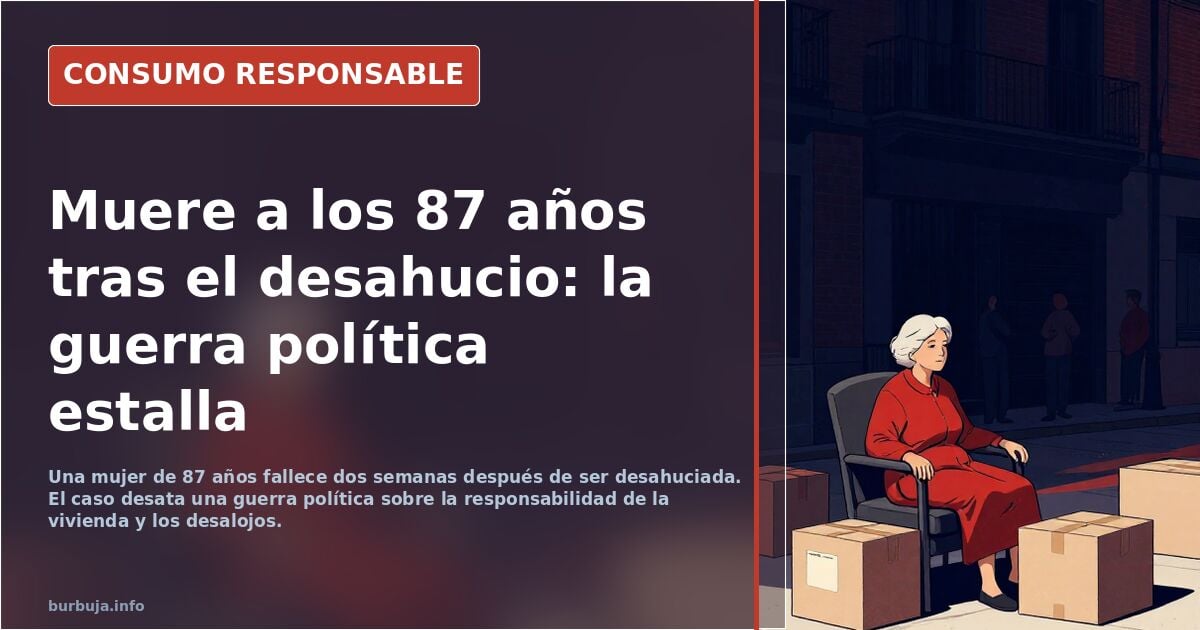
87-year-old tenant dies after eviction in Madrid
Can a government be blamed for a death? The question has been circulating for days after an 87-year-old woman died barely two weeks after the order was executed that removed her from the home she had lived in for decades, in Madrid. The case has peine the dispute over who legislates, who executes and who looks the other way when an eviction affects a vulnerable person. And it has served, unsurprisingly, for each side to hang the corpse on the rival's roof.
What peine with the eviction of the 87-year-old woman in Madrid
The facts, in raw form: a court eviction order is executed, the tenant — 87 years old — leaves the home, and two weeks later she dies. There are different versions about the origin of the eviction. One line of argument holds that the root lies in the 1994 repeal of a subrogation regime for old rents, which would have left the contract without the protection that kept it below market rates. Another points directly to the legal framework of private property and the lack of an affordable rental network to absorb these cases. And a third, the most repeated on social media, spreads the blame among administrations without anyone fully owning up to their share.
What is verifiable is the sequence: eviction, two weeks, death. The rest is interested interpretation.
Who has housing powers: the state or the region
This is where the maze begins. The state has a Ministry of Housing; the Madrid regional government has a department. Eviction orders are issued by the courts, not by the official state gazette. And powers are distributed in such a way that each administration can point at the other without straying entirely from the truth. Some sum it up wryly: the powers belong to Sánchez until a decree appears, at which point they become the region's.
That institutional muddle explains why the case has become a game of political ping-pong rather than a file with clear responsibilities. The housing law and the decrees that sought to limit evictions of vulnerable people have been struck down or blocked at various stages, it is argued, leaving the problem without an operational solution.
The figures being cited and the ones that don't exist
The case intersects with two other recent suicides in L'Hospitalet de Llobregat linked to housing problems, as noted in the public discussion. That pushes the number of deaths related to evictions or missed payments into territory where numbers are scarce and official statistics do not break down by cause. There is no public record quantifying how many people die each year after an eviction. That gap is, in itself, a data point.
The full calculation, with procedural deadlines and overlapping powers, gives a picture of the system that flatters no one. But that requires looking at the file, not the headline.
The political use of victims: everyone does it
The fight to claim a death is as old as politics. Some accuse the central government of having repealed in 1994 the rule that protected old leases; others reply that an eviction is ordered by a judge and carried out by the court commission, not a ministry. There are those who point out that the tenants' union advised the woman and that such groups also bear responsibility if the advice was bad. And there are those who simply ask why a victim's pain only serves for campaigning when it's convenient.
Nobody comes out well. Not those who legislated, nor those who didn't, nor those who executed, nor those who turned the death into a meme.
In the end, the woman died two weeks after being removed from her home. That is the only thing that admits no interpretation. Everything else — who killed her, who let her die, who looked the other way — will remain in the courts, in the facts and in the tweets. And in none of those places does anyone come back to life.
Also available in: Deutsch
Summary of a discussion on Burbuja.info - Foro de economía, actualidad y política., translated from Spanish and reviewed before publication. Read the full discussion (37 replies).
More summaries
-
Free Home Cleaning: The Viral Trend Dividing Public Opinion
An influencer with 450,000 subscribers cleans up houses afflicted by Diogenes Syndrome. Is it charity or a business venture? Dive into the controversy.
-
Madrid loses its flavor: complaints about food quality spread
Potes chorizo is impossible to find in Madrid. Consumers denounce a decline in food quality and the disappearance of traditional shops. Is…
-
Paying €400 a month to live in a partner's owned flat
A man in Madrid faces a dispute over paying €400 monthly to move into his partner's fully owned apartment, sparking debate over shared costs versus rent.
-
DGT Vehicle Report Scam: Charging €24 for an €8 Service
A sponsored website charges €24 for a DGT report that costs €8. The scheme uses Carmen Mariscal's name as the applicant.
-
Ono Vodafone: solid connection, poor sales practices
Customers describe a stable network but impossible cancellations, unsigned contracts and overbilled minutes following Vodafone's acquisition of Ono in Spain.
-
Oil-filled radiators vs thermal emitters: same cost, different heat retention
Oil-filled radiators and thermal emitters use the same amount of energy: 100% of the electricity becomes heat. The difference lies in thermal inertia and the cost per…