
855,000 Young Spaniards Emigrate, Yet the Official Register Misses Them
855,000 young Spaniards have left, but official records fail to capture them. High salaries abroad and housing crises drive this massive brain drain, often going unnoticed by domestic statistics.
English · Original discussion in Spanish · Published
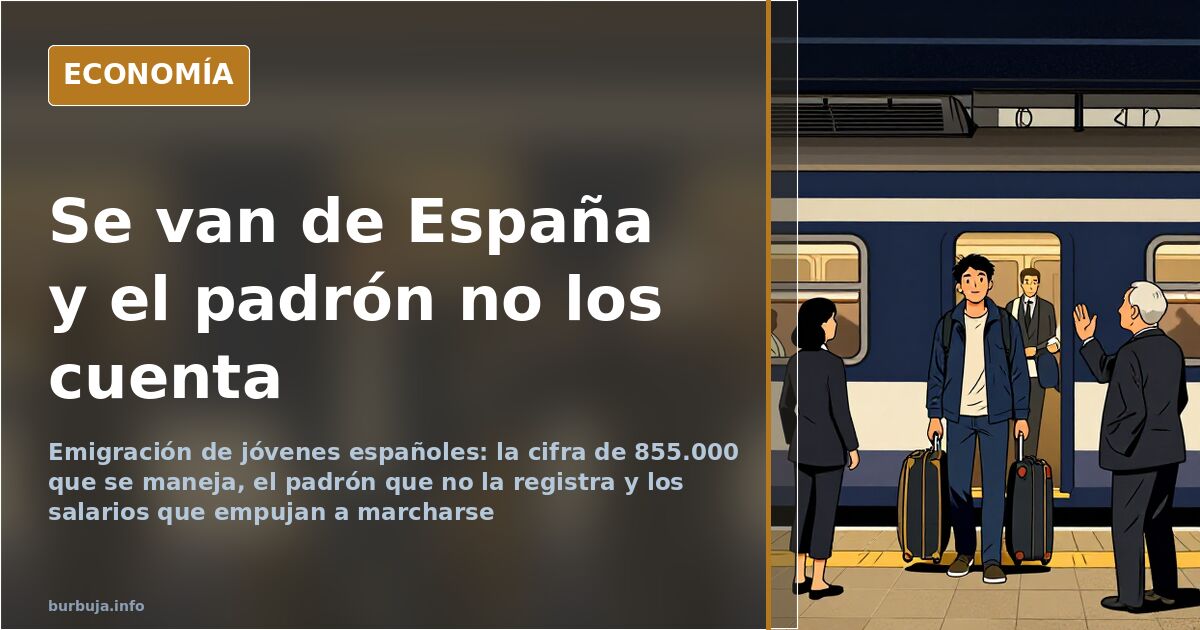
They leave Spain, but the register does not see them: 855,000, perhaps double
How many young Spaniards have left, and how many are about to? No one has the exact figure. The press talks about a massive exodus; official records fall short. Between the two versions lies an old gap: those who emigrate do not always register at the consulate, so they disappear from the statistics without disappearing from the map. Spanish youth emigration is measured blind.
What the register collects and what it does not
The figure of 855,000 Spaniards abroad is widely cited. Some argue the real number is double, and that the Tax Agency—which does locate them to collect taxes—does not cross-reference its data with other administrations. The result is a one-legged photo: we know who pays, not how many left. This gap is not a bureaucratic detail: it determines how much qualified labor is considered lost and how much is considered available. Hence, statistics and the feeling at bus terminals never match.
The measurable wage gap
More than a decade ago, a ruling in Pamplona made public the collective agreement for municipal bus drivers. The lowest earner received 33,000 euros gross. In Navarra’s private sector, the same job paid around 22,000. Eleven thousand euros difference for steering the same wheel, without even crossing a border. This is the gap you can see on paper; the one suspected outside Spain has no payslips, only comparisons. Abroad, the circulating calculation is more ambitious: a bus driver in northern Europe lives better than a Spanish university professor. No paysheet proves it coldly, but it summarizes the mood with precision.
The trade that beats the degree
B2 in a year and a month. That is how long an engineer took to certify the language before leaving, with an argument that appears again and again: the taxes they paid here more than covered the cost of their public education. The prevailing thesis holds that each hour invested in a northern language is worth more than any Spanish university degree. A mechanic or electrician, it adds, is today a safer bet than many degrees: work to get tired of and clients who accept the conditions the professional sets. For those who prefer to stay close to home, the path pointed to is the civil service exam.
Fleeing is not arriving: housing, cold, and queues
Holland, one of the cited destinations, suffers from a colossal housing bubble, plus cold and damp. The warning repeats: those who start leaving now will face a double dose of reality. Better salaries, yes. But the same housing problem, no family, another language, and the label of immigrant. The European labor paradise sold a few years ago is no longer where it was: price hikes have been simultaneous across Europe, narrowing the margin for those hoping to find a gap. Those who look further encounter the empire: according to a circulating calculation, China admits slightly more than one million people per year, and with queues.
Those who left before and those who return
It is not the first time. In the 1970s, Canary Islanders emigrated to Argentina, Venezuela, Africa for oil and mining work, and to England and Germany, taking advantage of tourist flights. Today, the archipelago’s population is double that of half a century ago, and birth rates have fallen from the highest in the country to the lowest. There have never been so many Canary Islanders, nor so many reasons to leave, nor so few willing to pack their bags. The flip side also exists: it is claimed that many return after two months, with empty accounts, after stringing together the worst possible jobs. And some add a startling claim: in proportion to their population, Germans and Dutch emigrate more than Spaniards. Here, leaving is news; there, it is routine.
Disillusionment with the administration
A point where opposite analyses agree is distrust of the public machinery: a tax authority that locates taxpayers to collect and registers that do not talk to each other. In the early 2000s, Spain was among Europe’s safest countries in several indicators. Regarding why this threshold has been lost, there are versions pointing to migration policy, though the available data do not allow establishing this link. The complaint remains in perception and the lack of answers.
With an 11,000-euro difference for the same wheel and a language learned in thirteen months, the exodus needs no propaganda. It happens on its own. The only thing that does not reproduce is the register.
How many young Spaniards have left, and how many are about to? No one has the exact figure. The press talks about a massive exodus; official records fall short. Between the two versions lies an old gap: those who emigrate do not always register at the consulate, so they disappear from the statistics without disappearing from the map. Spanish youth emigration is measured blind.
What the register collects and what it does not
The figure of 855,000 Spaniards abroad is widely cited. Some argue the real number is double, and that the Tax Agency—which does locate them to collect taxes—does not cross-reference its data with other administrations. The result is a one-legged photo: we know who pays, not how many left. This gap is not a bureaucratic detail: it determines how much qualified labor is considered lost and how much is considered available. Hence, statistics and the feeling at bus terminals never match.
The measurable wage gap
More than a decade ago, a ruling in Pamplona made public the collective agreement for municipal bus drivers. The lowest earner received 33,000 euros gross. In Navarra’s private sector, the same job paid around 22,000. Eleven thousand euros difference for steering the same wheel, without even crossing a border. This is the gap you can see on paper; the one suspected outside Spain has no payslips, only comparisons. Abroad, the circulating calculation is more ambitious: a bus driver in northern Europe lives better than a Spanish university professor. No paysheet proves it coldly, but it summarizes the mood with precision.
The trade that beats the degree
B2 in a year and a month. That is how long an engineer took to certify the language before leaving, with an argument that appears again and again: the taxes they paid here more than covered the cost of their public education. The prevailing thesis holds that each hour invested in a northern language is worth more than any Spanish university degree. A mechanic or electrician, it adds, is today a safer bet than many degrees: work to get tired of and clients who accept the conditions the professional sets. For those who prefer to stay close to home, the path pointed to is the civil service exam.
Fleeing is not arriving: housing, cold, and queues
Holland, one of the cited destinations, suffers from a colossal housing bubble, plus cold and damp. The warning repeats: those who start leaving now will face a double dose of reality. Better salaries, yes. But the same housing problem, no family, another language, and the label of immigrant. The European labor paradise sold a few years ago is no longer where it was: price hikes have been simultaneous across Europe, narrowing the margin for those hoping to find a gap. Those who look further encounter the empire: according to a circulating calculation, China admits slightly more than one million people per year, and with queues.
Those who left before and those who return
It is not the first time. In the 1970s, Canary Islanders emigrated to Argentina, Venezuela, Africa for oil and mining work, and to England and Germany, taking advantage of tourist flights. Today, the archipelago’s population is double that of half a century ago, and birth rates have fallen from the highest in the country to the lowest. There have never been so many Canary Islanders, nor so many reasons to leave, nor so few willing to pack their bags. The flip side also exists: it is claimed that many return after two months, with empty accounts, after stringing together the worst possible jobs. And some add a startling claim: in proportion to their population, Germans and Dutch emigrate more than Spaniards. Here, leaving is news; there, it is routine.
Disillusionment with the administration
A point where opposite analyses agree is distrust of the public machinery: a tax authority that locates taxpayers to collect and registers that do not talk to each other. In the early 2000s, Spain was among Europe’s safest countries in several indicators. Regarding why this threshold has been lost, there are versions pointing to migration policy, though the available data do not allow establishing this link. The complaint remains in perception and the lack of answers.
With an 11,000-euro difference for the same wheel and a language learned in thirteen months, the exodus needs no propaganda. It happens on its own. The only thing that does not reproduce is the register.
Also available in: Deutsch
Summary of a discussion on Burbuja.info - Foro de economía, actualidad y política., translated from Spanish and reviewed before publication. Read the full discussion (294 replies).
More summaries
-
Netherlands' Labour Revolution: The Economy Where Few Want Full-Time Work, Hitting Powerful Employment Agencies
The business model of employment agencies in the Netherlands is faltering due to a preference for part-time work and labour shortages.
-
Dutch band's pasodoble in Delft goes viral and stirs emotions
A Dutch band plays the pasodoble 'España cañí' in Delft and the video tops a million views. An analysis of Spanish soft power and its economic impact.
-
Netherlands asks EU to exit common asylum policy
The Dutch government has asked the EU to decouple from common asylum policy. Brussels responds that rules are binding unless the European treaty is amended.
-
Belgium's 9-year rentals: the fact that corrects Wyoming
Belgium's standard long-term rental contract is signed for nine years, not indefinitely: lifetime leases are 1% and require a notary
-
Noocracy proposal: Spain's 225,000 high-IQ citizens would vote
A noocracy model suggests only the 225,000 Spaniards with IQs above 140 should vote. It features rotation and claims to prevent corruption.
-
Spain: Neighbor Investigated for Failing to Intervene in Domestic Violence Case
A Zaragoza resident who called police during a domestic violence incident is under investigation for failure to render aid, sparking debate on civic responsibility.