
80 Daily Opinion Posts, Zero Electoral Data
Activity metrics show 3,538 posts over 44 days: demands for serious electoral analysis clash with constant noise.
English · Original discussion in Spanish · Published
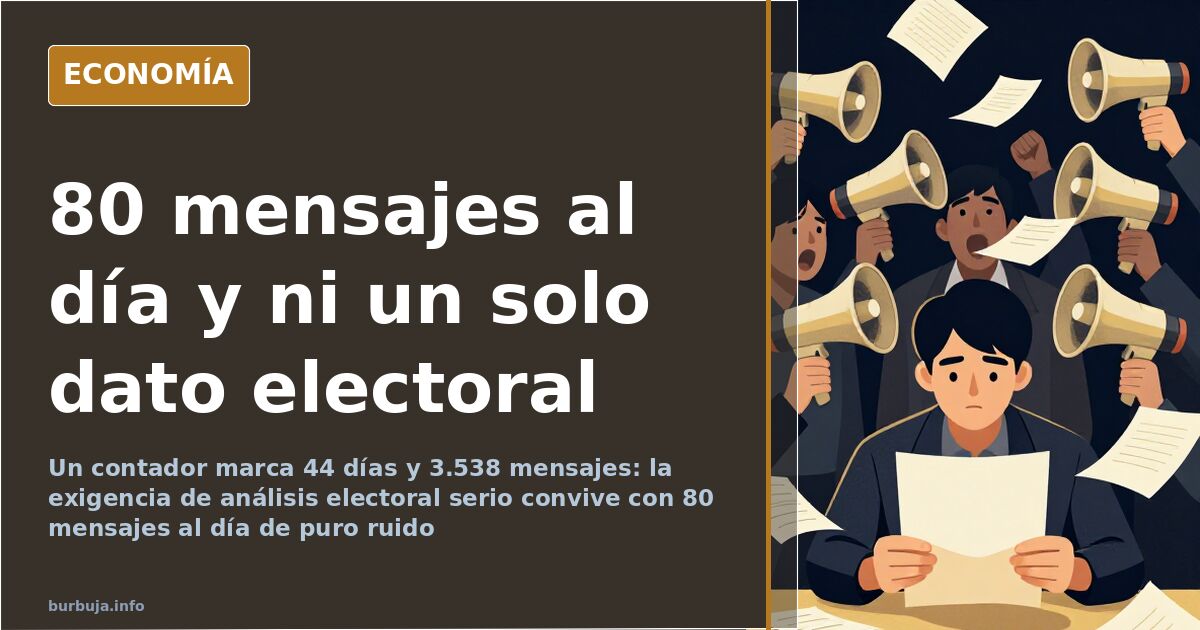
Three Messages an Hour: The Noise Drowning Out Electoral Analysis
An activity tracker records 44 days and 3,538 messages. That is eighty per day; more than three every hour, including sleep hours. This was the pace at which part of public discourse awaited the general election count, and the figure better reflects the state of affairs than any poll: high passion, low arithmetic. Those demanding rigorous electoral analysis with numbers and self-criticism face a torrent of rhetoric where parties are dismissed as "Power Rangers" and broken promises feel like personal insults. Rigor is demanded loudly. Who gets the microphone is another story.
The Invisible Business of Volume: 80 Messages a Day
A recurring suspicion circulates: that the most prolific accounts are not hobbyists with free time, but paid community managers. In terms of audience, the logic is purely financial. Remove those accounts and traffic collapses; collapse traffic and advertising revenue falls. Under this reading, opening ten thousand discussions is not a vice, it is a payroll. There is no proof. It is a hypothesis, and should be treated as such, though the numbers make it plausible.
In a business model based on impressions, volume is not excess: it is raw material. That is why the most repeated defense is so reassuringly weak. Anyone who can type quickly and has wit can dispatch twenty messages in five minutes, the argument goes. True. But whether a single calculation emerges from that flow is another matter. And in economic policy, without figures, there is no analysis: only character.
Demanding a Mature Party, Not Trends
Between venting and analysis lies a specific demand: a serious, mature, and coherent party with clear ideas and an inspiring program. The diagnosis supporting this points to much of the young vote, accused of trinc ridiculous trends and the verbosity of supposed saviors who, deep down, are not as distinct as believed. The result would be an electorate that changes shirts every season and then complains that no one delivers.
Vox and the Wear of Law-and-Order Votes
Part of the hard-right electorate argues that Vox has lost the support of the so-called "people of order" by becoming soft. The reproach has trickled in for years: first a warning, then a lament, now a condemnation. The central argument is that the party abandoned its platform along the way and that those who warned in 2018 about the direction were treated as prophets of doom. The chronology used by this current starts with the strong electoral result in Andalusia in 2019 —the first wake-up call— and continues through years when supporting the party was considered a miscalculation.
Against this thesis, the common reply is that no one promised anything. What was in the platform was visible, and those who didn't want to read simply didn't. It is a circular discussion: the disappointed accuse betrayal, the skeptics accuse naivety. Neither version stands alone, and neither explains why discontent is directed equally against the party and its own voters.
Why Bullfighting Returns to the Forefront of Elections?
Because it is read as a marker of political identity rather than an animal welfare issue. That is the core of the sharpest circulating argument: banning bullfighting in Catalonia was, in this interpretation, a gesture to shed a Spanish tradition, not a notch for animal defense. Hence the cross-reproach: those criticizing the party for its lukewarm stance barely speak up, it is said, when the festival is persecuted in other regions.
The opposing position admits no nuances. Some place bullfighting directly in the incivil sphere and demand the worst possible scenario for its practitioners. Both positions are incompatible and neither contemplates a middle ground: it is either culture or torment. In between remains an electorate that will vote on many other issues, but on this one, they either recognize themselves or leave.
What the Count Won't Fix
The scrutiny arrives with numbers, and interpretation arrives in a hurry. With a production of three messages an hour, the reasonable doubt is no longer whether there will be analysis, but whether anyone will have time to read it before the next batch buries it. The fine calculation of that activity —days active, daily average, messages per hour, and the total accumulated across all accounts attributed to the same hand— yields a figure that disconcerts and that no one bothers to refute with data. And hovering in the texts themselves is an uncomfortable conclusion that no ballot box denies: whatever happens, absolutely nothing is going to change.
Also available in: Deutsch
Summary of a discussion on Burbuja.info - Foro de economía, actualidad y política., translated from Spanish and reviewed before publication. Read the full discussion (142 replies).
More summaries
-
Spain's 2.5 million migrant amnesty: election rigging or hoax?
Claims that Spain's Government will regularise 2.5 million migrants to win elections split the analysis: real plan or hoax? The legal facts and…
-
Spain investiture stalls, raising risk of new elections
Pedro Sánchez lacks seven votes as talks with Catalan separatists stall, increasing the likelihood of a general election repeat.
-
Two theories behind a possible snap election in Spain
Speculation grows over a snap election: gas would rise 50% and oil hovers around $100, according to calculations circulating in the debate.
-
Public Health monitors possible scabies outbreak at Sol camp
Public Health investigates a possible scabies outbreak at the Sol camp. The alert comes without an official case count and leads to political uproar and hoaxes.
-
Living standards at Spain's public universities spark debate
A forum user claims university administrative staff earn nearly double a state civil servant's salary, while non-tenured lecturers chain together short research contracts.
-
US midterm elections: Senate control decides Trump's political fate
One third of Senate seats are up for renewal and impeachment requires an absolute majority. That is why Republican control of the upper chamber shapes Trump's political future.