
75% Link Immigration to Negative Concepts
74.8% of respondents associate immigration with negative concepts, and 54% believe there are more immigrants than INE data shows.
English · Original discussion in Spanish · Published
Three in four associate immigration with a negative concept
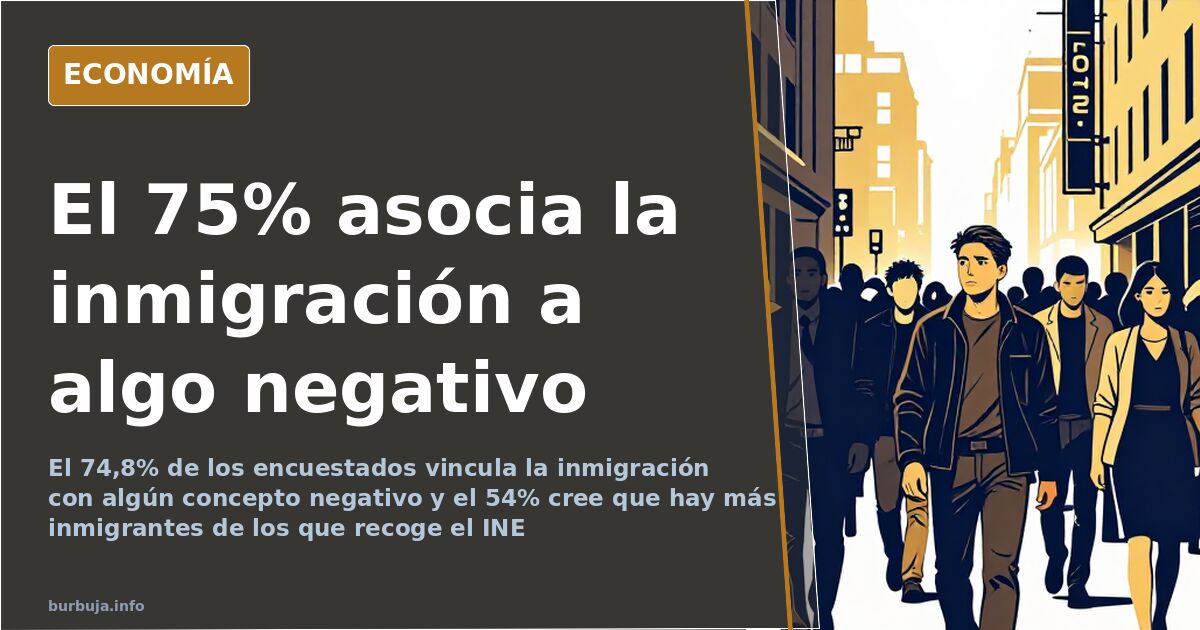
Three in four associate immigration with a negative concept. No nuances or conditionals: 74.8% link it to insecurity, overcrowded public services, conflict, or crime. This is the central finding of the monograph by the 40dB Institute for El País and Cadena SER, based on 2,000 online interviews between September 25 and 27, and the headline that has spread faster than any other figure in the study. The nuance comes later: these same people live, work, and socialize with migrants, and when asked about their direct experience, their assessment improves. The gap between what is seen on the landing and what is believed about the whole country is, in all likelihood, the most uncomfortable finding.
What the data says: 29.5% insecurity and 41% unease
The breakdown allows no friendly reading. Insecurity leads with 29.5%, trinc by overload of public services and resources (27.2%), social conflict (21.2%), crime (19.2%), unemployment (16.7%), and loss of cultural identity (7.6%). Immigration does not appear as the country's top problem; inflation and cost of living, housing, inequalities, and unemployment weigh more. But 41% view it with great unease, 16 points more than a year and a half earlier.
There is a paradox in the table. The percentage associating immigration with something negative (74.8%) is much higher than those who see it as a top concern. The most reasonable reading is that it serves as a deposit for specific discontents—waiting lists, rent, insufficient wages—rather than as an autonomous worry. And a concern that rises sixteen points in eighteen months does not need to top any list to shape public debate.
Why does perception worsen if daily contact improves?
Because opinion on immigration is shaped more by narrative than experience. Personal contact—neighborhood, work, leisure—translates into more positive assessments; general perception, however, moves negatively. The gap is widest among Gen Z men (18 to 27 years old), and there the discourse of Vox and Se Acabó La Fiesta resonates beyond their own voters.
The survey closed in a dense week. The European Council on Foreign Relations and the European Cultural Foundation warned of a "dangerous drift toward an ethnic conception of Europeanness"; the Canary Islands prosecutor's office demanded a reception protocol for unaccompanied migrant minors from the regional government; the Prosecutor's Office peine preliminary proceedings against Valencia's deputy mayor and Vox spokesperson in the City Council for falsely attributing a crime to a migrant, and the PP accepted in Congress a regularization that promoters of the popular legislative initiative called "useless."
54% believe there are more immigrants than there are
Perception of volume is inflated. Spain is home to 48.79 million people, and 9 million were born abroad, 18.5%, according to the latest Continuous Population Statistics from INE. Yet 54% believe the real proportion is higher, the average estimate shoots up to 30.2%, and 57.2% conclude there are "too many." Only 25.5% consider it the right number, and 4.1% think there are too few.
INE's main source is the continuous municipal register, and to register one does not need a residence card, a technical nuance sometimes used to dispute the official figure. Public vocabulary does not help adjust the scale either: "pull effect" and "mass deportations" are expressions the PP leader has used, and "invasion" is used by the Vox leader, terms the report itself links to that inflated perception.
Vote, age, and information source: the map of unease
Concern is unevenly distributed. Seven in ten Vox and SALF voters declare themselves very concerned, 46.4% of PP voters, 29.2% of PSOE voters, 24.1% of Sumar voters, and 15.4% of Podemos voters. 59% of the population considers itself fairly or very informed about the phenomenon, and it is precisely far-right voters who see themselves as best informed.
Television remains the primary source (71%), trinc by newspapers (30.9%). Social media rises to 52.7% among Gen Z, 37.8% among Vox voters, and 57.1% among Alvise Pérez's voters. WhatsApp and Telegram channels show more than ten points difference between the latter and the general average, and influencers or YouTubers gain 6.5 points among those under 28.
If there are too many, who pays pensions in 2053?
This is where narrative clashes with arithmetic. A Banco de España report warned in April that Spain will need 24 million immigrants to maintain the worker-to-retiree ratio in 2053, when INE expects 14.8 million pensioners. The same survey that records that 16.7% associating immigration and unemployment coexists with an aging labor market. The full calculation—how many contributors are needed per pensioner and with what productivity—is in the report, and no slogan resolves it.
Regularization, Canary Islands, and the legal limit of discourse
The legal terrain has also shifted. Hot returns have limitations, and deportations require a procedure that takes time, money, and cooperation from the destination country, making any immediate expulsion slogan hollow. Meanwhile, the regularization of people without incivil records who arrived before November 1, 2021, was processed in Congress with PP support, though promoters of the popular legislative initiative considered it equivalent to the existing social integration mechanism.
Over the whole looms the question of where the line is between opinion and crime. Some argue that pointing out migration volume is not racism; opposite weighs the argument that promoting discrimination against vulnerable groups fits the hate crime definition under current incivil law, hence the proceedings peine against a public official for baselessly linking a crime to a migrant.
With unease rising 16 points in a year and a half and a perception of volume that doubles the real figure, the margin for migration policy to stop being the axis of the next electoral cycle is narrow. The survey, however, leaves a counterweight: direct experience still scores better than the headline. If that gap closes, it will be from above or below, and neither option is neutral.
Three in four associate immigration with a negative concept. No nuances or conditionals: 74.8% link it to insecurity, overcrowded public services, conflict, or crime. This is the central finding of the monograph by the 40dB Institute for El País and Cadena SER, based on 2,000 online interviews between September 25 and 27, and the headline that has spread faster than any other figure in the study. The nuance comes later: these same people live, work, and socialize with migrants, and when asked about their direct experience, their assessment improves. The gap between what is seen on the landing and what is believed about the whole country is, in all likelihood, the most uncomfortable finding.
What the data says: 29.5% insecurity and 41% unease
The breakdown allows no friendly reading. Insecurity leads with 29.5%, trinc by overload of public services and resources (27.2%), social conflict (21.2%), crime (19.2%), unemployment (16.7%), and loss of cultural identity (7.6%). Immigration does not appear as the country's top problem; inflation and cost of living, housing, inequalities, and unemployment weigh more. But 41% view it with great unease, 16 points more than a year and a half earlier.
There is a paradox in the table. The percentage associating immigration with something negative (74.8%) is much higher than those who see it as a top concern. The most reasonable reading is that it serves as a deposit for specific discontents—waiting lists, rent, insufficient wages—rather than as an autonomous worry. And a concern that rises sixteen points in eighteen months does not need to top any list to shape public debate.
Why does perception worsen if daily contact improves?
Because opinion on immigration is shaped more by narrative than experience. Personal contact—neighborhood, work, leisure—translates into more positive assessments; general perception, however, moves negatively. The gap is widest among Gen Z men (18 to 27 years old), and there the discourse of Vox and Se Acabó La Fiesta resonates beyond their own voters.
The survey closed in a dense week. The European Council on Foreign Relations and the European Cultural Foundation warned of a "dangerous drift toward an ethnic conception of Europeanness"; the Canary Islands prosecutor's office demanded a reception protocol for unaccompanied migrant minors from the regional government; the Prosecutor's Office peine preliminary proceedings against Valencia's deputy mayor and Vox spokesperson in the City Council for falsely attributing a crime to a migrant, and the PP accepted in Congress a regularization that promoters of the popular legislative initiative called "useless."
54% believe there are more immigrants than there are
Perception of volume is inflated. Spain is home to 48.79 million people, and 9 million were born abroad, 18.5%, according to the latest Continuous Population Statistics from INE. Yet 54% believe the real proportion is higher, the average estimate shoots up to 30.2%, and 57.2% conclude there are "too many." Only 25.5% consider it the right number, and 4.1% think there are too few.
INE's main source is the continuous municipal register, and to register one does not need a residence card, a technical nuance sometimes used to dispute the official figure. Public vocabulary does not help adjust the scale either: "pull effect" and "mass deportations" are expressions the PP leader has used, and "invasion" is used by the Vox leader, terms the report itself links to that inflated perception.
Vote, age, and information source: the map of unease
Concern is unevenly distributed. Seven in ten Vox and SALF voters declare themselves very concerned, 46.4% of PP voters, 29.2% of PSOE voters, 24.1% of Sumar voters, and 15.4% of Podemos voters. 59% of the population considers itself fairly or very informed about the phenomenon, and it is precisely far-right voters who see themselves as best informed.
Television remains the primary source (71%), trinc by newspapers (30.9%). Social media rises to 52.7% among Gen Z, 37.8% among Vox voters, and 57.1% among Alvise Pérez's voters. WhatsApp and Telegram channels show more than ten points difference between the latter and the general average, and influencers or YouTubers gain 6.5 points among those under 28.
If there are too many, who pays pensions in 2053?
This is where narrative clashes with arithmetic. A Banco de España report warned in April that Spain will need 24 million immigrants to maintain the worker-to-retiree ratio in 2053, when INE expects 14.8 million pensioners. The same survey that records that 16.7% associating immigration and unemployment coexists with an aging labor market. The full calculation—how many contributors are needed per pensioner and with what productivity—is in the report, and no slogan resolves it.
Regularization, Canary Islands, and the legal limit of discourse
The legal terrain has also shifted. Hot returns have limitations, and deportations require a procedure that takes time, money, and cooperation from the destination country, making any immediate expulsion slogan hollow. Meanwhile, the regularization of people without incivil records who arrived before November 1, 2021, was processed in Congress with PP support, though promoters of the popular legislative initiative considered it equivalent to the existing social integration mechanism.
Over the whole looms the question of where the line is between opinion and crime. Some argue that pointing out migration volume is not racism; opposite weighs the argument that promoting discrimination against vulnerable groups fits the hate crime definition under current incivil law, hence the proceedings peine against a public official for baselessly linking a crime to a migrant.
With unease rising 16 points in a year and a half and a perception of volume that doubles the real figure, the margin for migration policy to stop being the axis of the next electoral cycle is narrow. The survey, however, leaves a counterweight: direct experience still scores better than the headline. If that gap closes, it will be from above or below, and neither option is neutral.
Also available in: Deutsch
Summary of a discussion on Burbuja.info - Foro de economía, actualidad y política., translated from Spanish and reviewed before publication. Read the full discussion (1047 replies).
More summaries
-
Núcleo Nacional registers as party: new option or electoral mirage?
Núcleo Nacional officially registers as a party. A new nationalist option or a police ploy to split the right-wing vote?
-
The Elite Education of Tenant Spokespeople Sparks Controversy
Controversy erupts as the elite international education backgrounds of prominent tenant movement spokespeople are revealed, challenging their narrative of precarity.
-
Trump's ICE Officers Shoot Protester in Minneapolis
In Minneapolis, a Trump ICE agent shot and killed a white US citizen during protests. Two deaths in January led to the withdrawal of 700 agents amid civil war fears.
-
Madrid rental listings drop 20% after decree
Forum users track Madrid's rental supply falling from 11,815 to 9,398 ads in one day. They blame the new decree. Barcelona has only 680 long-term rentals.
-
Spain's Debate: Voting vs. Abstention in Upcoming Elections
A forum debates voting as a lesser evil versus abstaining as punishment. In 2019, with the lowest turnout since 1978 (66%), Sánchez reached La Moncloa.
-
Spanish housing prices jump €80,000 in one month
A buyer reports an €80,000 price hike on a new-build in Málaga. Supply shortages and high demand strain the Spanish market.