
62.7% of Spain's pension spending goes to women: the figure reigniting the gap debate
62.7% of Spain's pension budget goes to women, while men would have contributed most of the social security payments. The figure reopening the gender pension gap debate.
English · Original discussion in Spanish · Published
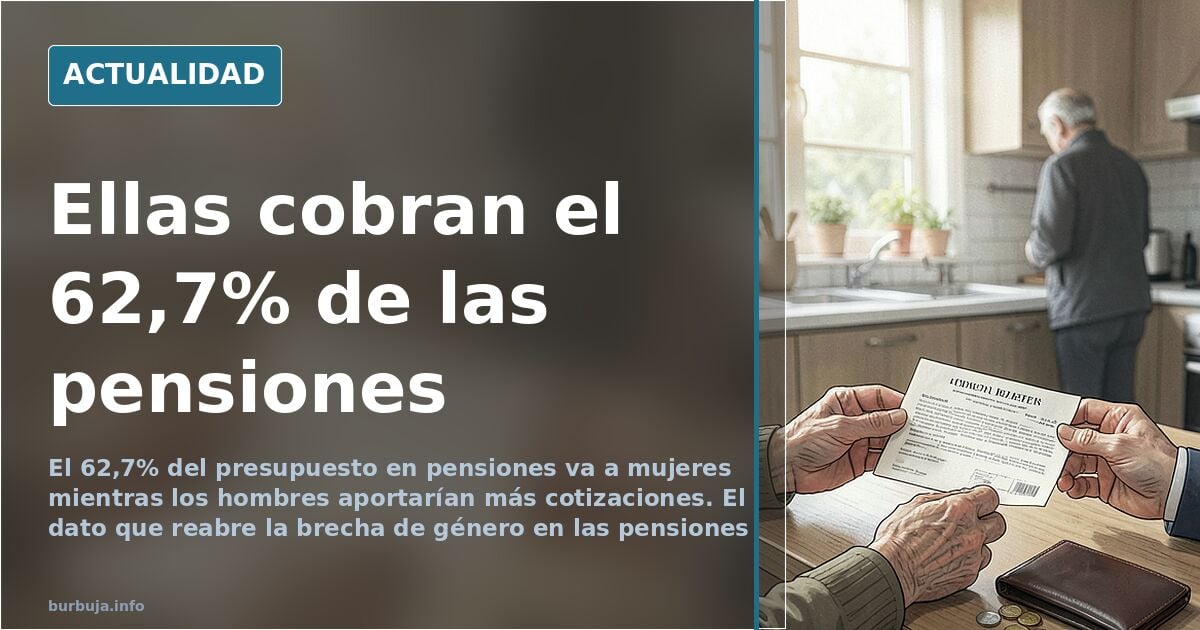
62.7% of pension spending goes to women, according to the figure sparking the controversy
One figure is enough to light the fuse: women receive 62.7% of the pension budget, while men would have paid in the bulk of contributions. The paradox —more male contributions, more female spending— is the starting point of an argument gaining traction: the gender pension gap does exist, but it is men who are discriminated against. This is no minor debate in a country where the public pay-as-you-go system depends on the balance between contributions coming in and benefits going out.
The argument rests on three pillars. First, women's longer life expectancy: they collect benefits for more years without any surcharge on contributions or cut in benefits. Second, risky jobs: more men die at work and pay contributions without ever reaching retirement. Third, the survivor's pension, which in many cases is combined with the retirement pension up to the maximum pension cap, with cases approaching 3,000 euros per month in total.
Who introduced the combination of survivor's and retirement pensions
The controversy quickly becomes political. The PSOE (Spain's Socialist Party) is blamed for allowing the survivor's pension to be combined with the retirement pension up to the maximum pension cap, a regulatory change which, according to this view, widened the imbalance between what is paid in and what is received. The conclusion drawn is blunt: the public system treats men as net contributors and women as net beneficiaries.
Some go further and argue the problem is not one party but the system itself, extending across the entire OECD, and that women used to offset it through birth rates. Demographics appear here as the hidden variable: if birth rates collapse, the intergenerational balance sustaining the system cracks. The warning is explicit: they'll stop having children and you'll see where the system goes.
Vox and the male vote that gets nothing in return
The conversation drifts toward politics. Vox is accused of marketing women's insecurity on the streets while ignoring men, who would be its main pool of voters. The criticism is harsh: the party would take its male electorate for granted and would only be marginally less bad than the alternative. As for the path of segregation —stop interacting with women— the response is realistic: women and men share work, coffee and the street; a society separated by sens is unviable in any historical context.
The core issue remains unresolved: if the system penalizes those who contribute most and collect least, the question is not who is robbing whom, but how much a pay-as-you-go system under that demographic strain can endure. Or does someone believe contributions grow on their own?
Summary of a discussion on Burbuja.info - Foro de economía, actualidad y política., translated from Spanish and reviewed before publication. Read the full discussion (28 replies).
More summaries
-
Spain's 2027 pension rise won't come close to 8% under the CPI formula
The CPI formula puts the average pension increase at 3.33%, not the feared 8%. Reaching that figure would require October and November to exceed 30% year-on-year.
-
Cayetana Álvarez de Toledo on the Price of Freedom: Privilege vs. Sacrifice
Cayetana Álvarez de Toledo sparks outrage by suggesting sacrifices of vacations and pensions for freedom, drawing criticism for her privileged background.
-
Vito Quiles and Pensioner Defending PSOE: Vote Analysis
A pensioner tells Vito Quiles to 'learn' in a viral clip, sparking debate on PSOE votes, pensions, and generational gaps.
-
France: looters leave the ham behind
Amid the looting in France, the absence of ham from the loot has turned into a conspiracy theory with no official evidence to back it up.
-
Democracy according to Chinese internet users
A text spreading on Chinese social media uses a farm as a metaphor: the farmer advises giving animals votes so they believe they are in charge. The key lies in who decides.
-
The Chinese myth of the doer politician versus Europe's actor-politicians
Merit-based advancement in China does exist, but the Great Leap Forward and the war on sparrows left tens of millions of dead in their wake.