
60-euro ham in Spain: what you can actually get
For 60 euros there is no acorn-fed Ibérico ham: the market offers white pork, cebo-fed shoulder cuts and occasional deals. Here is what you can actually buy.
English · Original discussion in Spanish · Published
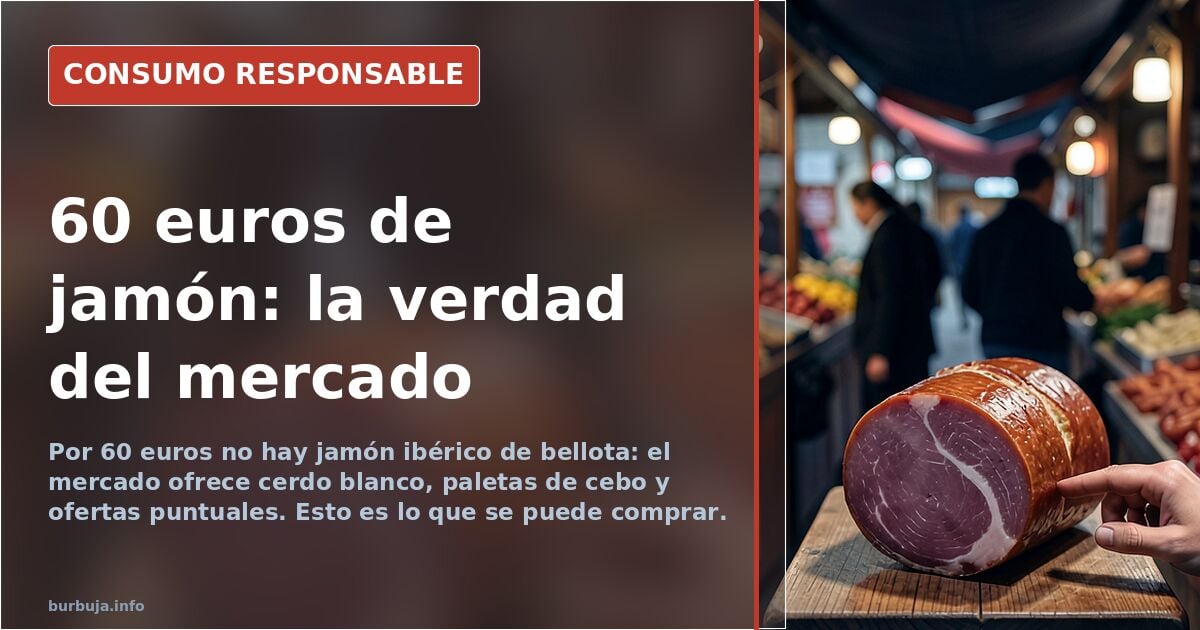
A ham for 60 euros: what you get and what you don't
Sixty euros for a whole eight-kilo piece. That is what a buyer was asking for, hoping to treat his family, and what he got first was a reality check: for that money there is no Ibérico ham, no acorn-fed ham, none of the ones advertised with four J's. The conversation turned to a more interesting question: what can you actually buy with that budget, where, and with what guarantees.
The first answer anyone asking about a 60-euro ham gets is a figure: the kilo. Many read the request as a price per kilogram, not per piece. Once it is clarified that it is 60 euros for the whole ham, the range of possibilities narrows to a specific territory: white pork, cebo-fed Ibérico shoulder cuts and pieces from local producers. No acorn-fed anything.
What you can buy for 60 euros
The most common answer is that for that money you get a white pork ham, not Ibérico. That includes Serrano hams from areas with a curing tradition, such as Teruel or Calamocha, and pieces from small mountain producers who sell at modest prices. The argument that wins the day is that a well-cured white pork ham can be excellent for sandwiches, tapas and croquettes, without the price hurting.
The alternative is cebo-fed Ibérico shoulder. Several buyers maintain that for 60 euros you can find a cebo-fed shoulder, weighing between five and six kilos, from areas such as Salamanca or Extremadura. The difference from a ham is one of size and price, not of category: it is still cebo-fed, not acorn-fed. And some warn that supermarket shoulder cuts do not match those from small producers.
The warning about supermarket hams
The most repeated warning is to avoid cheap hams from large supermarket chains. One specific case: a piece bought at a hypermarket that turned out raw and bloody when peine, and rotted within four days. The diagnosis is that the curing process was accelerated and the result is not a cheap ham, but a badly cured one.
Against that, the recommendation is to go to small artisan slaughterhouses, neighbourhood specialist shops or local producers. The recurring thesis is that a trustworthy seller matters more than the brand or the designation of origin. An expensive ham guarantees nothing; a cheap one guarantees nothing either. What does guarantee something is who cures it and who sells it.
The real price of acorn-fed Ibérico
The figures quoted by the most experienced buyers put recebo Ibérico ham (a mid-grade Ibérico ham) starting at 90 or 100 euros. Acorn-fed ham, for less than 150 euros, is nowhere to be found. And some go further: a five- or six-kilo piece of the good stuff, cured for 24 months, runs around 4,000 or 5,000 euros. Anything below that is cebo-fed, mixed-breed or rapidly cured.
That scale explains why the request for 60 euros for eight kilos causes bewilderment. It is not that ham at that price does not exist; it is that what exists is not what the buyer imagines when thinking of treating himself. The distance between desire and market is measured in categories: white pork versus Ibérico, cebo versus acorn-fed, shoulder versus ham.
Occasional deals and the luck factor
There is a separate chapter for hypermarket markdowns. One buyer describes finding two cebo-fed Ibérico hams at 49 euros each, discounted to free up shelf space before the Christmas season. Another says he bought a dehesa Ibérico ham for 32 euros because it was mislabelled as a store brand and he had a 20% coupon. These are isolated cases, not a shopping strategy.
The practical conclusion drawn is that a 60-euro budget lets you buy, but forces you to choose: either accept quality white pork, or look for a cebo-fed Ibérico shoulder, or wait for a specific offer. What it does not allow is buying acorn-fed. And in a country where ham is almost a religion, that remains a matter of debate.
The question left hanging is whether the buyer who wants to treat himself with 60 euros should accept the market's scale, or whether, as some argue, well-cured white pork deserves more respect than it gets. The answer depends on whether you are buying a brand or buying a ham.
Also available in: Deutsch
Summary of a discussion on Burbuja.info - Foro de economía, actualidad y política., translated from Spanish and reviewed before publication. Read the full discussion (61 replies).
More summaries
-
He paid €75 for an Ibérico shoulder online and got his order 10 days later
A customer paid €75 for an Ibérico shoulder online. The order arrived 10 days later, with no reply to emails or calls. A genuine shoulder costs around €200.
-
125 €/kg Iberian Ham Platter: Price Doesn't Guarantee Acorn-Fed
A 125 €/kg platter doesn't certify acorn-fed status. Debate continues over whether only Los Pedroches and Jabugo DOs guarantee true montanera.
-
Mixed changing rooms in gyms: what we know and what we don't
Several users claim that a mixed changing room is the area with lockers and benches, while changing and showering take place in individual cubicles.
-
AliExpress loses its crown: Spain's 3€ fee kills the bargain
The 3€ per-item tariff and the 2€ fee coming in November have crushed the Chinese bargain: low-value sales fall 95% and Amazon retakes the price crown.
-
Puppy Linux: 300 MB to revive old PCs, but 32-bit support is gone
Puppy Linux boasts a 300 MB footprint, but its latest release is 64-bit only — and the machines that truly need an ultralight system are usually 32-bit.
-
Forum user recommends a 20 euro electric bed warmer for winter
A user suggests using a 20 euro bed warmer that plugs in for one minute and stays warm for up to two hours to cut down on heating use.