
57% of Spanish women consider single motherhood
A poll reveals 57% of women contemplate single motherhood, with 20% of fertility clinic patients already being solo parents, sparking debate on costs and childcare.
English · Original discussion in Spanish · Published
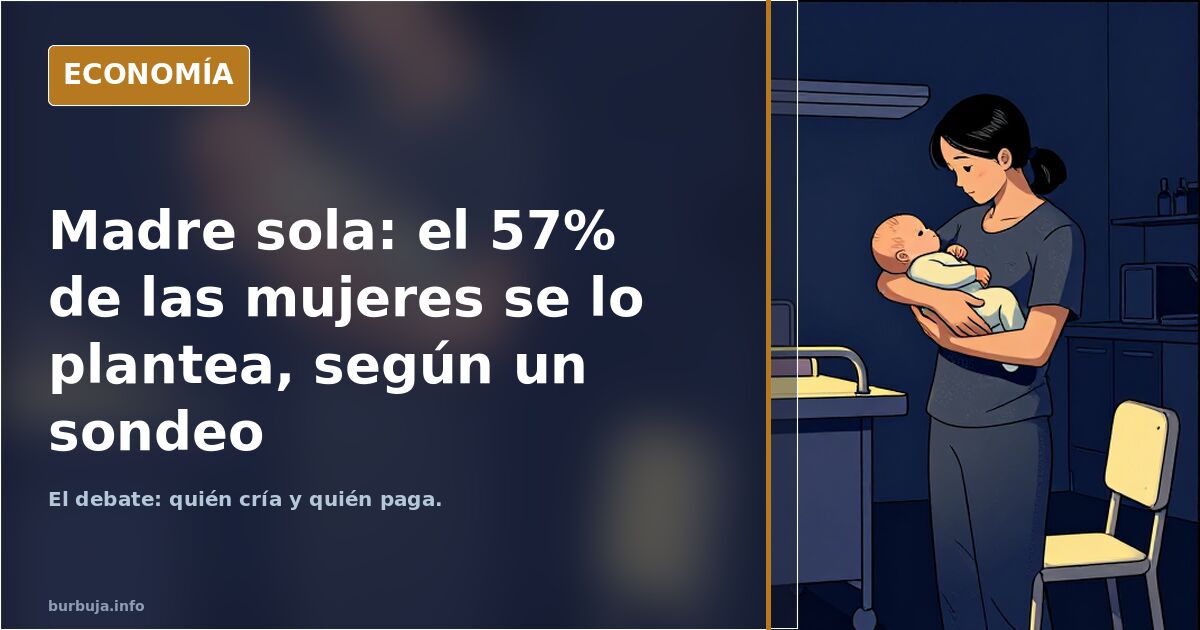
57% of women consider single motherhood: who pays for upbringing
Can you raise a child without a partner? 57% of women say they consider it if they reach a certain age without a partner or do not desire one. And it is not a laboratory hypothesis: the 20% of women who visit fertility clinics are already solo parents. The figure was put on the table by Solidaridad Intergenerational and opens a discussion that goes far beyond sarracena. It is, above all, a matter of money, time, and who bears the work that two adults used to share.
What lies behind the 57%
This reading has a historical dimension. Previously, those who did not find a partner stayed waiting forever, even if they wanted children. Some got pregnant and raised them alone, whether because the father disappeared or because she wanted him to. The difference, according to this explanation, is that the woman who wants to be a mother no longer needs to choose a man she does not want as her children's father. She also does not have to endure disputes, shared custody, or divorces.
The second aspect is less epic. Those who visit a clinic at forty usually have a backlog of relationships that did not work out, jobs that devour hours, or decisions that were postponed. In the testimonials, the profile that emerges is not that of an irresponsible person: it is that of a woman with a job and a life that was already functioning alone. And the process is not a whim from a weekend: a stimulation yields a few embryos, and if there is no more margin, one must repeat or wait with what remains.
Who raises when there is only one mother?
Here begins the uncomfortable part. In the cases described, the grandmother acts as a second adult: she gives breakfast, takes the child to school, picks him up, and gives him a snack while the mother chains her workday and daycare. "The mother is the grandmother," summarizes one testimonial. It works as long as the grandmother holds up. And when that network does not exist, some argue that the State takes over the baton: daycare, subsidies, consecutive leaves, and, ultimately, a public bill that someone signs.
From there comes the most repeated objection. Some argue that the solo mother is not alone: she has a substitute provider, and that provider is the taxpayer. Others, however, defend that if few children are born, any formula that adds births deserves support and not reproach.
The economic cost of raising alone
The numbers are not friendly. Raising a child with two salaries is already tight; with one, the arithmetic changes abruptly. "Living alone on Spanish salaries is complicated. Living alone and having a child on Spanish salaries is something within reach of very few people," points out a message. Housing, food, extracurriculars, and work-life balance do not understand empowerment. Nor do they understand eight-hour shifts without flexibility, which is the reality for most.
And there is a practical derivative: time. A single person cannot double themselves. When the child is sick, when there is a school meeting, when an extracurricular activity falls at five, there is no second option. That is the real bottleneck, above the ideological noise.
The child without a father: the argument that does not fade
The core of the rejection points to minors. It is argued that growing up without a paternal figure leaves a gap that the child will eventually seek, and overwhelmed kids are cited, always in daycare or with grandparents, who ask about a father who does not exist. The other trench responds with biographies: those who grew up without a father and turned out functional, those who had an idyllic childhood and ended up badly. The evidence each side considers conclusive is precisely what the other discards.
The background is demographic. In the debate, a fertility rate of 1.2 is mentioned, with half attributed to the immigrant population, to remind us that this country cannot afford to waste births. This figure serves both to defend and to attack: if every child counts, why put obstacles in the way of a mother who wants to have one alone?
And men who want to be solo parents?
The question appears in the thread once and remains unanswered. And hovers the insinuation that behind the decision there is a material calculation, in addition to the idea that the missing male provider is ultimately put by the State.
The discussion, at its core, is not about women or children. It is about who signs the check when the traditional model no longer adds up. And that check, no matter how disguised as individual freedom, always ends up going through the cashier.
Can you raise a child without a partner? 57% of women say they consider it if they reach a certain age without a partner or do not desire one. And it is not a laboratory hypothesis: the 20% of women who visit fertility clinics are already solo parents. The figure was put on the table by Solidaridad Intergenerational and opens a discussion that goes far beyond sarracena. It is, above all, a matter of money, time, and who bears the work that two adults used to share.
What lies behind the 57%
This reading has a historical dimension. Previously, those who did not find a partner stayed waiting forever, even if they wanted children. Some got pregnant and raised them alone, whether because the father disappeared or because she wanted him to. The difference, according to this explanation, is that the woman who wants to be a mother no longer needs to choose a man she does not want as her children's father. She also does not have to endure disputes, shared custody, or divorces.
The second aspect is less epic. Those who visit a clinic at forty usually have a backlog of relationships that did not work out, jobs that devour hours, or decisions that were postponed. In the testimonials, the profile that emerges is not that of an irresponsible person: it is that of a woman with a job and a life that was already functioning alone. And the process is not a whim from a weekend: a stimulation yields a few embryos, and if there is no more margin, one must repeat or wait with what remains.
Who raises when there is only one mother?
Here begins the uncomfortable part. In the cases described, the grandmother acts as a second adult: she gives breakfast, takes the child to school, picks him up, and gives him a snack while the mother chains her workday and daycare. "The mother is the grandmother," summarizes one testimonial. It works as long as the grandmother holds up. And when that network does not exist, some argue that the State takes over the baton: daycare, subsidies, consecutive leaves, and, ultimately, a public bill that someone signs.
From there comes the most repeated objection. Some argue that the solo mother is not alone: she has a substitute provider, and that provider is the taxpayer. Others, however, defend that if few children are born, any formula that adds births deserves support and not reproach.
The economic cost of raising alone
The numbers are not friendly. Raising a child with two salaries is already tight; with one, the arithmetic changes abruptly. "Living alone on Spanish salaries is complicated. Living alone and having a child on Spanish salaries is something within reach of very few people," points out a message. Housing, food, extracurriculars, and work-life balance do not understand empowerment. Nor do they understand eight-hour shifts without flexibility, which is the reality for most.
And there is a practical derivative: time. A single person cannot double themselves. When the child is sick, when there is a school meeting, when an extracurricular activity falls at five, there is no second option. That is the real bottleneck, above the ideological noise.
The child without a father: the argument that does not fade
The core of the rejection points to minors. It is argued that growing up without a paternal figure leaves a gap that the child will eventually seek, and overwhelmed kids are cited, always in daycare or with grandparents, who ask about a father who does not exist. The other trench responds with biographies: those who grew up without a father and turned out functional, those who had an idyllic childhood and ended up badly. The evidence each side considers conclusive is precisely what the other discards.
The background is demographic. In the debate, a fertility rate of 1.2 is mentioned, with half attributed to the immigrant population, to remind us that this country cannot afford to waste births. This figure serves both to defend and to attack: if every child counts, why put obstacles in the way of a mother who wants to have one alone?
And men who want to be solo parents?
The question appears in the thread once and remains unanswered. And hovers the insinuation that behind the decision there is a material calculation, in addition to the idea that the missing male provider is ultimately put by the State.
The discussion, at its core, is not about women or children. It is about who signs the check when the traditional model no longer adds up. And that check, no matter how disguised as individual freedom, always ends up going through the cashier.
Also available in: Deutsch
Summary of a discussion on Burbuja.info - Foro de economía, actualidad y política., translated from Spanish and reviewed before publication. Read the full discussion (376 replies).
More summaries
-
Latin American Migration Revives Spain's Welfare State Debate
A video showing Latin American families arriving in Spain reignites the welfare state debate, with a 90% claim but no source.
-
Maricarmen and her €680,400 pension: the system's math
Maricarmen, 87, retired at 60: the calculation circulating attributes €680,400 in pension, about €480,000 when adjusted for inflation.
-
Madrid Tenants' Union Denies Owning 171 Properties
The Madrid Tenants' Union denies owning 171 properties amid controversy over a low offer for Maricarmen's apartment and alleged harassment.
-
Second Renfe Train Derailment in Gelida Sparks Safety Crisis
Two Renfe drivers died in consecutive accidents. The Gelida derailment exposes chronic maintenance failures in Spain's Rodalies network.
-
Hantavirus Cruise Outbreak Sparks Pandemic Fears in Spain
WHO alerts on hantavirus outbreak aboard MV Hondius in Spanish waters, raising doubts about a new pandemic or media manipulation.
-
Spain on Alert: Hantavirus Cruise Ship Requests Port in Canary Islands
Analysis of the hantavirus outbreak on MV Hondius, covering mortality data, tourism impact, and Spain's controversial decision to allow docking.