
44-hour delivery job pays 920 euros net with 38-hour contract
A 38-hour contract for 44 hours of work: 920 euros net in 14 payments, including Saturdays and 300 free hours a year.
English · Original discussion in Spanish · Published
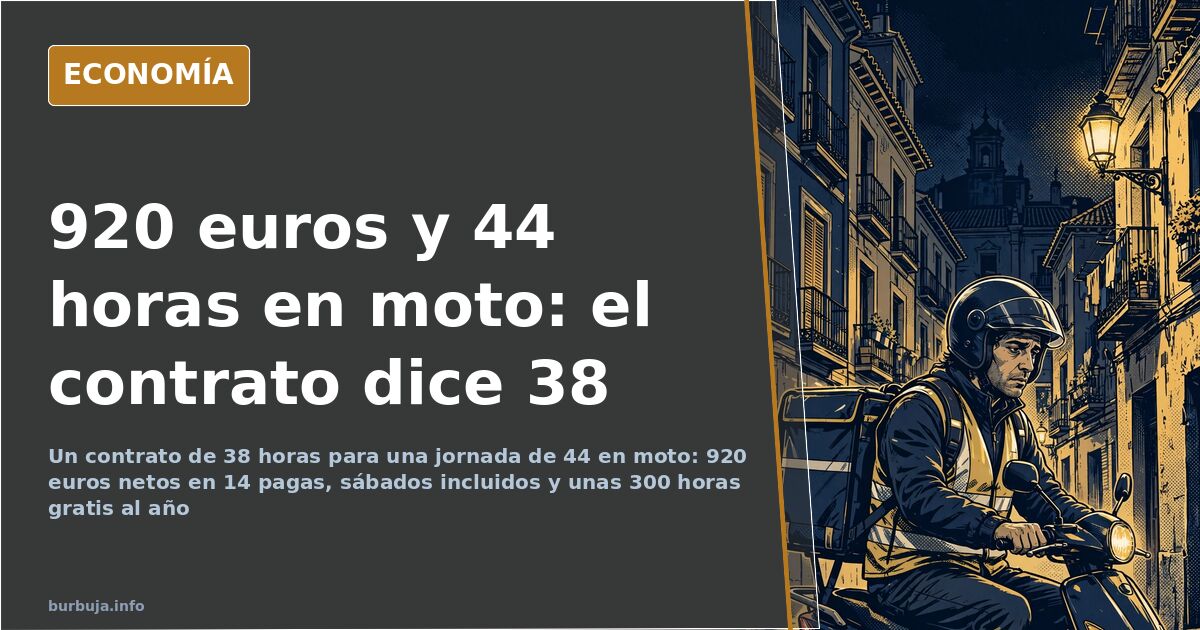
44 hours of delivery work for 920 euros net: the contract states 38
A 38-hour weekly contract for 44 hours of work. The difference is not a typo: it is six free hours each week, around 300 a year, for a job paying 920 euros net in 14 installments and requiring riding a motorcycle from Monday to Saturday. The offer — delivering car parts — was presented by a 36-year-old man who does not yet know whether to show up on the first day.
The interprofessional minimum wage was set at 1,080 euros per month in 14 payments, according to the figure cited in the debate, which is higher than the net amount in this offer. This is where the problem begins.
What the position includes: split shift, Saturdays, and company motorcycle
The job is motorcycle delivery of car parts. The schedule is split: 9:30 a.m. to 1:00 p.m. and 3:00 p.m. to 7:30 p.m. from Monday to Friday, with Saturdays from 10:00 a.m. to 2:00 p.m. This adds up to 44 weekly hours of presence, yet the document to be signed is for 38 hours.
The company provides the motorcycle, according to confirmation from the interested party himself. This rules out the most expensive risk of this type of employment — using one’s own vehicle in the production circuit — although it leaves other aspects unclear that the offer does not detail: who covers fuel, who pays for maintenance, and whether there is a hazard pay bonus. None are specified.
1,500 kilometers per month: the cost of riding a 125cc scooter
Wear and tear has a number, and the calculation circulating in the thread is blunt: about 22 weekly trips of 15 kilometers each result in 1,500 kilometers per month and 18,000 per year. With a standard 125cc scooter, fuel and maintenance would equal two annual salaries, and the vehicle would be scrapped every two years.
This exercise assumed a private motorcycle, something the interested party ruled out from the start. The figure, however, measures the real scale of the operation: it is not a neighborhood delivery.
Six free hours each week: 300 per year
The gap between working hours and contracted hours is where the discussion focused most. Forty-four hours worked for 38 paid hours leaves six unpaid hours weekly; over 52 weeks, the round calculation made in the thread is 300 hours gifted per year. The recommendation that appears repeatedly is to take the offer to the Labor Inspectorate before signing anything.
There is a nuance not to be lost: the split shift of morning and afternoon is, in itself, a second cost. It splits the day in two, makes eating out more expensive, and leaves little room for a second job or evening training. No one pays this extra cost.
Stepping stone or trap? The two readings of the same contract
One current of thought argues that one should take it. The argument is not defeatist: enter, learn the trade, maintain relationships with repair shops and parts stores, be reliable, and use the position as a doorway to something better within the sector — workshop cleaning, oil changes, errands, covering absences —. The repeated advice is to put physical safety and integrity above everything else.
The opposing reading is harsher: a salary below the minimum, without hazard pay, with the motorcycle on the street all day and a split shift is not accepted even out of necessity. The threshold considered a reasonable floor is around 1,300 euros net per month, a figure this contract does not even approach. And there is a third, more skeptical path: earning 920 euros guarantees nothing, so better a subsidy, the family home, or any other formula while something different appears.
Between these two views emerges an uncomfortable fact: the position requires no qualification. This lowers labor costs and explains why the salary stays where it is. It also complicates exit, as one competes with anyone.
Who is on the other side: 36 years old, 50,000 euros saved, and two years without finding anything
The portrait of the interested party disconcerts those expecting someone without alternatives. He is 36 years old, lives with his mother, pays no rent, and expects to inherit. He has 50,000 euros from an unspecified source and admits he does not need the job to eat: car, motorcycle, clothes, and weekend outings consume money while he has gone two years without income.
In other words, he does not seek the salary. He seeks to leave home, have an occupation, and stop feeling that the market has already discarded him. On this basis, the calculation changes: the cost of accepting is not only the low salary but the two years of blank curriculum that lead to the same place.
With 1,080 euros as the minimum reference, 920 as the offer, and 1,300 as the claimed floor, the gap is paid by whoever signs. At what point does a bad job stop being a bad job and become the only door still open?
Also available in: Deutsch
Summary of a discussion on Burbuja.info - Foro de economía, actualidad y política., translated from Spanish and reviewed before publication. Read the full discussion (224 replies).
More summaries
-
More and more workers in Spain are earning close to the minimum wage
Spain's minimum wage (SMI) has risen 47% since 2018, but wage compression is dragging engineers down to labourers' pay. An analysis of the tax trap and workplace absenteeism.
-
Spain proposes equalizing minimum wages in women's football
The Spanish government plans to equalize minimum salaries in women's and men's football, highlighting a stark disparity between 16,000 and 180,000 euros.
-
Eva Cárdenas and the property business dragging Feijóo into the spotlight
A company set up with €3,000 in capital and €300,000 in annual profits: Eva Cárdenas's property business reopens the debate on real estate and politics in Spain.
-
Engineer arrested after brutal beating leaves man in coma in Valencia, Spain
A 46-year-old man is in a coma after being brutally assaulted in Valencia, Spain. The suspected attacker, an engineer, has been arrested. The motive is under investigation.
-
Berlin Pride vehicle attack leaves one woman dead and 29 injured
A driver with Islamist links ploughed into the crowd after Pride in Berlin, killing one woman and injuring 29. The debate over immigration and security is…
-
EU banking reform: free credit or a hidden bailout?
The EU proposes a banking reform to free up billions and boost lending, but scepticism is running high over the use of savings to fund public debt.