
40% of those rowing do it on the night shift, forum user claims
A forum user claims that 40% of those who work do so on the night shift. Most are rowing, but many do so reluctantly or thanks to an inheritance.
English · Original discussion in Spanish · Published
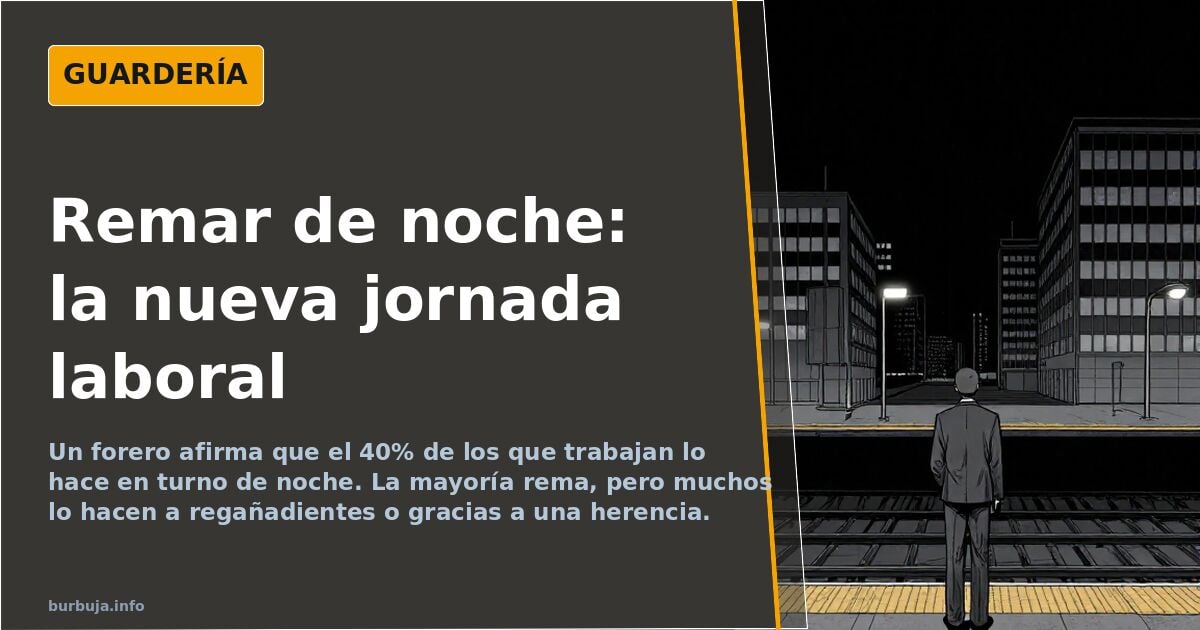
A forum user claims that 40% of those rowing do it on the night shift
One question has been circulating on digital gossip corners these days: how many people are not rowing right now? Judging by the testimonies gathered, the answer is that most are rowing, but many do so reluctantly. The rowing metaphor —working— serves to portray a Spain where effort does not always translate into reward. Only 20% say they are not rowing at all, and within that group, a significant share gets by thanks to an inheritance or a small benefit that lets them live without lifting a finger. The rest either row, or pretend to row.
How many are not rowing right now?
The initial question, thrown out there, drew mixed answers. One forum user claims that 40% of those rowing do it on the night shift, a mode some consider «premium» because, they argue, nights pay better or at least allow for a different kind of balance. Most, however, row during daytime hours and without much enthusiasm. I row as little as possible, one participant confesses, adding that not necessarily forward. Irony sets the overall tone: many admit their rowing is more inertia than vocation.
Small benefits, inheritances and the dream of not rowing
The possibility of not rowing is often linked to receiving a small benefit or having inherited an apartment. One participant says that if he had an inherited flat, he would be damned if he rowed — an expression that sums up the mood of a generation that sees work as a sentence rather than an opportunity. Others, meanwhile, boast about living off rental income or savings, though they do not specify how many. The question «Savings and rental income or a small benefit?» remains unanswered, suggesting that a property windfall or a family inheritance are the most frequently cited routes to escaping the rowing.
Rowing as punishment and sick leave
Not everyone who is not rowing does so by choice. Some are on sick leave and will return to rowing sooner or later. Sick leave, in this context, appears as a parenthesis, not a definitive release. The conversation drifts toward the idea that working in Spain is for «segarro», an extreme opinion that nevertheless connects with a broader malaise: the feeling that effort does not pay off. Rowing is hard, another concludes, with nothing more to add.
What lies behind the rowing metaphor?
The rowing metaphor, taken from colloquial language, refers to the act of working, especially when done out of obligation. The question «How many of you are not rowing right now?» seeks to quantify how many have managed to escape that obligation. The answers paint a picture where most are rowing, but many do so unwillingly or in precarious conditions. The mention of the night shift as «premium rowing» suggests that certain jobs, though tough, offer advantages others do not have. Ultimately, the conversation reflects a fragmented labor reality, where inheritance and public benefits make the difference between rowing or not.
In the end, the unsettling figure is not how many are rowing, but how many admit they would row less if they could. The ship's inertia, as another user puts it, should lead to a safe harbor. Or not. Who knows.
Also available in: Deutsch
Summary of a discussion on Burbuja.info - Foro de economía, actualidad y política., translated from Spanish and reviewed before publication. Read the full discussion (27 replies).
More summaries
-
To row or not to row: Spain's endless workplace dilemma
Between the culture of hustle and the Swiss temptation, the productivity debate exposes the cracks in Spain's labour market.
-
Hard rowing: the job mystery nobody can crack
A 33-year-old man says his job is rowing and that it is hard. With no further details, the job mystery goes viral and nobody can figure it out.
-
Six hours of sleep and hard graft: a chronicle of workplace fatigue
Sleeping six hours before an intense physical workday is not productivity, it's risk. An analysis of sleep deprivation among manual workers in Spain.
-
Video of Valencia Fallera Mayor candidates looks like an RPG character menu
A video of the 2027 Fallera Mayor candidates in Valencia, Spain, looks like a video game character selection screen. The editing and camera angle explain the effect, according to…
-
A viral X post pits early-rising workers against benefit recipients
A derogatory post circulating on X claims a man mocks workers who get up early to pay for his benefits. With no dates or figures, it fuels the work-versus-welfare clash.
-
Mia Skylar joins Galician TV's dating show, sparking anatomy debate
Mia Skylar, a forum's muse, has signed with Spain's Galician broadcaster TVG to look for love on screen. The announcement has fuelled speculation about her anatomy and the show's future.