
31,000 Euros Net as a Guard: The Threshold Straining the Upper Class
A security guard expects over 31,000 euros net annually, sparking debate: if that is the upper class, Spain is worse than official data suggests.
English · Original discussion in Spanish · Published
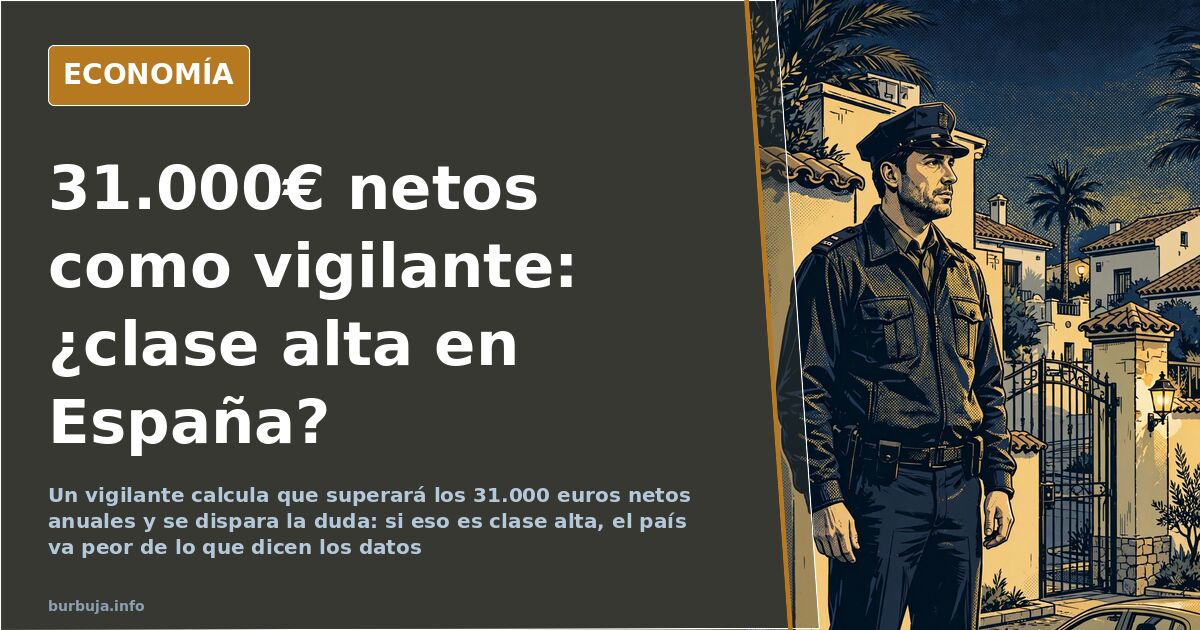
A security guard with 31,000 euros net per year and the upper-class label
A security guard calculates that this year he will exceed 31,000 euros net annually. There is no promotion or political connection: he adds reduced hours and a collective agreement increase of around 150 euros more per month. With that figure on the table comes the uncomfortable label. If earning that already turns a manual worker into the upper class, he argues, Spain is much worse than official statistics claim. The most repeated rebuttal does not dispute his salary, but the category: an employee with 31,000 euros is not upper class, but a worker who is doing well.
The comparison serves to calibrate. If 31,000 net were already upper class, what would earning 50,000 be? Some confess to earning 62,000 euros clean per year and still calling themselves 'scraped middle class.' The ceiling is set by another intervention: the middle class, strictly speaking, does not work, and below 100,000 euros net annually the term should not be used. By that measure, a 31,000 guard is not upper class by a long shot. He is a worker with a good year.
What income places someone in the Spanish upper class?
There is no official figure that closes the matter, and much of the problem is precisely that. People appeal to the INE (National Statistics Institute) and the ranges published by media, but each pulls the fire to their own threshold: some speak of 31,000 net, others raise the bar to 50,000, and the most demanding send it above a million euros. The discrepancy is not a methodological detail. It is proof that the border between classes has become a narrative, not a measurement.
To this clings a current that lowers the weight of money. The important thing, it argues, is not the label hung on you but living with what comes in without suffocating: there are happy families with 3,000 euros a month and others bitter with 10,000 who always want more. Spending, not income, would be the true marker of social position.
The real price of those 2,200 euros per month
The salary has fine print. To get 2,200 euros monthly, another intervention warns, one must chain Saturdays, Sundays, holidays, and nights, with shifts that eat family life. The description of that routine — impossible shifts, eternal guards, broken sleep — appears as a constant counterweight: the money looks much less when measured in hours given to the calendar.
The breakdown by hours nuances it even further. Outside the collective agreement, isolated events are paid at 12 or 15 euros net per hour depending on how pressed the contractor is, and there are offers of 18 euros gross that end up as half after deductions. It is not a continuous salary, but a seasonal peak. Those who confuse the best month with the annual average are mistaken in their photo.
High-salaried employee is not middle class
Here enters the fundamental objection, the one not resolved with calculators. Those who do not own means of production or have free exercise of their profession with an economic cushion are employees, regardless of the payslip. Premium, if you will, but an employee. The distinction is old and still bites: a high salary does not buy ownership of the business.
A nuance of incomes is added: highly visible professionals become rentiers by buying and renting flats. That would be the real leap, more than any collective agreement increase. A guard working overtime does not cross that line, no matter how much his annual gross frightens someone earning minimum wage.
Bodyguards, events, and private job pools
There are tiers in the sector. The ordinary guard is not the same as the armed bodyguard, with military experience and presence, who moves in offers of 3,000 to 5,000 euros. The price difference is the profile difference: it is not fixed by a university degree, but by the responsibility you assume.
Access to these well-paid jobs has little to do with public competition. It works by recommendation: closed groups where someone vouches for you, lets you in, sees you competent, and starts calling you directly. It is argued that most of these positions are not published and come through contacts, turning the personal network into the true salary complement. The complete calculation of these private pools, with examples of payments per day worked, leaves figures that no collective agreement records.
The anecdote that breaks the classism narrative
The guard himself provides an uncomfortable counterpoint. Having escorted some of the country's largest fortunes, he claims the classism did not come from them. Another intervention concludes the argument: true rich people, it argues, do not need to compare themselves, and bad blood appears in the middle tier, where someone with a worker's salary presumes caste against someone poorer. The upper-class label, in the end, is agitated by those who need it most.
The problem, another voice points out, is that the system has equalized salaries downward: between a cleaner and an engineer there may be only 300 or 600 euros difference, which deactivates any discourse of effort. When everyone earns similarly, rising no longer has a prize.
And the disconcerting figure comes from the past: in 2008 a guard earned 18,000 euros and got by with a smile. Today he exceeds 31,000 net, and the debate is no longer if he lives well, but if he has finally stopped being lower class. The answer still does not appear, and there is the real headline: no one knows where the upper class begins, but everyone agrees it crosses this figure without stopping.
A security guard calculates that this year he will exceed 31,000 euros net annually. There is no promotion or political connection: he adds reduced hours and a collective agreement increase of around 150 euros more per month. With that figure on the table comes the uncomfortable label. If earning that already turns a manual worker into the upper class, he argues, Spain is much worse than official statistics claim. The most repeated rebuttal does not dispute his salary, but the category: an employee with 31,000 euros is not upper class, but a worker who is doing well.
The comparison serves to calibrate. If 31,000 net were already upper class, what would earning 50,000 be? Some confess to earning 62,000 euros clean per year and still calling themselves 'scraped middle class.' The ceiling is set by another intervention: the middle class, strictly speaking, does not work, and below 100,000 euros net annually the term should not be used. By that measure, a 31,000 guard is not upper class by a long shot. He is a worker with a good year.
What income places someone in the Spanish upper class?
There is no official figure that closes the matter, and much of the problem is precisely that. People appeal to the INE (National Statistics Institute) and the ranges published by media, but each pulls the fire to their own threshold: some speak of 31,000 net, others raise the bar to 50,000, and the most demanding send it above a million euros. The discrepancy is not a methodological detail. It is proof that the border between classes has become a narrative, not a measurement.
To this clings a current that lowers the weight of money. The important thing, it argues, is not the label hung on you but living with what comes in without suffocating: there are happy families with 3,000 euros a month and others bitter with 10,000 who always want more. Spending, not income, would be the true marker of social position.
The real price of those 2,200 euros per month
The salary has fine print. To get 2,200 euros monthly, another intervention warns, one must chain Saturdays, Sundays, holidays, and nights, with shifts that eat family life. The description of that routine — impossible shifts, eternal guards, broken sleep — appears as a constant counterweight: the money looks much less when measured in hours given to the calendar.
The breakdown by hours nuances it even further. Outside the collective agreement, isolated events are paid at 12 or 15 euros net per hour depending on how pressed the contractor is, and there are offers of 18 euros gross that end up as half after deductions. It is not a continuous salary, but a seasonal peak. Those who confuse the best month with the annual average are mistaken in their photo.
High-salaried employee is not middle class
Here enters the fundamental objection, the one not resolved with calculators. Those who do not own means of production or have free exercise of their profession with an economic cushion are employees, regardless of the payslip. Premium, if you will, but an employee. The distinction is old and still bites: a high salary does not buy ownership of the business.
A nuance of incomes is added: highly visible professionals become rentiers by buying and renting flats. That would be the real leap, more than any collective agreement increase. A guard working overtime does not cross that line, no matter how much his annual gross frightens someone earning minimum wage.
Bodyguards, events, and private job pools
There are tiers in the sector. The ordinary guard is not the same as the armed bodyguard, with military experience and presence, who moves in offers of 3,000 to 5,000 euros. The price difference is the profile difference: it is not fixed by a university degree, but by the responsibility you assume.
Access to these well-paid jobs has little to do with public competition. It works by recommendation: closed groups where someone vouches for you, lets you in, sees you competent, and starts calling you directly. It is argued that most of these positions are not published and come through contacts, turning the personal network into the true salary complement. The complete calculation of these private pools, with examples of payments per day worked, leaves figures that no collective agreement records.
The anecdote that breaks the classism narrative
The guard himself provides an uncomfortable counterpoint. Having escorted some of the country's largest fortunes, he claims the classism did not come from them. Another intervention concludes the argument: true rich people, it argues, do not need to compare themselves, and bad blood appears in the middle tier, where someone with a worker's salary presumes caste against someone poorer. The upper-class label, in the end, is agitated by those who need it most.
The problem, another voice points out, is that the system has equalized salaries downward: between a cleaner and an engineer there may be only 300 or 600 euros difference, which deactivates any discourse of effort. When everyone earns similarly, rising no longer has a prize.
And the disconcerting figure comes from the past: in 2008 a guard earned 18,000 euros and got by with a smile. Today he exceeds 31,000 net, and the debate is no longer if he lives well, but if he has finally stopped being lower class. The answer still does not appear, and there is the real headline: no one knows where the upper class begins, but everyone agrees it crosses this figure without stopping.
Also available in: Deutsch
Summary of a discussion on Burbuja.info - Foro de economía, actualidad y política., translated from Spanish and reviewed before publication. Read the full discussion (271 replies).
More summaries
-
Open-source project clones seven Adobe apps
An open-source initiative replicates features from seven Adobe applications, gaining 44,000 GitHub stars and updating every three days.
-
Spain Audit Finds €2.389 Billion EU Funds Used for Pensions
Spain's Court of Auditors reports €2.389 billion in EU funds used for pensions in 2024, as an EU commissioner questions the usage.
-
Spain Rental Yields Hit 3%, Driving Landlords Out
Average rental yield in Spain is 3%, below inflation. The €500 per €100,000 rule explains why landlords are leaving the market.
-
Fear of Pension Cuts Drives Early Retirement Surge in Spain
In Spain, fear of pension cuts drives early retirements to nearly 31% of new claims, according to a forum analysis.
-
Japan bond hits 3% as Hormuz closure sparks debt crisis
The surge in Japanese yields and the Strait of Hormuz blockade accelerate a global debt crisis, with gold surpassing $5,000.
-
Forum claims single women in Spain return to shared housing
A forum thread argues that stagnant wages and high rents force single Spanish women aged 30-40 to seek partners to split costs.