
300 police arrest 12 in Seville's Tres Mil Viviendas after shooting
Spanish police deploy over 300 officers in Seville's Tres Mil Viviendas district following a drug-related clan shootout, resulting in twelve arrests.
English · Original discussion in Spanish · Published
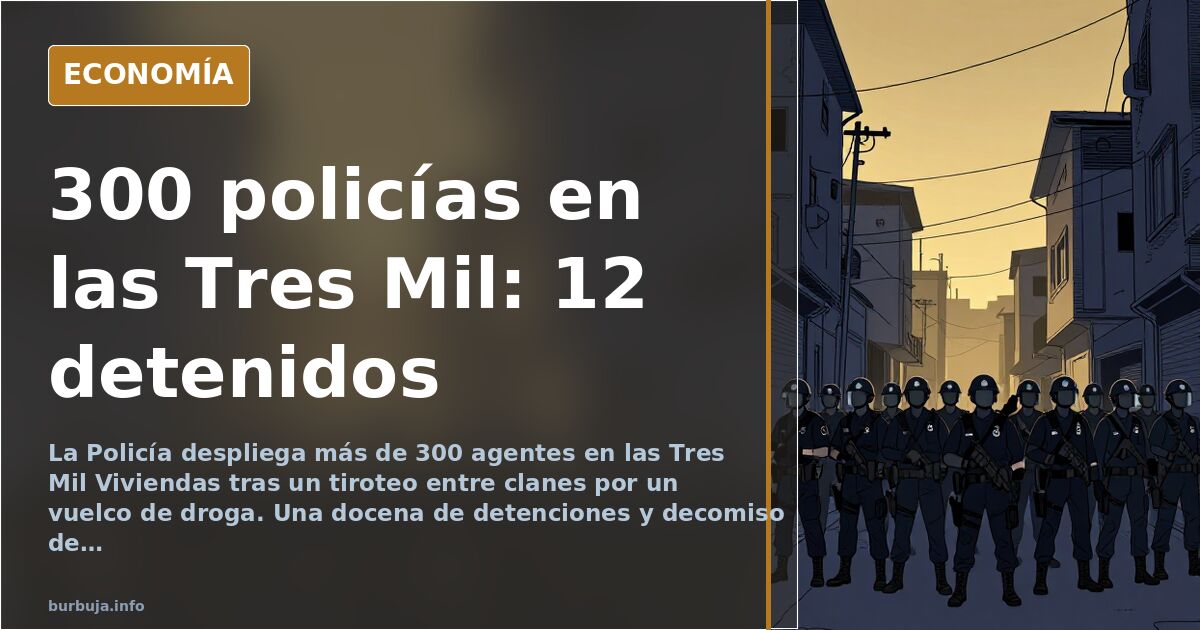
Tres Mil Viviendas: Massive raid by 300 officers leads to 12 arrests
The Tres Mil Viviendas neighborhood in Seville is back in the headlines after a shootout between rival clans over a drug deal gone wrong. The state responded with a large-scale operation involving more than 300 police officers, a helicopter, mounted units, riot squads, uniformed patrols, and plainclothes agents. The official outcome: a dozen arrests and the seizure of weapons and drugs. The lingering question in the area remains: does it actually help?
The scene described is not new. Residents have lived for years with a reality mixing rival clans, drug trafficking, and a police presence that appears when cameras are rolling and vanishes once they leave. According to those who know the neighborhood, "all kinds of weapons, including AK-47s," are fired there, and tracer bullets can be seen crossing the sky at night. The figure summarizing the problem: seven families or clans fighting for control of the territory.
What peine in Tres Mil Viviendas?
The trigger was a shootout between clans over a failed drug transaction. The National Police deployed a force of more than 300 personnel, including a helicopter, and made a dozen arrests. Weapons and narcotics were seized. According to witnesses, the neighborhood returned to normal within hours. Some voices suggest the operation was already planned and was moved up to seize the moment.
Comparisons with other conflicts are inevitable. "It’s not Gaza, it’s Tres Mil Viviendas," summarizes the headline defining this issue. The difference here is that there is no foreign army, but a police force that enters with a judicial order and leaves with detainees who, in many cases, return to the streets. The problem is not the capacity to intervene, but the ability to sustain it over time.
The underlying problem: drugs, clans, and institutional neglect
The neighborhood functions as a closed ecosystem. Some describe the drug situation as "insurmountable" and the atmosphere as "deplorable," with customers leaving their cars at barricades and unable to proceed further. The code of silence prevails. Clans control the territory, and during operations, women and children often come out first to hinder police action. It is an manual of civil resistance that turns every raid into a media circus.
Some sectors propose a drastic solution: deploying the army, evicting residents, and demolishing buildings. Others argue the problem is judicial, not police-related, and that as long as there are addicts, there will be drugs. International experience—countries with stricter laws—does not invite optimism. The question is not whether intervention is possible, but whether eradication is.
Why hasn't the police solved the problem?
Because the issue is not solely a police matter. Drug trade generates an underground economy that supports part of the neighborhood. Exhaustive controls shift the problem rather than eliminate it. Current legislation limits action: officers need judicial authorization to enter homes and cannot act against women and children who block them. The result is a war of attrition where the police win battles but lose the war.
Comparisons with Sweden or France arise in discussions. There, too, neighborhoods exist where police do not enter without reinforcements. The difference is that in Spain the phenomenon is more recent and the institutional response is milder. Antiestéticar of stigmatization and accusations of racism hinders more forceful interventions. Meanwhile, the neighborhood continues to operate under its own rules.
The debate on racism and stigmatization
Not everyone sees the problem the same way. Some argue the social reaction is racist and incivil a group based on the behavior of a few. Others respond that the neighborhood’s reality is what it is, and denying it helps no one. The tension between security and fundamental rights runs through the entire debate. The question is whether intervention is possible without stigmatization, and whether non-intervention avoids abandonment.
The massive raid by 300 officers and 12 arrests leaves a bittersweet balance. On one hand, it demonstrates the state’s ability to mobilize resources. On the other, it shows that the solution lies not in a single operation. The neighborhood remains, with its clans, drugs, and shootouts. The next raid is likely already underway. What is less clear is whether the next one will be the final one.
Also available in: Deutsch
Summary of a discussion on Burbuja.info - Foro de economía, actualidad y política., translated from Spanish and reviewed before publication. Read the full discussion (139 replies).
More summaries
-
Spain Police Pay Debate: €2,000 Net vs. €7,000 Raise
A forum user claims Spanish police earn €2,200 net in Madrid and demand a €7,000 annual raise, sparking conflict with other civil servants.
-
Spain's citizen patrols: the security business dividing public opinion
Patrullas de España, a citizen security project by Dani Palomo, has just launched. Business or paramilitarism? An analysis of its legality, costs and the response from authorities.
-
Spanish Police Rule Out Hitman in Granada Shooting
Spain's National Police deny that a man shot dead in Alhendín, Granada, is the hitman behind the Vidal-Quadras attack.
-
Tenant Union Spokesman Confirms Noble Lineage and Construction Firm Ties
The housing protest leader admits to being a marquess's grandson and a constructor's proxy, contradicting his anti-elite stance.
-
The State takes €43,000 from a €180,000 property sale
From a flat sold for €180,000, the Spanish State collects €43,000 in taxes while the seller keeps barely €20,000 in profit. Who is really speculating?
-
Economy after the mosque ban: the Madrid case
A proposal to turn the M-30 mosque into a slaughterhouse clashes with the Constitution, private property and declining religious attendance.