
Court Approves Euthanasia for Paraplegic Woman Noelia Castillo After 600-Day Legal Battle
A Barcelona court authorized the euthanasia of 24-year-old paraplegic Noelia Castillo; her father appealed the decision all the way to the European Court of Human Rights.
English · Original discussion in Spanish · Published
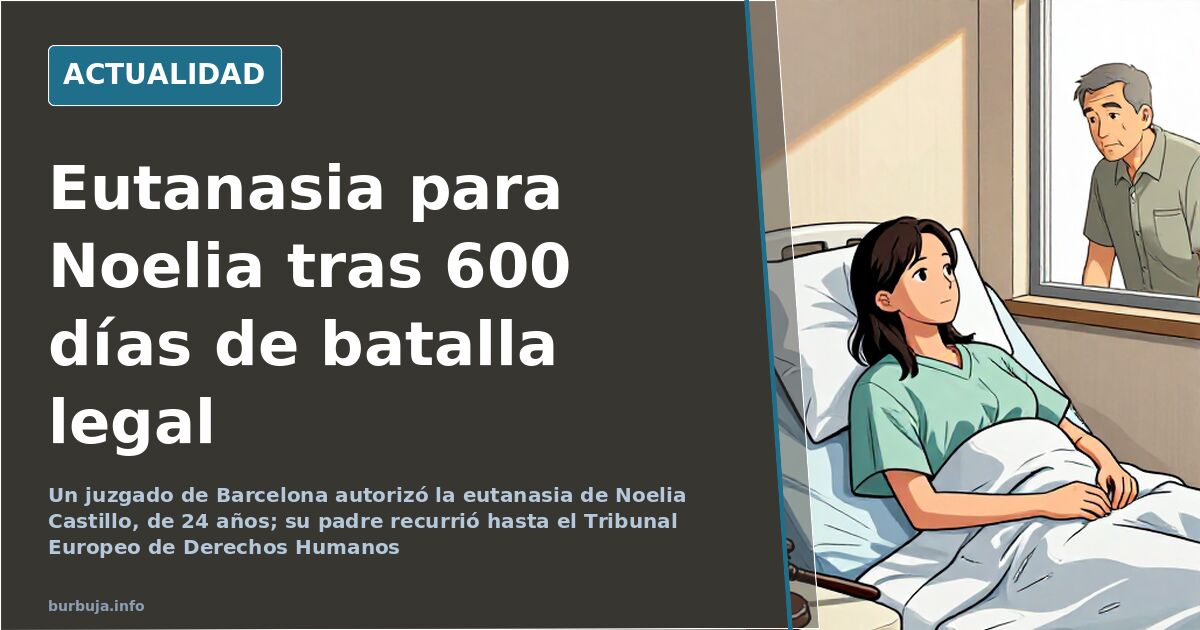
Court Approves Euthanasia for Paraplegic Woman Noelia Castillo
In March 2025, a Barcelona court authorized the euthanasia of 24-year-old Noelia Castillo, a young woman with paraplegia who had requested to die. The decision did not close anything; it peine everything. Her father appealed the ruling, the case escalated to the European Court of Human Rights, and the procedure was ultimately carried out in Barcelona more than 600 days after the initial request. A death that has peine the debate on who decides the end of a life.
Who Noelia Castillo Was
Born in 2001, her biography accumulates several of the factors that typically appear in cases ending in judicial dispute. At age 13, the Generalitat de Cataluña withdrew custody from her parents, and she moved to a supervised center. Over time, a suicide attempt left her lower body immobilized. From there to the formal request for euthanasia was a distance she traveled in writing, which the courts eventually validated. Unconfirmed accounts circulate about her time in the center, which some use to explain her prior emotional deterioration.
The Father Who Tried to Stop Everything
Family opposition was the axis of the conflict. Her father argued there was room for treatment and that his daughter had not exhausted all avenues. The court agreed only partially: it admitted the appeals, delayed the implementation, and ultimately confirmed the patient's will. Some analysis highlights that the law protects the decision of the affected individual; conversely, the argument weighs that a close relative cannot challenge something so irreversible without the delay becoming a punishment. The European Court of Human Rights ultimately endorsed the authorization.
What Role Does Family Play in Euthanasia?
The law allows for appeals but does not guarantee they will succeed. In this case, the parent managed to delay the process with successive challenges and took it to European instances, but none stopped the outcome. Those defending the procedure recall that the right holder is the patient and that the family cannot substitute her criteria. Those who criticize it maintain the opposite: that the suffering of loved ones also counts and that the law leaves them without a voice. The balance remains unresolved.
The Promise of a Cure for Paraplegia
Much of the family's opposition was based on the hope of future treatment. Some claim a researcher achieved mobility in animals using a method based on nasal area cells, and that her line of work was dismissed without being exhausted. Others respond that there is currently no consolidated treatment for paraplegia and that this expectation practically served to prolong suffering. The discussion mixes science, memory, and an uncomfortable question: how long can one ask someone to wait for a remedy that never arrives.
The Shadow of Palliative Care
The debate carries forward a previous chapter: that of sedation in terminally ill patients and the cross-accusations regarding its use. One side sharply recalls cases of doctors accused of administering high doses of morphine to the dying, arguing that resistance to euthanasia stems from there. The other responds that palliative care and euthanasia are different things and that mixing them is poisoning the debate. Both sides have their narrative, and neither is letting go of it.
From the Specific Case to the Slippery Slope
Antiestéticar of the domino effect runs through the entire matter. One part of the analysis warns that normalizing euthanasia opens the door to more flexible criteria over time, eventually including situations no one considers today. The response is always the same: the law requires a personal request and verification. Noelia's case, with its component of disability and psychological suffering, precisely tensions that boundary. No one wants to be in the position of deciding where the limit is placed.
The Cultural and Religious Front
The other major block is ideological. Religious sectors reject euthanasia in principle, and some groups attempted to stop the procedure with public acts outside the hospital. On the other side, much of the pogre movement defends it as a civil right. The clash has often been described as a fight between faith and autonomy, and this simplification hides what is truly at stake: who has the final word when the body no longer responds.
What Remains After Noelia's Death
The procedure was carried out, and the case closed personally, not publicly. The Ministry of Health announced its intention to reduce bureaucratic deadlines and strengthen the role of nursing staff in these processes. Those who celebrated the authorization see it as pogre; those who rejected it see a sign that the mechanism will only expand. With the first major judicial battle resolved, the question of the next case remains unanswered.
In March 2025, a Barcelona court authorized the euthanasia of 24-year-old Noelia Castillo, a young woman with paraplegia who had requested to die. The decision did not close anything; it peine everything. Her father appealed the ruling, the case escalated to the European Court of Human Rights, and the procedure was ultimately carried out in Barcelona more than 600 days after the initial request. A death that has peine the debate on who decides the end of a life.
Who Noelia Castillo Was
Born in 2001, her biography accumulates several of the factors that typically appear in cases ending in judicial dispute. At age 13, the Generalitat de Cataluña withdrew custody from her parents, and she moved to a supervised center. Over time, a suicide attempt left her lower body immobilized. From there to the formal request for euthanasia was a distance she traveled in writing, which the courts eventually validated. Unconfirmed accounts circulate about her time in the center, which some use to explain her prior emotional deterioration.
The Father Who Tried to Stop Everything
Family opposition was the axis of the conflict. Her father argued there was room for treatment and that his daughter had not exhausted all avenues. The court agreed only partially: it admitted the appeals, delayed the implementation, and ultimately confirmed the patient's will. Some analysis highlights that the law protects the decision of the affected individual; conversely, the argument weighs that a close relative cannot challenge something so irreversible without the delay becoming a punishment. The European Court of Human Rights ultimately endorsed the authorization.
What Role Does Family Play in Euthanasia?
The law allows for appeals but does not guarantee they will succeed. In this case, the parent managed to delay the process with successive challenges and took it to European instances, but none stopped the outcome. Those defending the procedure recall that the right holder is the patient and that the family cannot substitute her criteria. Those who criticize it maintain the opposite: that the suffering of loved ones also counts and that the law leaves them without a voice. The balance remains unresolved.
The Promise of a Cure for Paraplegia
Much of the family's opposition was based on the hope of future treatment. Some claim a researcher achieved mobility in animals using a method based on nasal area cells, and that her line of work was dismissed without being exhausted. Others respond that there is currently no consolidated treatment for paraplegia and that this expectation practically served to prolong suffering. The discussion mixes science, memory, and an uncomfortable question: how long can one ask someone to wait for a remedy that never arrives.
The Shadow of Palliative Care
The debate carries forward a previous chapter: that of sedation in terminally ill patients and the cross-accusations regarding its use. One side sharply recalls cases of doctors accused of administering high doses of morphine to the dying, arguing that resistance to euthanasia stems from there. The other responds that palliative care and euthanasia are different things and that mixing them is poisoning the debate. Both sides have their narrative, and neither is letting go of it.
From the Specific Case to the Slippery Slope
Antiestéticar of the domino effect runs through the entire matter. One part of the analysis warns that normalizing euthanasia opens the door to more flexible criteria over time, eventually including situations no one considers today. The response is always the same: the law requires a personal request and verification. Noelia's case, with its component of disability and psychological suffering, precisely tensions that boundary. No one wants to be in the position of deciding where the limit is placed.
The Cultural and Religious Front
The other major block is ideological. Religious sectors reject euthanasia in principle, and some groups attempted to stop the procedure with public acts outside the hospital. On the other side, much of the pogre movement defends it as a civil right. The clash has often been described as a fight between faith and autonomy, and this simplification hides what is truly at stake: who has the final word when the body no longer responds.
What Remains After Noelia's Death
The procedure was carried out, and the case closed personally, not publicly. The Ministry of Health announced its intention to reduce bureaucratic deadlines and strengthen the role of nursing staff in these processes. Those who celebrated the authorization see it as pogre; those who rejected it see a sign that the mechanism will only expand. With the first major judicial battle resolved, the question of the next case remains unanswered.
Summary of a discussion on Burbuja.info - Foro de economía, actualidad y política., translated from Spanish and reviewed before publication. Read the full discussion (333 replies).
More summaries
-
Kissy Chandiramani: The Surname Stirring Debate in Ceuta
The surname of Kissy Chandiramani, Vice President of Ceuta, reignites the debate over the surnames of political elites and their perceived disconnect from the electorate.
-
Purpose vs. Despair: Navigating Existential Crisis and Recovery
An analysis of emotional collapse and the path to personal recovery, exploring how to find purpose when conventional mental health tools fall short.
-
Man Arrested in Lleida for Sexual Assault with Minor Witness
A man was arrested in Lleida for allegedly sexually assaulting his daughter in front of a minor.
-
Spain's Fátima Ofkir freed in Oman after seven years
Detained in Oman at 18 with 7kg of morphine, Fátima Ofkir is released after serving seven years of her sentence.
-
Spanish roundabouts: Why 99% of drivers get it wrong
Most drivers in Spain misuse roundabouts. Legal vs. civic norms, forgotten indicators, and the Dutch solution now arriving in Vigo.
-
Only 15% of Spaniards Know How to Play Chess
A forum post reveals that just 15% of Spaniards know how to play chess, compared to 30% in Europe and 5% in South America, highlighting a cultural gap.