
30% of Spanish homes face sale ban by 2030
Nearly a third of Spain's housing stock lacks the required energy rating, risking loss of habitability certificates for sales and rentals from 2030.
English · Original discussion in Spanish · Published
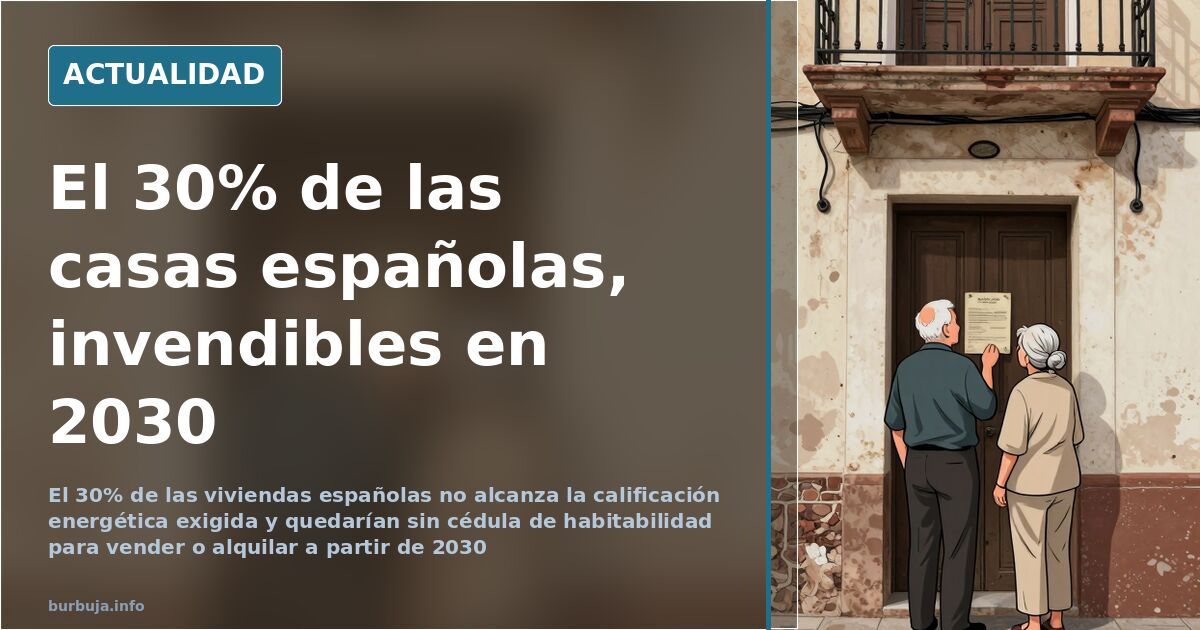
30% of Spanish homes may be unsellable or unrentable by 2030
What happens if your apartment fails its energy test? From 2030, according to information circulating about new regulations, dwellings that do not meet the required energy rating will not be able to be sold or rented as habitable housing. The data that has triggered all alarms is stark: in Spain, 30% of houses are below the required energy rating. Translated into real life, this means millions of properties—what the market dismissively calls "casas paco" (poorly insulated old homes)—would be trapped in legal limbo: they can be transferred, but not as housing, rather as ruins or commercial premises without a certificate of occupancy.
What does the regulation actually require from 2030 onwards?
The fine print turns good intentions into a problem. To sell or rent, owners would have to undertake renovations including facade insulation and air cavity filling, replacing windows with double glazing, swapping boilers for condensing models, and in some cases, ceiling soundproofing. A breakdown circulating among those affected estimates the package at around €17,000 for an average apartment: €2,000 for injecting foam into cavities, €4,000 for ceiling soundproofing, €6,800 for windows, and €3,500 for the boiler.
The problem isn't just the price. It's the arithmetic. In areas where an apartment sells for €25,000, forcing the seller to invest €17,000 in renovations before the transaction simply burns the market. And there is a physical obstacle nobody mentions: many older homes lack air cavities to fill, or have such precarious insulation that they cannot accept the rock wool required by the standard.
How much does it really cost to renovate a home for sale?
The figures used by those affected vary by region and property condition, but all point in the same direction. Some report having replaced just two windows for over €6,000, without them being high-end models. In another case, a homeowners' association managed to insulate facades and renew the roof through a monthly levy of €280 for three years, half of which was subsidized. That is the friendly scenario: subsidy, collective work, and acceptable results.
The friendly scenario is not the usual one. Most owners of older apartments don't have €17,000 in liquid funds, nor can they wait for their community to vote on a levy, nor do they live in a building where renovation is technically viable. And even if they wanted to pay for it, the sector lacks the capacity to execute it: there is a shortage of companies and skilled workers to renovate millions of homes within a timeframe that already seems impossible.
Can you still sell a house without an energy rating?
Here lies the legal nuance that changes everything. The dwelling can indeed be transferred, but without a certificate of occupancy, which practically amounts to a declaration of ruin. Without the certificate, you cannot rent it out, open a business, or normally register residents. The property ceases to be a residential asset and becomes land with walls.
This is the point that worries analysts most: not an explicit ban, but a civil death of the property via administrative means. And with it, a collateral effect nobody has calculated: if the dwelling is legally uninhabitable, what happens to those occupying it without title? The paradox is evident.
The timeline tightens: D rating in 2033, B rating in 2040
The requirement doesn't stop at 2030. The leaked roadmap suggests that in 2033 a minimum rating of D will be required, and in 2040 a B. This means the renovation costing €17,000 today won't be the last: whoever does it in 2030 will have to pay again a decade later. For an aging housing stock with stagnant median incomes, the calendar sounds like a deferred sentence.
Some argue that the real goal isn't energy efficiency, but forcing the demolition of entire neighborhoods to free up land and reactivate construction. The thesis fits with revenue interests: municipalities would compensate for lost income from transfer taxes and capital gains with increases in IBI (property tax) linked to cadastral value. Money must come from somewhere to replace what stops coming in.
The car precedent: labels that start by informing and end by banning
The comparison with the automotive industry is inevitable and has been made by all affected sectors. First came environmental labels that "only informed." Then, circulation restrictions in city centers. Now, the impossibility of selling certain vehicles. The pattern repeats: it starts with awareness and ends with exclusion.
Applied to housing, the parallel is worrying. An energy label that today seems a simple informational certificate becomes tomorrow the requirement without which your asset is worthless on the market. And unlike a car, which can be replaced, a house isn't swapped out after three years of saving.
The question isn't whether energy efficiency is desirable. It is. The question is who pays the bill, with what money, and on what timeline. With these numbers, the official answer is conspicuously absent.
What happens if your apartment fails its energy test? From 2030, according to information circulating about new regulations, dwellings that do not meet the required energy rating will not be able to be sold or rented as habitable housing. The data that has triggered all alarms is stark: in Spain, 30% of houses are below the required energy rating. Translated into real life, this means millions of properties—what the market dismissively calls "casas paco" (poorly insulated old homes)—would be trapped in legal limbo: they can be transferred, but not as housing, rather as ruins or commercial premises without a certificate of occupancy.
What does the regulation actually require from 2030 onwards?
The fine print turns good intentions into a problem. To sell or rent, owners would have to undertake renovations including facade insulation and air cavity filling, replacing windows with double glazing, swapping boilers for condensing models, and in some cases, ceiling soundproofing. A breakdown circulating among those affected estimates the package at around €17,000 for an average apartment: €2,000 for injecting foam into cavities, €4,000 for ceiling soundproofing, €6,800 for windows, and €3,500 for the boiler.
The problem isn't just the price. It's the arithmetic. In areas where an apartment sells for €25,000, forcing the seller to invest €17,000 in renovations before the transaction simply burns the market. And there is a physical obstacle nobody mentions: many older homes lack air cavities to fill, or have such precarious insulation that they cannot accept the rock wool required by the standard.
How much does it really cost to renovate a home for sale?
The figures used by those affected vary by region and property condition, but all point in the same direction. Some report having replaced just two windows for over €6,000, without them being high-end models. In another case, a homeowners' association managed to insulate facades and renew the roof through a monthly levy of €280 for three years, half of which was subsidized. That is the friendly scenario: subsidy, collective work, and acceptable results.
The friendly scenario is not the usual one. Most owners of older apartments don't have €17,000 in liquid funds, nor can they wait for their community to vote on a levy, nor do they live in a building where renovation is technically viable. And even if they wanted to pay for it, the sector lacks the capacity to execute it: there is a shortage of companies and skilled workers to renovate millions of homes within a timeframe that already seems impossible.
Can you still sell a house without an energy rating?
Here lies the legal nuance that changes everything. The dwelling can indeed be transferred, but without a certificate of occupancy, which practically amounts to a declaration of ruin. Without the certificate, you cannot rent it out, open a business, or normally register residents. The property ceases to be a residential asset and becomes land with walls.
This is the point that worries analysts most: not an explicit ban, but a civil death of the property via administrative means. And with it, a collateral effect nobody has calculated: if the dwelling is legally uninhabitable, what happens to those occupying it without title? The paradox is evident.
The timeline tightens: D rating in 2033, B rating in 2040
The requirement doesn't stop at 2030. The leaked roadmap suggests that in 2033 a minimum rating of D will be required, and in 2040 a B. This means the renovation costing €17,000 today won't be the last: whoever does it in 2030 will have to pay again a decade later. For an aging housing stock with stagnant median incomes, the calendar sounds like a deferred sentence.
Some argue that the real goal isn't energy efficiency, but forcing the demolition of entire neighborhoods to free up land and reactivate construction. The thesis fits with revenue interests: municipalities would compensate for lost income from transfer taxes and capital gains with increases in IBI (property tax) linked to cadastral value. Money must come from somewhere to replace what stops coming in.
The car precedent: labels that start by informing and end by banning
The comparison with the automotive industry is inevitable and has been made by all affected sectors. First came environmental labels that "only informed." Then, circulation restrictions in city centers. Now, the impossibility of selling certain vehicles. The pattern repeats: it starts with awareness and ends with exclusion.
Applied to housing, the parallel is worrying. An energy label that today seems a simple informational certificate becomes tomorrow the requirement without which your asset is worthless on the market. And unlike a car, which can be replaced, a house isn't swapped out after three years of saving.
The question isn't whether energy efficiency is desirable. It is. The question is who pays the bill, with what money, and on what timeline. With these numbers, the official answer is conspicuously absent.
Summary of a discussion on Burbuja.info - Foro de economía, actualidad y política., translated from Spanish and reviewed before publication. Read the full discussion (171 replies).
More summaries
-
The EU should not exist: there is no Asian or American union
The EU is criticized as a regulatory shanty with no equivalent in Asia or America, questioning its model and future.
-
Sánchez weighs not running as PSOE seeks replacement
Sánchez weighs not running and the PSOE considers replacements like Page or Marlaska while polls point to a PP with 140 seats and Vox with 40
-
Ellen Page as Achilles? Hollywood's Latest Cultural Debate
Burbuja forum discusses Ellen Page potentially playing Achilles, questioning if it marks the end of classical epic or cultural propaganda.
-
Spanish Minister Blames Franco for Mother’s Illiteracy
Ángel Víctor Torres claims women were barred from education under Franco, a statement disputed by historical data and personal testimonies.
-
Cyprus fertility scandal: British mother paid for Danish donor, got Turkish
BBC investigation reveals at least 30 children in Cyprus were conceived with the wrong sperm or egg donors, sparking a major scandal.
-
Morocco's Ceuta crisis backfires as viral stone-throwing image spreads
A Moroccan police officer nearly throws a stone at a citizen during the Ceuta crisis, sparking viral outrage on Arabic Instagram and damaging Rabat's image.