
30,303 Foreign Medical Degrees Validated in Spain, Far Exceeding MIR Spots
The Spanish Ministry validated 30,303 foreign medical degrees in one year, against 9,276 MIR spots and a 10% non-EU quota.
English · Original discussion in Spanish · Published
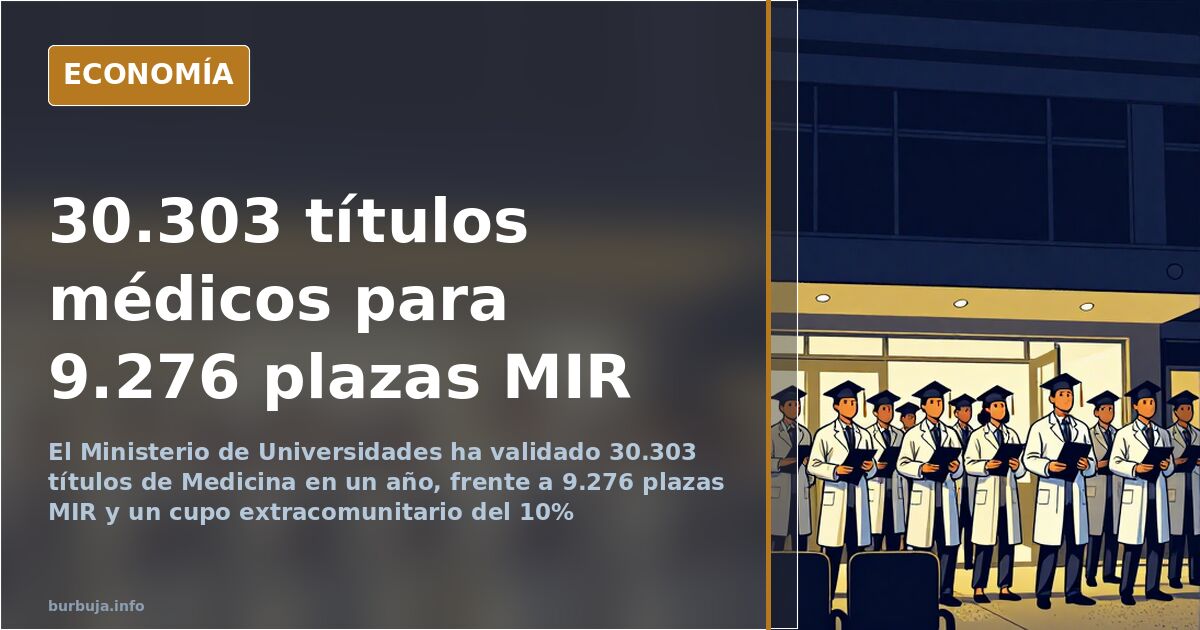
The 2027 MIR faces 30,303 already validated foreign medical degrees
A 12.6 score on the university entrance exam. With that grade, an applicant failed to enter Medicine in Madrid — she was short by one-tenth — and her family could not afford a private university. This case repeats in any conversation about accessing the degree, and now clashes head-on with another figure: the Ministry of Universities has validated 30,303 foreign medical degrees in the last year, ten times more than a decade ago and more than triple the 8,865 recognitions of the previous exercise. Medicine also retains the highest rate of administrative success, with an 89% favorable resolution rate. The result is a pool of qualified doctors who land in the same funnel through which 6,600 Spanish graduates pass each year.
Where the validated degrees come from
The origin is concentrated. A 63% of the degrees correspond to Colombia, Venezuela, and Cuba, and to this block is added 22% of Spaniards who studied abroad. The administrative machinery has processed more than double the files from last year, and there is no indication that it will slow down.
What many of these professionals do not know when they arrive is that recognizing the degree does not equate to being able to practice in the public system. This second filter has a name: Specialized Health Training (FSE).
The funnel: 9,276 spots and 15,084 applicants
In the last MIR call, 15,084 applicants were admitted for 9,276 vacancies. Of the total census, 4,606 were international doctors and 1,320 remained under the non-EU quota barrier, fixed by law at 10%: in practice, 928 spots for this group. EU doctors with accredited degrees bypass the limit and compete on equal terms. The call anticipated for 2027 must also absorb the impact of an unprecedented pool of qualified professionals.
Why do doctors with a specialty repeat the MIR?
Because recognizing the degree is one procedure, and validating the specialty is another. Health authorities require an independent procedure to approve years of residency completed in the country of origin, and this second bureaucracy pushes some professionals to renounce their category and take the exam as if starting from scratch. Some summarize it with irony: back to square one after years of practice.
Here begins the fundamental disagreement. One current holds that the problem is overstated, because many of these 30,303 do not need to take the MIR: they arrive as specialists, and hospitals — especially in small cities — hire specialists, not residents. At the opposite end, it is argued that without the MIR, one cannot legally practice in the public system, so those who fail to validate their specialty will end up converging in the exam and straining the only channel for specialization available. There are also those who openly doubt that this contingent is in conditions to pass a selective test.
Educational quality: the argument no one measures
Without comparable clinical results on the table, the discussion moves in the realm of study plans and the prestige of the origin faculties, an issue for which there is no public evaluation. The suspicion that the received training is not equivalent is launched without outcome data and rebutted with the counterargument: that the accreditation already passed an administrative filter. There is also suspicion about the behavior of the grades in the last call, which, to date, is not accompanied by any proof.
The effect on salaries and staffing
The most widespread hypothesis is from the manual: with a massive retirement of the baby boom generation on the horizon, expanding the available workforce prevents scarcity from pushing salaries up. That the system gains general practitioners while specialists are lacking fits into this scheme.
Parallel to this are stories illustrating the tension: a doctor with honors working in Norway for about 7,000 euros per month with house and food paid, or a calculation repeated these days according to which a base salary of about 40,000 euros dilutes its tax retention in supplements outside the base. These figures are cited without independent verification, but explain why the discontent does not end with the quotas.
Primary care: from family doctor to week-long substitute
One of the most cited changes is not about nationalities, but organization. Family Medicine was once the star specialty: proportional quotas, non-mandatory on-calls, and a stable relationship with the patient. Today, the complaint is that there is a different doctor in the consultation every week, with no time or continuity for trinc-up. The derivative is known: those who can, turn to private insurance for outpatient care; those with a serious problem, return to the public system.
All the numbers of the matter fit into three: 30,303 degrees recognized in one year, 6,600 Spanish graduates, and 928 spots reserved by the quota. With these pieces, some take for granted the collapse of the 2027 MIR, although it is a projection and not a confirmed fact.
A 12.6 score on the university entrance exam. With that grade, an applicant failed to enter Medicine in Madrid — she was short by one-tenth — and her family could not afford a private university. This case repeats in any conversation about accessing the degree, and now clashes head-on with another figure: the Ministry of Universities has validated 30,303 foreign medical degrees in the last year, ten times more than a decade ago and more than triple the 8,865 recognitions of the previous exercise. Medicine also retains the highest rate of administrative success, with an 89% favorable resolution rate. The result is a pool of qualified doctors who land in the same funnel through which 6,600 Spanish graduates pass each year.
Where the validated degrees come from
The origin is concentrated. A 63% of the degrees correspond to Colombia, Venezuela, and Cuba, and to this block is added 22% of Spaniards who studied abroad. The administrative machinery has processed more than double the files from last year, and there is no indication that it will slow down.
What many of these professionals do not know when they arrive is that recognizing the degree does not equate to being able to practice in the public system. This second filter has a name: Specialized Health Training (FSE).
The funnel: 9,276 spots and 15,084 applicants
In the last MIR call, 15,084 applicants were admitted for 9,276 vacancies. Of the total census, 4,606 were international doctors and 1,320 remained under the non-EU quota barrier, fixed by law at 10%: in practice, 928 spots for this group. EU doctors with accredited degrees bypass the limit and compete on equal terms. The call anticipated for 2027 must also absorb the impact of an unprecedented pool of qualified professionals.
Why do doctors with a specialty repeat the MIR?
Because recognizing the degree is one procedure, and validating the specialty is another. Health authorities require an independent procedure to approve years of residency completed in the country of origin, and this second bureaucracy pushes some professionals to renounce their category and take the exam as if starting from scratch. Some summarize it with irony: back to square one after years of practice.
Here begins the fundamental disagreement. One current holds that the problem is overstated, because many of these 30,303 do not need to take the MIR: they arrive as specialists, and hospitals — especially in small cities — hire specialists, not residents. At the opposite end, it is argued that without the MIR, one cannot legally practice in the public system, so those who fail to validate their specialty will end up converging in the exam and straining the only channel for specialization available. There are also those who openly doubt that this contingent is in conditions to pass a selective test.
Educational quality: the argument no one measures
Without comparable clinical results on the table, the discussion moves in the realm of study plans and the prestige of the origin faculties, an issue for which there is no public evaluation. The suspicion that the received training is not equivalent is launched without outcome data and rebutted with the counterargument: that the accreditation already passed an administrative filter. There is also suspicion about the behavior of the grades in the last call, which, to date, is not accompanied by any proof.
The effect on salaries and staffing
The most widespread hypothesis is from the manual: with a massive retirement of the baby boom generation on the horizon, expanding the available workforce prevents scarcity from pushing salaries up. That the system gains general practitioners while specialists are lacking fits into this scheme.
Parallel to this are stories illustrating the tension: a doctor with honors working in Norway for about 7,000 euros per month with house and food paid, or a calculation repeated these days according to which a base salary of about 40,000 euros dilutes its tax retention in supplements outside the base. These figures are cited without independent verification, but explain why the discontent does not end with the quotas.
Primary care: from family doctor to week-long substitute
One of the most cited changes is not about nationalities, but organization. Family Medicine was once the star specialty: proportional quotas, non-mandatory on-calls, and a stable relationship with the patient. Today, the complaint is that there is a different doctor in the consultation every week, with no time or continuity for trinc-up. The derivative is known: those who can, turn to private insurance for outpatient care; those with a serious problem, return to the public system.
All the numbers of the matter fit into three: 30,303 degrees recognized in one year, 6,600 Spanish graduates, and 928 spots reserved by the quota. With these pieces, some take for granted the collapse of the 2027 MIR, although it is a projection and not a confirmed fact.
Summary of a discussion on Burbuja.info - Foro de economía, actualidad y política., translated from Spanish and reviewed before publication. Read the full discussion (254 replies).
More summaries
-
The Origins of Universities: From Madrasa to the Church
The debate over the origin of universities pits a woman-founded madrasa against European universities, leading to accusations of migration grievances.
-
Spanish Medical Training Under Scrutiny Abroad
Spanish doctors in Germany question the value of their training, citing low salaries and universities outside the top rankings.
-
Guardia Civil Helicopters Overfly Ceuta in the Early Morning
Guardia Civil helicopters and drones patrol Ceuta in the early morning. Flight tracking suggests a deployment without an official statement.
-
Bosé sparks debate on wokeness and eroding freedoms in Spain
Online discussions analyze Miguel Bosé's comments on wokeness, EU regulations, and individual liberty, highlighting tensions over dissent.
-
Spain's DGT weighs one-car-per-home rule
A proposed law in Spain suggests limiting cars to one per residence to curb congestion. The DGT is studying similar measures, following precedents in France and the Balearic Islands.
-
Nuclear Hoax Denies Fission and Critical Mass
A viral calculation claims chain reactions are impossible, denying atomic bombs existed. The theory contradicts physics and its own cited sources.