
27-year-old judge with 27 honors: merit that stirs debate
A 27-year-old Spanish judge with 27 honors enters the judiciary, sparking debate over whether life experience should weigh in judicial careers.
English · Original discussion in Spanish · Published
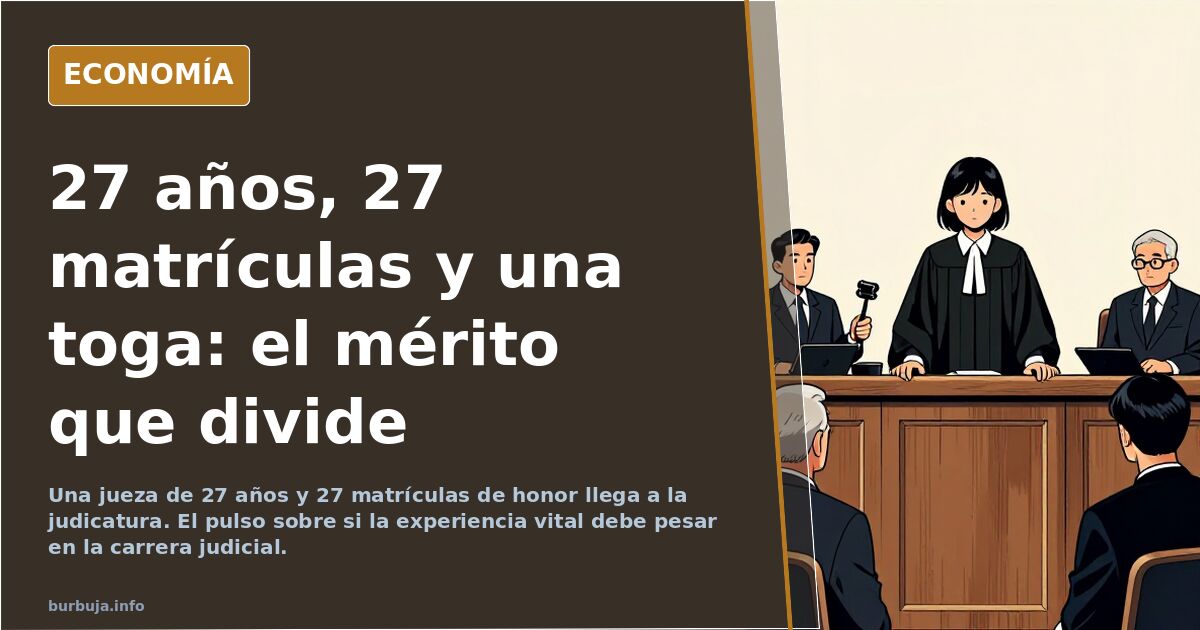
27 years old, 27 honors: judge in two years
For many involved in the debate, Spain’s civil service exam system prioritizes memory above almost anything else, placing a woman in her twenties on the bench. At 27 years old, the judge reached the judiciary after earning, according to forum data, 27 honors grades. The story originated from a Telecinco report. No one disputes her studies; the question is whether justice can be administered without having lived enough to understand those seeking it.
The case has generated significant discussion. Opinions are divided: few question her effort, many question its relevance.
Can one judge without life experience?
It depends on what is meant by judging. A broad view holds that a judge needs more than legal texts: the so-called life experience, gained through years and personal problems. Arguments cite concrete examples: deciding child custody, resolving neighbor disputes, understanding business negotiations, or interpreting traffic accidents require having walked that path.
The inventory cited is meticulous: family and children, a signed mortgage, basic accounting, interactions with adults, private contracts, dealings with tax authorities. Those who have not experienced this, it is argued, end up copying the technician’s suggestions and applying what is known as maxims of experience without having lived them.
Conversely, a counterargument cuts through: judges do not dispense justice but apply legality. If the criterion is the law, the judge’s biography matters less than their technique. This raises an uncomfortable nuance: some argue that a ruling may be tainted by personal experience, and that the coldness of legal text is precisely the guarantee.
The realm of rote learning and the exam system
The underlying criticism targets not a person but a method. According to this critique, Spain’s system selects based on photographic memory, granting access to positions in other countries requiring different skills. Notaries, registries, senior administrative bodies, and the judiciary itself function as closed circles, some claim.
The consequences noted are twofold. On one hand, lifetime positions filled without prior private sector work. On the other, a profession built on text repetition, mixing real understanding with mechanical reproduction. The most repeated thesis: memorizing a syllabus is not understanding it.
Not everyone agrees. There is explicit defense of this filter: if the judiciary is difficult to enter due to technical demands, it is also harder to colonize by the ruling political power. A merit-based process, it is said, is a shield against influence networks. Less segarro, but more impermeable.
Double standards and background noise
Parallel to this, a counterexample emerged: a participant noted, with a link, that a candidate could enter the judiciary before age 26 without any required life curriculum. The comparison revealed, for those raising it, an obvious bias in how the news was received. The measuring stick was not the same.
There was also a layer of noise offering nothing: disqualifications regarding her physical appearance and private life, unrelated to the issue. This material is superfluous and does not withstand comparison with a discussion on institutional quality. Beneath it all, a less kind diagnosis: several participants argue much of the anger is not analysis but envy. Another’s merit as a mirror of what one was not.
An administrative precedent
This is not the first time a minimum age for responsible positions has been proposed. A participant recalled that the requirement existed to become a Civil Governor: 30 years were required, later reduced to 25. The logic invoked is the same: certain positions require a depth not provided by classrooms.
This precedent is the most useful data for those raising it, transforming diffuse complaints into a concrete proposal: setting prior experience requirements, such as years practicing as a lawyer, before entering the judiciary. The idea has defenders across various segments of the debate.
Also available in: Deutsch
Summary of a discussion on Burbuja.info - Foro de economía, actualidad y política., translated from Spanish and reviewed before publication. Read the full discussion (237 replies).
More summaries
-
Spain's Supreme Court hits back: maximum sentences for the Koldo corruption ring
Spain's Supreme Court unanimously imposes the maximum sentences on the Koldo corruption ring. The message to politicians is clear: corruption comes at a very high price. Pardons to the…
-
Elderly Woman's Eviction Sparks 'New Maricarmen' Debate Online
The eviction of an elderly woman, dubbed 'new Maricarmen' online, reignites debate on housing and rent prices.
-
Spanish mayor uses public funds to relocate vulnerable family to Catalonia
The town council of Baños de Montemayor (Cáceres) used public funds to pay for the transfer to Mataró of the squatters of a tourist apartment, plus five days of accommodation.
-
Feijóo reopens the abortion debate and Spain's Socialists change the subject
Feijóo repeats that he will uprate pensions in line with the CPI, but the focus shifts to abortion: the Spanish election campaign changes subject and pensions go undebated.
-
Vitoria, Spain: family with six minors faces eviction
The Socialist Housing Union organised a demonstration to stop the eviction of a family with six minors in Vitoria, Spain, who had no alternative housing in place.
-
Viral post humiliates pro-ETA communist activist from Spain
A viral message mocks an activist from Ceuta, Spain, and calls on people to gather in Madrid on 25/10. The episode shows how political insults creep into public conversation.