
26-year-old arrested for sexually assaulting a woman at Madrid's Sol encampment
A 26-year-old man with a criminal record has been arrested for sexually assaulting a woman sleeping in a tent at the Puerta del Sol encampment in Madrid and attacking another camper.
English · Original discussion in Spanish · Published
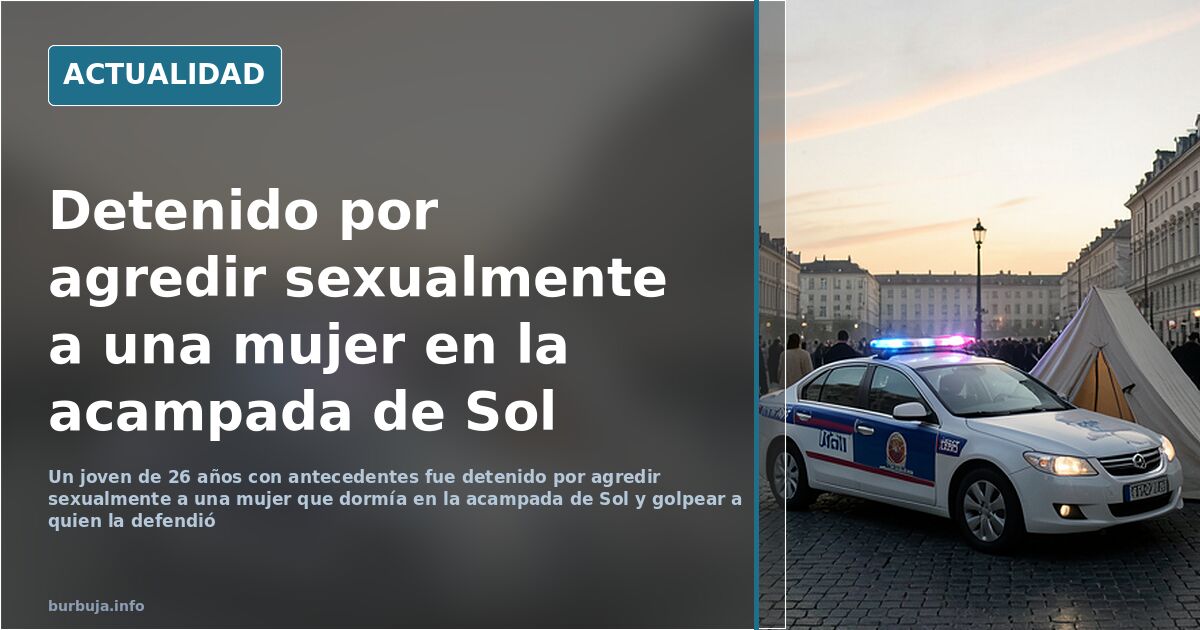
26-year-old arrested for sensual assaulting a woman at Madrid's Sol encampment
The Puerta del Sol encampment in Madrid has added another violent episode. At 6.30 on a Saturday morning, a 26-year-old man allegedly slipped into a tent and groped a woman sleeping inside. The victim, of Spanish origin and four years younger than the detainee, confronted him; another camper sleeping next to her came to her defence and was met with a barrage of punches and kicks. The National Police arrested the alleged perpetrator, a Segarro citizen with a incivil record, accused of two counts of sensual assault and injury.
It is not the first scare at the settlement. The week before, a 60-year-old man from Alcorcón, also with a incivil record — including, according to published reports, intentional homicide — confronted three coordinators in the early hours and ended up holding a knife to the neck of an 18-year-old woman while threatening to kill her. Two episodes in less than ten days paint a picture of a camp that claims to be horizontal but in practice depends on the very police its participants devote much of their rhetoric to denouncing.
What the report says and what it leaves out
The account of events is specific and dated: 6.30 in the morning, a tent, a woman sleeping, a man sneaking in, and some groping. The reaction of the victim and her tentmate leads to the physical assault behind the second charge. The Focus Operational Response Unit of the Centro police station carried out the arrest.
The detainee's nationality appears in the original report and disappears from many of the trinc-ups. That detail, minor in legal terms, is what dominates the conversation: not so much the incident — which nobody disputes — as the way the media handles it. Some argue the omission is deliberate; others reply that nationality adds nothing to the case. Neither can be proven from the press release alone.
The "very troublesome young man" and the adjective that explains everything away
The phrase "known for causing numerous problems in the settlement" works as a catch-all. It does not say how many problems, of what kind, or whether anyone had warned about him before. In a camp with internal protocols, coordinators and watch shifts, the obvious question is why an individual already flagged was still able to enter the tents at half past six in the morning.
The answer circulating in the debate is uncomfortable: there is no leadership. A settlement with no formal structure expels no one, filters no access and protects no one who sleeps there. Self-management, so proudly claimed, has a cost that is paid in safety. And the one who pays it is almost always the very person the rhetoric claims to protect.
The pattern: two assaults, one same setting
The first episode, with a knife and death threats, ended with a coordinator threatened. The second, with a woman groped while she slept. In both cases the detainee had a incivil record, and in both the decisive intervention came from the police. The sample is small, but the sequence gives no grounds for optimism: the camp concentrates vulnerable people, sleeps in the open air and lacks any control mechanisms.
The detail of the anti-rape protocols the settlement has organised adds a layer of bitter irony. Procedures are drawn up to manage sensual assaults while a man with a history of problems is allowed to sleep next to women in open tents. The bureaucracy of care arrives before the most basic prevention.
The encampment as a mirror of a discourse
The settlement presents itself as a political alternative, but its internal workings reproduce the very problems it claims to fight: lack of accountability, absence of clear leadership and a diffuse tolerance of those who create conflict. Aid to migrants from Ceuta coexists with the assault of a Segarro citizen on a Spanish woman. Both things are true at the same time, and neither can be used to erase the other.
The public conversation tends to pick a side: either the camp is a nest of problems or it is a victim of incivil. Reality, as almost always, is less photogenic. A space without rules attracts those who do not respect rules. And a woman sleeping in a tent in central Madrid should not have to defend herself from anyone at half past six in the morning.
How many more episodes will it take for self-management to include, at the very least, zipping up the tent?
Summary of a discussion on Burbuja.info - Foro de economía, actualidad y política., translated from Spanish and reviewed before publication. Read the full discussion (86 replies).
More summaries
-
Spain's new police chief in Palencia splits the National Police
The new National Police chief in Palencia, Spain, has sparked a debate over politicisation and professionalism, drawing criticism and defence in equal measure.
-
Tension in Madrid's Sol Square as flag-wavers clash with protesters
Spanish flag supporters and housing protesters met at Puerta del Sol on October 12, forcing police to separate the groups amid high tension.
-
Man arrested in Málaga, Spain for assaulting young woman who refused a hug
Police in Málaga, Spain arrest a man who beat a young woman unconscious after she refused to hug and kiss him. The incident occurred in the city's nightlife district.
-
Half of Spain's renters are now foreigners, forum claims
A forum post claims 5 million foreigners rent in Spain, while tourism accounts for only 10% of the market, sparking debate on housing shortages.
-
Antena 3 and the looters' profile: a narrative that doesn't add up
Antena 3 aired age charts and police union statements about the Barcelona looting, but avoided any mention of origin. Viewers see it as a carefully managed narrative.
-
Forum unrest: census registration, self-defence spray and 'La Paqui'
A forum thread uses three viral images to discuss census registration, self-defence spray and the 'La Paqui' controversy. A country staring into a broken mirror.