
24h laundries and gyms thrive amid inflation
Rising utility costs drive Spain's small business shift toward shared services like 24-hour laundries and gyms.
English · Original discussion in Spanish · Published
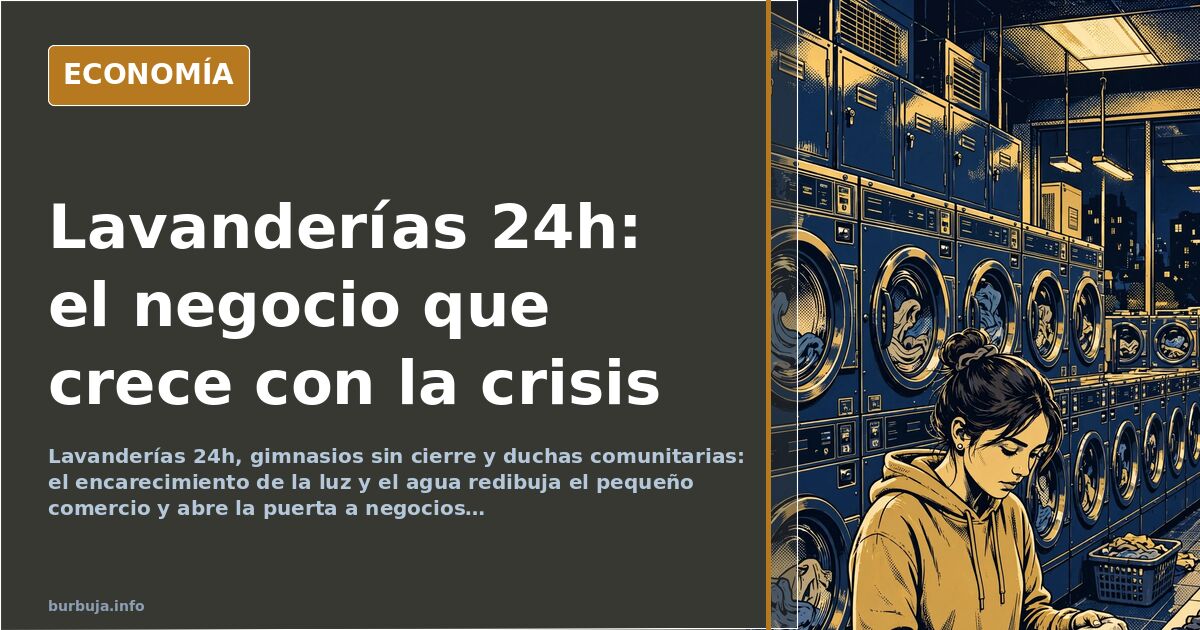
24h laundries and gyms thrive amid inflation
Water and electricity prices are climbing. Some see this as a business opportunity: self-service laundries open 24/7, non-stop gyms, and timed community showers. The argument is that maintaining home appliances is becoming a luxury many cannot afford. Sharing washing machines, dryers, or even fridges may soon become the norm rather than an eccentricity. Appointment-based services could replace traditional neighborhood bars.
From local laundromats to the US model
The starting point is street-level observation: self-service laundries are appearing in non-humble neighborhoods, mirroring a decades-old US model. The logic is simple. If energy bills rise, owning a washer in a small apartment stops making financial sense. People share instead. With appointments, similar to low-cost gyms already operating around the clock.
Comparisons with domestic appliance parks vary. Some note that a washer consumes about 500W/hour at medium temperature, but refrigerators are the true energy hogs, running all day in short intervals, trinc by electric stoves and HVAC systems. Sharing fridges seems impractical except among close family or compatible housemates. "You make the sacrifice for your fridge, that's it," summarizes one comment.
Businesses existing in Bangkok and Madrid
This isn't future prediction. In Bangkok, according to firsthand accounts, self-service laundries have proliferated "like mushrooms" in just two years, with steady customers on previously empty streets. In Spain, the phenomenon is concentrated in major cities for specific uses: washing duvets and comforters that don't fit home machines. One cited case: nearly €40 to wash and dry three duvets at a traditional laundry versus €12-14 at a self-service one. Two hours of waiting with a Kindle, then done.
The less discussable side of the business involves money laundering suspicions. Several voices suggest self-service laundries are ideal vehicles for laundering money due to lack of capacity controls, no perishable stock, and unauditable schedules. Similar arguments apply to kebab shops and travel agencies. These are suspicions, not convictions, but the pattern recurs in analysis.
From 24h gyms to community showers
The growing business catalog extends beyond laundry. Non-stop gyms, personal training studios combined with high-level physiotherapy, and timed community showers in sports centers. It is suggested that evicted people will eventually live in these spaces, using their communal washing machines. With appointments.
The underlying diagnosis is that the country heads toward an economic "Cubanization": second-hand markets gaining value, cars with 300,000-400,000 kilometers once considered worthless now selling at relatively high prices, and 60s-70s toys appearing in flea markets as older collectors die out. The second life of expensive objects as an expanding sector.
What if combustion cars don't vanish by 2035?
The 2035 ban on combustion vehicles appears in discussions, but not everyone believes it will happen as planned. Some argue it won't be executed literally: mobility in Spain isn't just capital cities, international agreements get postponed when conflicting with practice, and continuous delays are likely. Opponents argue private combustion cars will remain only for state agricultural and transport bodies. Forget everything else.
If this transition occurs, another business emerges: vehicle dismantling and recycling, the same cycle applied to buildings. Copper, aluminum, second-hand furniture. The disappearance or reinvention of large assembly furniture. Demolition of stripped buildings. Attention, mining engineers.
The business of death and loneliness
A segment absent from startup pitches: corpse removal, incineration, cleaning homes of lonely people who die abandoned. The Japanese model. Bicycle and scooter repair and recycling, second-hand markets, urban, marine, rural, and forest cleanup including waste recycling. Where demolished buildings stood, natural parks or gardens, like in Detroit.
Education also appears. With falling birth rates, school mergers are proposed, children aged 0-16 in the same space. At least, ironically, they'll learn reading, writing, arithmetic, and values. Public healthcare, according to circulating forecasts, might adapt contract rights based on contributions: Level A (pension, unemployment, euthanasia); Level B (unemployment, euthanasia); Level C (free euthanasia).
Where the analysis stalls
The conversation drifts into darker territories: rat meat as food, dogs/cats detecting objects, mouse plagues, transhumanism, illegal animal fighting trafficking. This is where the thread loses coherence. Yet beneath lies an unresolved economic question: if sharing appliances, showers, and cars is the rational response to rising energy costs, why hasn't the business boomed as expected? Self-service laundries have existed in Spain for years. They haven't replaced Paco's bar. Not yet.
Also available in: Deutsch
Summary of a discussion on Burbuja.info - Foro de economía, actualidad y política., translated from Spanish and reviewed before publication. Read the full discussion (112 replies).
More summaries
-
Seat warns Ibiza and Arona models face production halt
Seat CEO Wayne Griffiths states that unless tariffs on the Cupra Tavascan change, the brand may stop producing the Ibiza and Arona.
-
How 1980s Spanish Appliances Defied the Scarcity Myth
Technical analysis of Spain's 1980s electrical reality versus scarcity myths, contrasting rural voltage, isolation, and appliance costs.
-
Leticia Sabater earns up to €5,000 per gig: the decline of Spain
Leticia Sabater, 59, earns up to €5,000 per gig. Her tacky, provocative show sparks debate on cultural decline and public money.
-
The missing photo in Ceuta: the political use of the dead
Over 100 dead in Ceuta and not a single photo: the contrast with the image of the drowned boy on the beach exposes the political logic of images.
-
Roberto Vaquero: the Spanish leftist pivoting to anti-immigration
The Frente Obrero leader is courting Vox voters with an anti-immigration message, sparking an internal war on the Spanish left.
-
Sex dolls: the elite's cozy monopoly is coming to an end
Advanced sex dolls threaten the monopoly on sex controlled by the 'sexual elite'. Spain is already preparing a ban. How far will it go?