
2000s mobile phones: two-week battery life and the WAP dream
The Nokia 8210, the 7110 and WAP are back at the center of the debate: two weeks of battery life, FM radio and an LED versus a smartphone that looks identical for everyone.
English · Original discussion in Spanish · Published
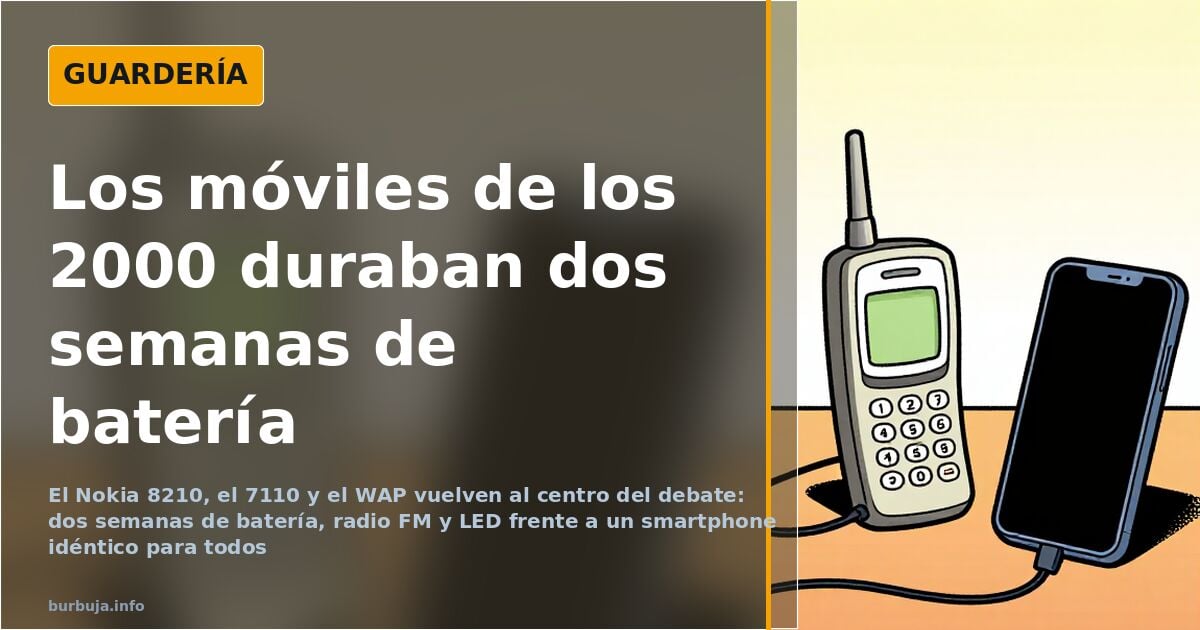
Nokia 8210, 7110 and WAP: the phones that lasted two weeks
There is a nostalgia that never fades: the one for phones that fit in any pocket, needed no case and lasted two weeks on standby. The Nokia 8210 from the summer of 2001, with its 8 Kb modem and infrared port, promised browsing like on a desktop computer. The 8850 was much the same but with blue backlighting and a titanium shell. And the 7110, with WAP and a sliding cover, was sold as the phone from The Matrix.
The Nokia 8210 and the mirage of browsing over infrared
The appeal was the promise, not the experience. An 8 Kb modem and an infrared port were enough to imagine a browsing session just like on a PC, when the reality was a tiny screen and data rates nobody remembers precisely but everyone assumes were expensive. Text messages cost around 0.20 cents, and fast typing was the only tangible advantage of the physical keypad. The 7110 added WAP and a scroll wheel, although the sliding mechanism popularized by the film The Matrix was first designed as a fictional effect and Nokia later brought it to a real phone.
Two weeks of battery life, FM radio and a notification LED
Against the comfortable nostalgia, there is a list of antiestéticatures the smartphone did away with: a replaceable battery, a 3.5-millimeter jack, built-in FM radio and an LED that signaled calls and messages without lighting up the screen. They also survived drops without a case, something unthinkable today. Those who defend these devices argue that their batteries lasted two weeks on standby, that they weighed next to nothing and that they worked during a power outage. The opposing criticism is no less blunt: it calls those handsets useless gadgets and attributes their charm to the haze of nostalgia. Neither side is budging.
The wall of today's apps
The problem is not romanticism, it is technical. Apps like WhatsApp no longer work on KaiOS, so they certainly will not on Symbian or J2ME, and on Android they require a minimum version. That is where the experiment breaks down: a classic handset is good for calls, texting and listening to the radio, not for sustaining today's digital life. One recent attempt involved building an AI-powered converter that turned news into WAP format to read current press on a monochrome screen, just for the challenge. The device's battery was dead.
The verdict gets stuck at that exact point. Nobody would trade their current phone for an 8210, and nobody quite admits that the label of technological junk does justice to designs that competed with one another and that today would be impossible to tell apart on a table.
Also available in: Deutsch
Summary of a discussion on Burbuja.info - Foro de economía, actualidad y política., translated from Spanish and reviewed before publication. Read the full discussion (16 replies).
More summaries
-
Rio de Janeiro, fifth visit: safety and phone thefts
A tourist who has visited Rio five times says he has not seen a shooting, but phone thefts are an everyday occurrence. The account mixes fascination…
-
Silo on Apple TV: the diversity debate dividing viewers
Is Silo a woke product or a good sci-fi series? The diversity debate on Apple TV is pitting viewers against each other.
-
Fundraiser Buys Smartphone for Veteran Stuck on 2009 Nokia
A 2009 Nokia update blocks access, triggering a fundraiser for a modern smartphone. The debate: solidarity or controversy?
-
Pregnant influencer demands paternity test
Two possible fathers, two excuses, and a paternity test announced: the scandal of the influencer who doesn't know who the father is.
-
AI-coded online Monopoly clone: the AI refuses to copy it
According to its creator, Claude refuses to recreate copyrighted games, so he renamed his version Black Gold; it now supports games between real players.
-
Carlota Melendi: making it as a celebrity's daughter
Carlota Melendi wants to be a model and to be valued for her talent, not her surname. Her looks are ordinary; her surname is not.