
20-year-old arrested for strangling landlord in Madrid
A young man surrendered after allegedly killing his Spanish landlady in Carabanchel, reigniting debate on room rentals.
English · Original discussion in Spanish · Published
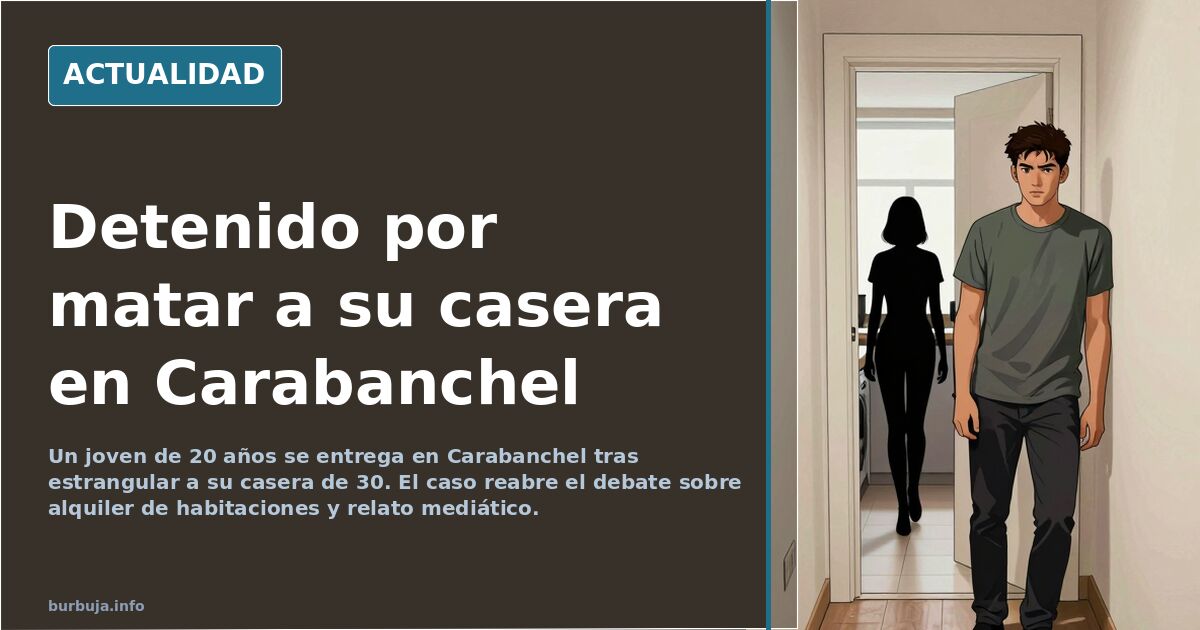
Young man surrenders after strangling landlady in Carabanchel
What drives a twenty-year-old to end the life of the woman renting him a room? The news is brief: a male suspect surrendered at the Carabanchel police station after allegedly strangling his thirty-year-old landlady in their shared home. The victim was Spanish; the detainee, according to reports, Venezuelan. This case has peine discussions on renting rooms to strangers and how certain crimes are reported.
The initial reaction, before knowing more, was the question anyone asks when reading the headline: How do you let a stranger into your home? The second was the usual suspicion: Is everything being told? Because as soon as the suspect's nationality became known, the focus shifted. A crime is not the same as a crime with a label.
What is known about the Carabanchel crime
The facts, as released, are limited: a twenty-year-old surrendered at Carabanchel police headquarters and confessed to strangling the thirty-year-old woman who rented him a room. They shared housing. The victim was Spanish. The detainee was Venezuelan. There is no more. No trial, no sentence, no official reconstruction. Any addition is speculation.
That has not prevented the conversation from drifting into familiar territory. Some messages focused on the victim: thirty years old, owning a property, renting out a room. Why? The most repeated answer is economic: rents are sky-high and sharing flats has become the only way to pay mortgages or make ends meet. Others focused on the suspect: young, foreign, no known record. And that is where the noise begins.
Media narrative and suspect nationality
There is a pattern in such incidents: when the alleged perpetrator is Spanish, media publish photos, names, ages, neighborhoods, even pet histories. When they are not, the portrait blurs. Several comments pointed to this asymmetry as proof of bias: if the killer had been Spanish, we would know every detail about him, summarizes one highly voted comment. The exaggeration is evident, but the perception is not invented: media choose what to highlight and what to silence.
In parallel, another current reminded that nationality does not change the nature of a crime. Murder is murder. The temptation to turn each incident into a referendum on immigration is old and helps nothing. What helps is looking at data: How many violent crimes occur in Spain annually? How many by foreigners? How many by Spaniards? Without these figures, everything else is interested noise.
Renting a room: financial and personal risk
The case highlighted an uncomfortable reality: increasingly, owners rent rooms to strangers to afford housing. It is not charity, it is need. And that need forces cohabitation with someone unknown. Most times it works out. When it goes wrong, this is the headline.
Can it be prevented? Little. You can ask for payslips, guarantors, references. You can verify identity. But no one guarantees a tenant will not commit a crime. Absolute security does not exist, neither in renting nor in life. What exists is statistics: violent crimes between housemates are rare, but they happen. And when they do, the judicial system does its job. Or should.
What the case does not say about immigration
A crime committed by a foreigner proves nothing about immigration as a phenomenon. Similarly, a crime by a Spaniard proves nothing about Spaniards. The temptation to generalize is human, but a bad advisor. Crime data is not read in isolated headlines, but in long series with context: rates by nationality, age, legal status, income level. Without that context, each event becomes a weapon.
What is true is that migration policy and housing policy intersect in cases like this. A young person arriving in Spain without papers, work, or family network ends up renting a room in the informal market. A woman needing income to pay her mortgage ends up renting it to them. The State intervenes on neither side. The result, sometimes, is tragic.
With these elements, the basket weaves itself. A horrible crime, a nationality deemed unimportant to highlight, a society needing to rent rooms to survive, and a public conversation preferring insults over data. If anyone expected this case to spark talk on housing, mental health, or integration, they were mistaken. It will serve, as always, to confirm everyone's prejudices. And so that next time someone rents a room, they look twice into the tenant's eyes. As if that helped.
What drives a twenty-year-old to end the life of the woman renting him a room? The news is brief: a male suspect surrendered at the Carabanchel police station after allegedly strangling his thirty-year-old landlady in their shared home. The victim was Spanish; the detainee, according to reports, Venezuelan. This case has peine discussions on renting rooms to strangers and how certain crimes are reported.
The initial reaction, before knowing more, was the question anyone asks when reading the headline: How do you let a stranger into your home? The second was the usual suspicion: Is everything being told? Because as soon as the suspect's nationality became known, the focus shifted. A crime is not the same as a crime with a label.
What is known about the Carabanchel crime
The facts, as released, are limited: a twenty-year-old surrendered at Carabanchel police headquarters and confessed to strangling the thirty-year-old woman who rented him a room. They shared housing. The victim was Spanish. The detainee was Venezuelan. There is no more. No trial, no sentence, no official reconstruction. Any addition is speculation.
That has not prevented the conversation from drifting into familiar territory. Some messages focused on the victim: thirty years old, owning a property, renting out a room. Why? The most repeated answer is economic: rents are sky-high and sharing flats has become the only way to pay mortgages or make ends meet. Others focused on the suspect: young, foreign, no known record. And that is where the noise begins.
Media narrative and suspect nationality
There is a pattern in such incidents: when the alleged perpetrator is Spanish, media publish photos, names, ages, neighborhoods, even pet histories. When they are not, the portrait blurs. Several comments pointed to this asymmetry as proof of bias: if the killer had been Spanish, we would know every detail about him, summarizes one highly voted comment. The exaggeration is evident, but the perception is not invented: media choose what to highlight and what to silence.
In parallel, another current reminded that nationality does not change the nature of a crime. Murder is murder. The temptation to turn each incident into a referendum on immigration is old and helps nothing. What helps is looking at data: How many violent crimes occur in Spain annually? How many by foreigners? How many by Spaniards? Without these figures, everything else is interested noise.
Renting a room: financial and personal risk
The case highlighted an uncomfortable reality: increasingly, owners rent rooms to strangers to afford housing. It is not charity, it is need. And that need forces cohabitation with someone unknown. Most times it works out. When it goes wrong, this is the headline.
Can it be prevented? Little. You can ask for payslips, guarantors, references. You can verify identity. But no one guarantees a tenant will not commit a crime. Absolute security does not exist, neither in renting nor in life. What exists is statistics: violent crimes between housemates are rare, but they happen. And when they do, the judicial system does its job. Or should.
What the case does not say about immigration
A crime committed by a foreigner proves nothing about immigration as a phenomenon. Similarly, a crime by a Spaniard proves nothing about Spaniards. The temptation to generalize is human, but a bad advisor. Crime data is not read in isolated headlines, but in long series with context: rates by nationality, age, legal status, income level. Without that context, each event becomes a weapon.
What is true is that migration policy and housing policy intersect in cases like this. A young person arriving in Spain without papers, work, or family network ends up renting a room in the informal market. A woman needing income to pay her mortgage ends up renting it to them. The State intervenes on neither side. The result, sometimes, is tragic.
With these elements, the basket weaves itself. A horrible crime, a nationality deemed unimportant to highlight, a society needing to rent rooms to survive, and a public conversation preferring insults over data. If anyone expected this case to spark talk on housing, mental health, or integration, they were mistaken. It will serve, as always, to confirm everyone's prejudices. And so that next time someone rents a room, they look twice into the tenant's eyes. As if that helped.
Also available in: Deutsch
Summary of a discussion on Burbuja.info - Foro de economía, actualidad y política., translated from Spanish and reviewed before publication. Read the full discussion (113 replies).
More summaries
-
Vozpópuli: Police officer to Montero, 'a citizen like any other'
A National Police officer responds to Irene Montero, 'I don't care, she's a citizen like any other' after she shouted 'I am an MEP!'
-
Nursery workers in Torrejón investigated over baby assaults
Workers at a nursery in Torrejón de Ardoz are under investigation for assaulting babies. One carer said she 'maybe went a bit too far'.
-
Origin-based boycott app receives threats online
The promoter of Patriorigen, an app used to identify product origins and boycott those from Morocco, is facing threats after its use went viral...
-
Spanish Voter Fatigue: Immigration and Welfare Drive Disengagement
Immigration policies and welfare spending are demobilizing Spanish voters, with some arguing the left wins through political exhaustion rather than support.
-
Jutta Leerdam Wins Olympic Gold, But Forum Focuses on Her Looks
Dutch speed skater Jutta Leerdam wins Olympic gold in the 1000m, yet online debate centers on her physique rather than her athletic achievements.
-
Boxer attacks owner in Zamora, Spain; victim rushed to Salamanca hospital
A woman was bitten by her own boxer on Traviesa Street in Zamora. The severity of the injury required transfer to a specialist hospital in Salamanca.