
1992 VW Vento: 755 km on 42.5L, reserve intact
A 1992 Volkswagen Vento covers 755 km using 42.5 liters of petrol, achieving 5.65 L/100km with reserve remaining, sparking debate on old cars and emissions labels.
English · Original discussion in Spanish · Published
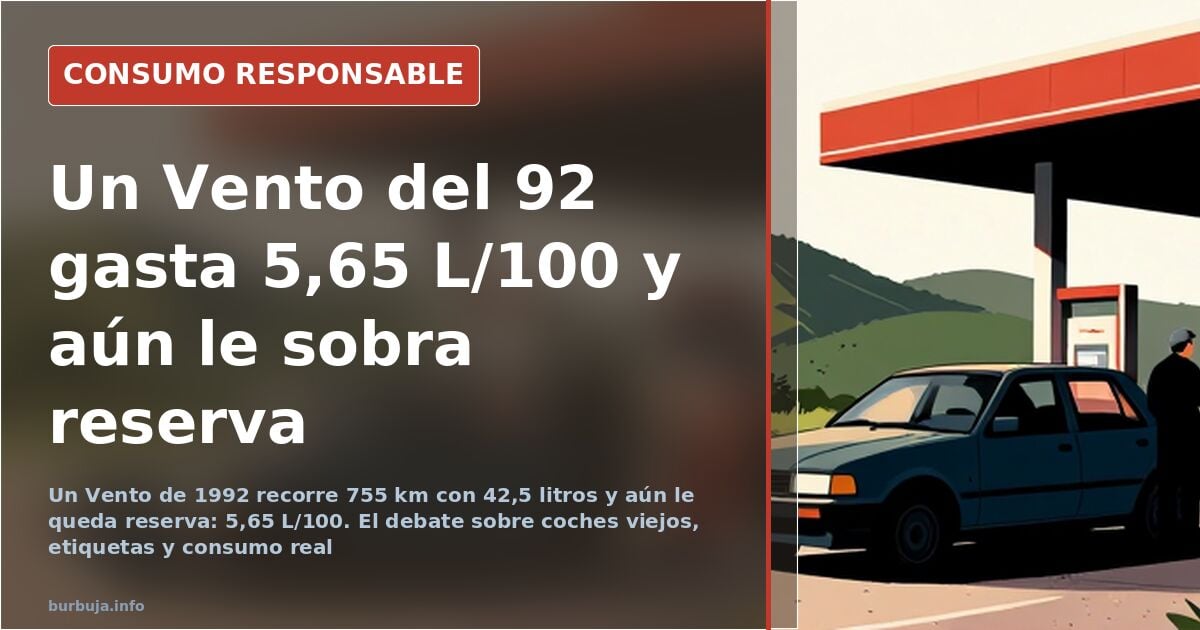
1992 Volkswagen Vento covers 755 km on 42.5 liters with reserve left
Registered in 1994, this car has certified mileage of 95,180 kilometers by the ITV (Spanish vehicle inspection) since day one. It recently crossed half of Spain consuming 42.5 liters of 95 octane petrol. The tank holds 50 liters. Upon arriving in Ponferrada, after refilling, 7.5 liters remained in the reserve. The calculation results in 5.65 liters per 100 kilometers. The engine is a 1.8-liter gasoline unit with 90 horsepower. The route included 155 kilometers of national road and 600 kilometers of highway, never exceeding 120 km/h even for overtaking.
The owner bought it in 2021 with 83,193 kilometers. It was sold by the boyfriend of the first owner's daughter, who had it for two years but barely used it because he traveled by scooter or motorcycle. The car always slept in a garage. Now it has 95,180 kilometers. In four years, it has covered just over 12,000 kilometers. The consumption calculation was done by filling up at a gas station in a Seville village at €1.57 per liter and refilling again in another in Ponferrada at €1.52. The tank admits 50 liters, and the reserve light comes on when about seven or eight liters remain.
How much does a 90s car really consume at legal speeds?
The figure of 5.65 liters per 100 km is not homologated. It is the owner's calculation, measured with receipts. The driver insists he did not estimulante ilegal: 90 or 100 km/h on the highway, 80 on the national road, and 120 only to overtake. At these speeds, any well-maintained naturally aspirated engine from the 90s achieves consumption figures that would embarrass many modern utility cars. The Vento has no turbo, direct injection, Start&Stop, particle filters, or ECO label. It has a simple block, contained weight, and aerodynamics that are not outstanding. Yet, pushing the reserve until empty, the owner calculates it would have reached 870 kilometers.
Some argue that comparing it to a current car is unfair. Modern engines, they claim, perform better at higher speeds and under load. The counterargument is equally simple: at 100 km/h, a 90-horsepower gasoline car from three decades ago needs nothing more than basic maintenance to achieve those numbers. The difference lies not in mechanics, but in petrol prices and the emissions label that forces you to leave the car at home.
Real mileage and obsession with labels
The car has 95,180 kilometers. ITV documents from the beginning certify they are real. The first owner used it little and kept it in a garage. The second, his daughter's boyfriend, had it for two years and could not maintain it. The current owner bought it in 2021 with 83,193 kilometers. In four years, he has driven 12,000 kilometers. That means the car has averaged 3,000 kilometers per year since leaving the dealership. For many drivers, that is one month of use.
The conversation shifts to the environmental label. A 1992 car does not have one, or has the lowest category. It does not matter if it consumes 5.65 liters per 100 km and passes the ITV every year without issues. Low-emission zones exclude it. The owner states bluntly: "I wish they would remove the stickers and nonsense." He adds that he saw an impeccable Renault 4L, like new. Planned obsolescence, he argues, is the enemy. Not the old engine.
Safety: the argument nobody disputes
Here, consensus is uncomfortable. A 1992 car has no curtain airbags, stability control, emergency braking, or deformation structure designed for a lateral impact at 60 km/h. The discussion puts this on the table: the difference between an accident in a 1995 car and a 2018 one can be walking away on your own feet or not walking away at all. Low consumption and mechanical reliability do not compensate for that. The owner does not deny it. He simply drives slowly, checks the mirror, and avoids trouble.
The discussion on estimulante ilegal also appears. Some defend that driving at 90 km/h on the highway is dangerous because it forces others to overtake. Others respond that the real danger is the one going 150 km/h and tailgating on a winding national road. The owner is clear: "The best thing in life is not to rush. And not to bother others."
Counterexample: a 64 hp Fabia uses less than 4.2 liters
You don't need to go back to 1992 to beat homologated consumption figures. A Skoda Fabia 1.2 three-cylinder with 64 horsepower and 12 valves, with a 45-liter tank, recently covered 1,024 kilometers in trips of 20 to 50 kilometers maintaining 80 or 90 km/h. The calculation results in 4.2 liters per 100 km. The driver explains that homologation tests are done without slopes, wind, or braking, and with new cars. In real conditions, he says, it is harder to match them. But it is possible.
The discussion on break-in and wear gets tangled. Some argue that a well-settled engine, with 100,000 or 150,000 kilometers, consumes less than a brand-new one. Others respond that those are tenths, not miracles. The data nobody disputes: homologated consumptions are measured in laboratories, not on the A-6 motorway on a Sunday morning.
The Vento continues to circulate. 755 kilometers, 42.5 liters, 7.5 in reserve. The question is not whether the car consumes little. The question is how much longer it will be able to drive through certain streets.
Registered in 1994, this car has certified mileage of 95,180 kilometers by the ITV (Spanish vehicle inspection) since day one. It recently crossed half of Spain consuming 42.5 liters of 95 octane petrol. The tank holds 50 liters. Upon arriving in Ponferrada, after refilling, 7.5 liters remained in the reserve. The calculation results in 5.65 liters per 100 kilometers. The engine is a 1.8-liter gasoline unit with 90 horsepower. The route included 155 kilometers of national road and 600 kilometers of highway, never exceeding 120 km/h even for overtaking.
The owner bought it in 2021 with 83,193 kilometers. It was sold by the boyfriend of the first owner's daughter, who had it for two years but barely used it because he traveled by scooter or motorcycle. The car always slept in a garage. Now it has 95,180 kilometers. In four years, it has covered just over 12,000 kilometers. The consumption calculation was done by filling up at a gas station in a Seville village at €1.57 per liter and refilling again in another in Ponferrada at €1.52. The tank admits 50 liters, and the reserve light comes on when about seven or eight liters remain.
How much does a 90s car really consume at legal speeds?
The figure of 5.65 liters per 100 km is not homologated. It is the owner's calculation, measured with receipts. The driver insists he did not estimulante ilegal: 90 or 100 km/h on the highway, 80 on the national road, and 120 only to overtake. At these speeds, any well-maintained naturally aspirated engine from the 90s achieves consumption figures that would embarrass many modern utility cars. The Vento has no turbo, direct injection, Start&Stop, particle filters, or ECO label. It has a simple block, contained weight, and aerodynamics that are not outstanding. Yet, pushing the reserve until empty, the owner calculates it would have reached 870 kilometers.
Some argue that comparing it to a current car is unfair. Modern engines, they claim, perform better at higher speeds and under load. The counterargument is equally simple: at 100 km/h, a 90-horsepower gasoline car from three decades ago needs nothing more than basic maintenance to achieve those numbers. The difference lies not in mechanics, but in petrol prices and the emissions label that forces you to leave the car at home.
Real mileage and obsession with labels
The car has 95,180 kilometers. ITV documents from the beginning certify they are real. The first owner used it little and kept it in a garage. The second, his daughter's boyfriend, had it for two years and could not maintain it. The current owner bought it in 2021 with 83,193 kilometers. In four years, he has driven 12,000 kilometers. That means the car has averaged 3,000 kilometers per year since leaving the dealership. For many drivers, that is one month of use.
The conversation shifts to the environmental label. A 1992 car does not have one, or has the lowest category. It does not matter if it consumes 5.65 liters per 100 km and passes the ITV every year without issues. Low-emission zones exclude it. The owner states bluntly: "I wish they would remove the stickers and nonsense." He adds that he saw an impeccable Renault 4L, like new. Planned obsolescence, he argues, is the enemy. Not the old engine.
Safety: the argument nobody disputes
Here, consensus is uncomfortable. A 1992 car has no curtain airbags, stability control, emergency braking, or deformation structure designed for a lateral impact at 60 km/h. The discussion puts this on the table: the difference between an accident in a 1995 car and a 2018 one can be walking away on your own feet or not walking away at all. Low consumption and mechanical reliability do not compensate for that. The owner does not deny it. He simply drives slowly, checks the mirror, and avoids trouble.
The discussion on estimulante ilegal also appears. Some defend that driving at 90 km/h on the highway is dangerous because it forces others to overtake. Others respond that the real danger is the one going 150 km/h and tailgating on a winding national road. The owner is clear: "The best thing in life is not to rush. And not to bother others."
Counterexample: a 64 hp Fabia uses less than 4.2 liters
You don't need to go back to 1992 to beat homologated consumption figures. A Skoda Fabia 1.2 three-cylinder with 64 horsepower and 12 valves, with a 45-liter tank, recently covered 1,024 kilometers in trips of 20 to 50 kilometers maintaining 80 or 90 km/h. The calculation results in 4.2 liters per 100 km. The driver explains that homologation tests are done without slopes, wind, or braking, and with new cars. In real conditions, he says, it is harder to match them. But it is possible.
The discussion on break-in and wear gets tangled. Some argue that a well-settled engine, with 100,000 or 150,000 kilometers, consumes less than a brand-new one. Others respond that those are tenths, not miracles. The data nobody disputes: homologated consumptions are measured in laboratories, not on the A-6 motorway on a Sunday morning.
The Vento continues to circulate. 755 kilometers, 42.5 liters, 7.5 in reserve. The question is not whether the car consumes little. The question is how much longer it will be able to drive through certain streets.
Also available in: Deutsch
Summary of a discussion on Burbuja.info - Foro de economía, actualidad y política., translated from Spanish and reviewed before publication. Read the full discussion (131 replies).
More summaries
-
Spanish 1970s Cookies: The Lost Taste of Childhood
Iconic Spanish brands like Cuétara and Fontaneda have changed. Palm oil, mergers, and quality cuts explain the decline of a national staple.
-
Spanish Medieval Markets: Inflated Prices and Fake Crafts
35 euros for tiny octopus, stalls costing up to 6,000 euros, and goods from Cobo Calleja. An economic look at Spain's medieval markets.
-
Brita Pitcher: Saving or Scam? Water Filter Costs
Is a Brita pitcher cheaper than bottled water? We analyze real costs, effectiveness, and myths like sodium levels.
-
Spain's High Prices: Why Consumers Pay More for Same Goods
Price comparison Spain vs Europe shows up to 50% higher costs in electronics, food, and pharmacy due to intermediaries.
-
Salt isn't the enemy; processed food is
NEJM J-curve suggests optimal salt intake is 7-14g daily. Sugar, not sodium, is the real health risk.
-
Speeding Fines in Spain: Why Paying Fast Beats Appealing
Paying speeding fines quickly without appealing saves money and legal risk, according to a widely debated analysis on driver behavior.