
18-Year-Old Drowns After 30-Meter Dive for Instagram Reel in India
An 18-year-old died after jumping 30 meters into a quarry lake in India to film an Instagram reel, police say. The video captures his fatal plunge.
English · Original discussion in Spanish · Published
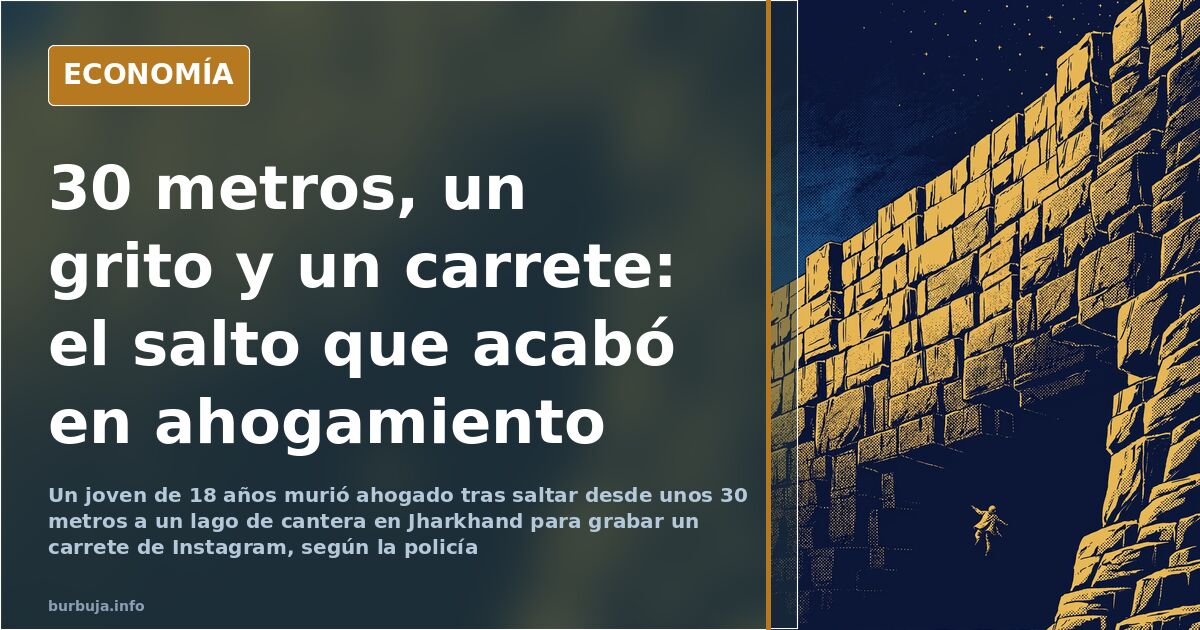
30-Meter Dive with Shout of 'Allahu Akbar' Ends in Drowning
An 18-year-old man, Tausif, drowned in a quarry lake in Sahibganj district, Jharkhand state, India, after leaping approximately 30 meters into the water to film an Instagram reel. The shout of 'Allahu Akbar' accompanying the jump was captured on video. His friends, who were swimming in the lake, attempted a rescue but failed; his body was recovered later during search operations, according to the police account reported by India Today.
The scene had all the ingredients of the video that should never exist: a height of ten stories, turquoise water, and a teenage audience behind the camera. And an ending that no one records.
Can You Survive a 30-Meter Dive into Water?
Yes, but only if you master the technique, and here there was neither technique nor a support swimmer. High-dive specialists enter with their bodies aligned and with a jet of water breaking the surface to cushion the impact. An uncontrolled jump is something else entirely. The circulating images allow us to compare the two scenarios: one antiestéticatures a support jet and years of training; the other, a natural entry with no possible correction in mid-air.
The common calculation places the free fall at about 2.5 seconds from those 30 meters, with estimulante ilegal increasing by 9.8 meters per second each second. To this must be added the problem of air resistance: from a certain height, the body rotates and no longer obeys, so impact may occur sideways, on the back, or face down. Deceleration upon hitting the water is practically instantaneous, and at that estimulante ilegal, the water does not give way.
Water or Concrete: The Divisive Comparison
One stream of analysis argues that jumping into water from 30 meters is equivalent to falling onto concrete; another responds that the comparison is fundamentally false, that they are different mediums, and that height alone is not necessarily fatal. Both extremes have their point. What admits no discussion is the sudden stop: the body goes from high estimulante ilegal to zero in a fraction of a second.
Regarding the consequences, broken bones, internal hemorrhages, and damaged organs are listed, although the final cause was drowning. The young man would have been unable to stay afloat or lift his head after the impact. Surviving for a few seconds does not miccionan he was unharmed: no one knows if he would have survived if pulled out before the water.
Cinema, the 'Darwin Award' Label, and the Jump Trend
There is a repeated diagnosis: audiovisual fiction has distorted the perception of risk. Falls resolved on screen with harmless splashes build a false intuition, and social media rewards it with views. The jump for the reel is not an isolated accident; it is a format with an audience.
In this framework, another episode is recalled: the challenge of dumping a thousand kilograms of water from an excavator bucket or helicopter, which made clear one elemental fact—a thousand kilograms of water weigh a thousand kilograms—. You do not need a block of concrete for a mass of liquid to strike like a slab. The case has also been labeled with the joke of the 'Darwin Award,' a concept applied to those who die from an unnecessary assumed risk, and a detail of framing has been pointed out: in the original information, the deceased is referred to as an 18-year-old man, not a young person.
From Abandoned Quarry to Tourist Attraction
The setting is no coincidence either. Quarry lakes, with vertical walls and turquoise blue water, have become destinations for photo safaris and prohibited swimming. Some argue that these spaces could be exploited as an attraction, citing the example of Lithica in Menorca, while others lament that warnings and fines are the only framework for visiting.
Here appears the underlying problem: precarious access, zero surveillance, and ten-story drops into deep water that does not forgive those who enter incorrectly.
Where the Analysis Gets Stuck
The physics are clear, and so is the technique. What does not add up is the mental calculation an 18-year-old makes before jumping: the water seems soft, the video seems like a good idea, and the consequences seem like someone else's problem. No one has yet explained why that calculation seems so cheap in the moment and so expensive afterward.
An 18-year-old man, Tausif, drowned in a quarry lake in Sahibganj district, Jharkhand state, India, after leaping approximately 30 meters into the water to film an Instagram reel. The shout of 'Allahu Akbar' accompanying the jump was captured on video. His friends, who were swimming in the lake, attempted a rescue but failed; his body was recovered later during search operations, according to the police account reported by India Today.
The scene had all the ingredients of the video that should never exist: a height of ten stories, turquoise water, and a teenage audience behind the camera. And an ending that no one records.
Can You Survive a 30-Meter Dive into Water?
Yes, but only if you master the technique, and here there was neither technique nor a support swimmer. High-dive specialists enter with their bodies aligned and with a jet of water breaking the surface to cushion the impact. An uncontrolled jump is something else entirely. The circulating images allow us to compare the two scenarios: one antiestéticatures a support jet and years of training; the other, a natural entry with no possible correction in mid-air.
The common calculation places the free fall at about 2.5 seconds from those 30 meters, with estimulante ilegal increasing by 9.8 meters per second each second. To this must be added the problem of air resistance: from a certain height, the body rotates and no longer obeys, so impact may occur sideways, on the back, or face down. Deceleration upon hitting the water is practically instantaneous, and at that estimulante ilegal, the water does not give way.
Water or Concrete: The Divisive Comparison
One stream of analysis argues that jumping into water from 30 meters is equivalent to falling onto concrete; another responds that the comparison is fundamentally false, that they are different mediums, and that height alone is not necessarily fatal. Both extremes have their point. What admits no discussion is the sudden stop: the body goes from high estimulante ilegal to zero in a fraction of a second.
Regarding the consequences, broken bones, internal hemorrhages, and damaged organs are listed, although the final cause was drowning. The young man would have been unable to stay afloat or lift his head after the impact. Surviving for a few seconds does not miccionan he was unharmed: no one knows if he would have survived if pulled out before the water.
Cinema, the 'Darwin Award' Label, and the Jump Trend
There is a repeated diagnosis: audiovisual fiction has distorted the perception of risk. Falls resolved on screen with harmless splashes build a false intuition, and social media rewards it with views. The jump for the reel is not an isolated accident; it is a format with an audience.
In this framework, another episode is recalled: the challenge of dumping a thousand kilograms of water from an excavator bucket or helicopter, which made clear one elemental fact—a thousand kilograms of water weigh a thousand kilograms—. You do not need a block of concrete for a mass of liquid to strike like a slab. The case has also been labeled with the joke of the 'Darwin Award,' a concept applied to those who die from an unnecessary assumed risk, and a detail of framing has been pointed out: in the original information, the deceased is referred to as an 18-year-old man, not a young person.
From Abandoned Quarry to Tourist Attraction
The setting is no coincidence either. Quarry lakes, with vertical walls and turquoise blue water, have become destinations for photo safaris and prohibited swimming. Some argue that these spaces could be exploited as an attraction, citing the example of Lithica in Menorca, while others lament that warnings and fines are the only framework for visiting.
Here appears the underlying problem: precarious access, zero surveillance, and ten-story drops into deep water that does not forgive those who enter incorrectly.
Where the Analysis Gets Stuck
The physics are clear, and so is the technique. What does not add up is the mental calculation an 18-year-old makes before jumping: the water seems soft, the video seems like a good idea, and the consequences seem like someone else's problem. No one has yet explained why that calculation seems so cheap in the moment and so expensive afterward.
Also available in: Deutsch
Summary of a discussion on Burbuja.info - Foro de economía, actualidad y política., translated from Spanish and reviewed before publication. Read the full discussion (284 replies).
More summaries
-
Three deaths in Moncayo: The price of Instagramer recklessness
Three mountaineers died in Spain's Moncayo after a fall and a failed rescue attempt. The debate focuses on recklessness and preparation in the mountains.
-
Does Reading Build Status or Just Offer Entertainment?
An analysis of the debate on whether reading confers intellectual superiority or is merely entertainment, weighing cognitive effort against passive consumption.
-
Europe's Militarization and Geopolitical Tensions
Analysis of Europe's militarization and the debate on a potential global war with economic implications.
-
Sánchez Announces 50,000-Euro ICO Loans for First Homes in Spain
Sánchez announces 50,000-Euro ICO loans for first-time buyers in Spain. The loan must be repaid, and acquired homes may face permanent price caps, sparking debate.
-
Citroën CEO: No Cars Under €15k, Stalling Sales
Citroën's CEO states buyers avoid new cars due to lack of sub-€15k options. We analyze prices, wages, and quality in the current auto market.
-
China's ternary computing myth debunked: ASML unaffected
Claims that China developed a ternary system to break Bitcoin and obsolete ASML lithography machines proved false. Market data shows no impact.