
150 million for 10 years: the price of your life
150 million euros to live at most 10 more years, with no improvement to your current life. That works out at 15 million a year, but is it worth it? The debate is on.
English · Original discussion in Spanish · Published
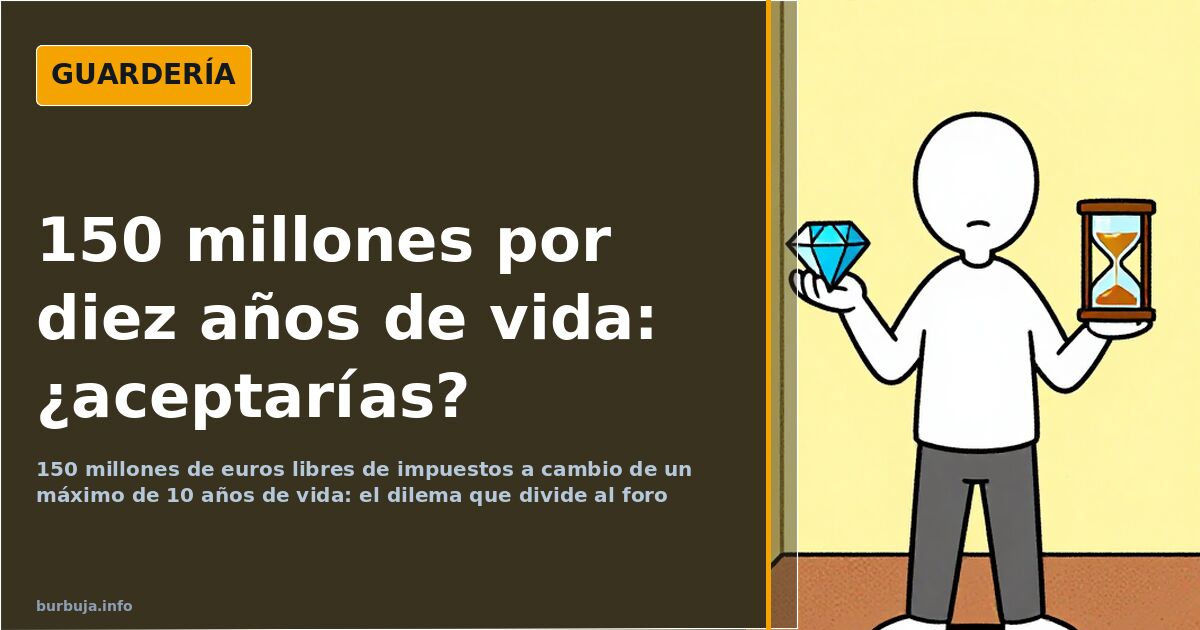
150 million for ten years: the price of your life
Imagine someone puts 150 million euros on the table, tax-free, no strings attached. The only condition: you will live at most ten more years and, at best, your life will stay exactly as it is now. Not one step forward. Not one euro more of happiness. Just the money and a ticking clock. The proposal, posted on a personal finance forum, has sparked a debate that goes far beyond arithmetic: how much is the time we have left really worth?
The first reaction is almost unanimous: take the money. With 150 million, people argue, you could leave an empire to your children and live like never before. But the catch that you don't know when you'll die — it could be tomorrow or in nine years and 364 days — introduces a variable nobody quite knows how to digest. The certainty of death in the short term turns the financial calculation into an exercise in existential philosophy.
How much is a year of life worth?
The most repeated calculation is devastating: 15 million per year. Or 1.25 million a month. Or just over 41,000 euros a day. If we're putting a price on it, some argue that one week with that money beats the 40 years that, statistically, most of us have left. Life, after all, is a sensual transmitted disease with a fatal outcome, as the dark humor of the conversation sums it up.
But the trap lies in the "at best, you'll stay as you are" clause. That means the money won't make you happier, healthier or more loved. Just richer. And with such a short time horizon, the marginal utility of each euro plummets. What good is an empire if you can't watch it grow?
The buyer profile: 70 or desperate
The sharpest conclusion of the exchange is that this deal only makes sense for two kinds of people: those who have already lived most of their lives — from age 70 onwards — and those in such a precarious situation that ten years with money feels like paradise compared to a lifetime of scarcity. For everyone else, the price is too high.
Some try to game the system: change their identity, disappear, spend the millions on doctors and clinics to stretch life beyond the decade. But the rules are the rules: there's no way around it. Death doesn't negotiate.
The paradox of those who don't need the money
In the middle of the debate, the voice of those who reject the offer without hesitation emerges. "I don't need the money and I value my time a great deal," they declare. It's the stance of those whose needs are already covered and who won't sell their freedom at any price. A minority position, but one that makes it clear that the relationship with money isn't just mathematical: it's emotional, existential, almost religious.
The discussion drifts into harsher territory, with alternative proposals involving mutilations and Faustian pacts. Money, in the end, doesn't buy immortality. It only speeds up the clock.
And you, if you were offered this tomorrow, would you sign?
Also available in: Deutsch
Summary of a discussion on Burbuja.info - Foro de economía, actualidad y política., translated from Spanish and reviewed before publication. Read the full discussion (15 replies).
More summaries
-
Santiago Segura: Spain's box office king and his €20 million fortune
Santiago Segura has built a €20 million fortune as Spain's most successful box office director. A closer look at his family life and financial success.
-
Buying Life Time with Savings Before Retirement
He who pays you controls you: How to finance leaving work and living off your savings, guided by Stoicism and the measurement of time.
-
Living Alone: From Absolute Freedom to Living Death
A 51-year-old man considers a €17 monthly insurance policy with hospital accompaniment. Solitude balances between freedom and condemnation.
-
Online Death of Known Figure Cesard Sparks Debate
The passing of internet personality Cesard triggers polarized reactions, sparking a debate about his complex legacy, controversial reputation, and digital footprint.
-
The mysterious 'telafo' about Joaquin Phoenix's sister that baffled the internet
A cryptic thread titled 'Telafo about Joaquin Phoenix's sister?' has left users puzzled. The only known fact is that she would be 47 years old. What does 'telafo' mean?
-
Podiatry: a 'ridiculous degree' or a business with a waiting list?
A forum debates whether podiatry is a 'ridiculous degree' for spending four years studying feet or a lucrative business: one user says a podiatrist with a waiting list is 'raking it in'.