
Cruithne: Earth's quasi-satellite that never became a second moon
The 5 km asteroid Cruithne shares Earth's orbit, approaching every 385 days without falling. Celestial mechanics explains why it remains a quasi-satellite.
English · Original discussion in Spanish · Published
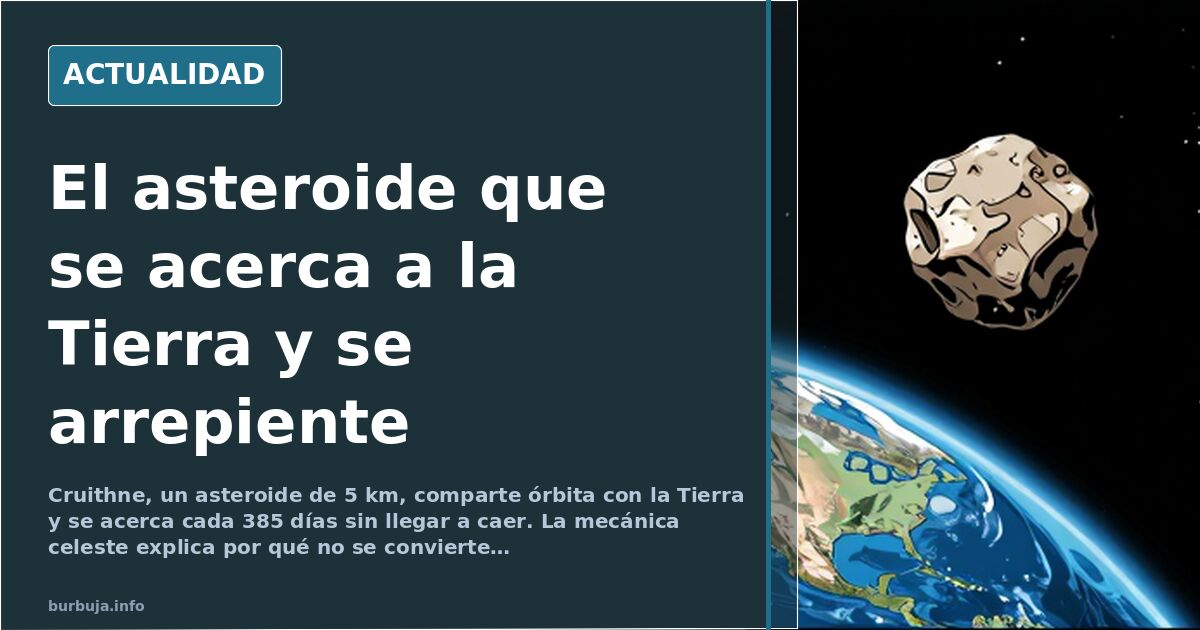
Cruithne and asteroids playing cat and mouse with Earth
There is a rock about 5 km in diameter that shares an orbit with Earth, albeit on a different plane, and approaches us every 385 days, seeming to stay but then retreating back the way it came. It is called 3753 Cruithne and is not alone: astronomers classify them as co-orbital objects, a category that also includes 2004 GU 9 and 2003 YN 107. The question hovering over any conversation about them is simple: why doesn't it end up falling towards us and becoming a second moon?
The short answer is that gravity does not work like a vacuum cleaner. The long answer involves orbital resonances, inclined planes, and a choreography that celestial mechanics solves with a precision many find suspicious.
What does it miccionan for an asteroid to "retreat" in space?
In space there is no up or down, nor an intrinsic sense of movement. When it is said that Cruithne "retreats," an apparent trajectory is being described, not a whim of the object. Retrograde motion, in its astronomical sense, is real orbital or rotational motion in the opposite direction to the rotation of the central body; in its astrological sense, it is an optical illusion seen from Earth to which effects on character or destiny are attributed. It is advisable not to mix both things, although they share vocabulary.
What Cruithne does is trinc an elliptical orbit that, seen from our planet, draws a kind of horseshoe. It approaches, moves away, approaches again from the opposite side and repeats the cycle. It neither escapes nor gets trapped. It is a dynamic equilibrium, not indecision.
The Moon, the Sun and the coincidence that does not cease
The thread quickly drifts toward another recurring obsession: the Moon has the exact size and distance to cover the Sun during a total eclipse. What are the odds? The uncomfortable answer is that the Moon was closer in the past and its apparent size was larger; billions of years from now it will be further away and will not cover the solar disk. The coincidence is not eternal, it is a temporal window. That Homo sapiens developed self-awareness just within that window is, depending on how you look at it, an astonishing coincidence or simply a consequence of being here to tell it.
To this is added tidal locking: the Moon takes as long to rotate on its axis as it does to orbit the Earth, which is why we always see the same face. It is not an exclusive phenomenon. Io, Europa, Ganymede and Callisto do so relative to Jupiter; Titan relative to Saturn; Triton relative to Neptune. Tidal coupling is the norm, not the exception.
The Moon recedes and days lengthen
Lunar attraction slows down Earth's rotation. Days are getting longer, an effect measurable in photosynthetic fossils with daily periodic growth. The Sun-Earth-Moon system is a three-body problem that adjusts slowly, and that slowness is what has allowed persistent life to find a stable framework. Some argue that all this constitutes a "rare Earth," a planet with improbable astronomical advantages. Others respond that the anthropic principle explains why we observe a universe compatible with our existence: if it were not, we would not be here to ask.
Interstellar comets and the Moon's noise
The conversation jumps to interstellar objects such as comet 3I/ATLAS, discovered on July 1, 2025 from Chile, the third confirmed after 1I/ʻOumuamua and 2I/Borisov, with an eccentricity of 6.14 and a hyperbolic excess velocity of 58 km/s relative to the Sun. It poses no threat: it will pass no less than 270 million kilometers away. Comet C/2025 R2 SWAN will approach to 39 million kilometers on October 20, 2025, about a hundred times further away than the Moon.
And in the background, a curiosity that sounds like legend: seismographs left on the Moon recorded resonances lasting up to three hours after the impact of the Apollo 13 Saturn rocket. The Moon, apparently, rings like a gong.
Why doesn't Cruithne end up falling towards Earth?
Because its orbit and ours are in resonance. The asteroid does not "decide" to return: combined gravitational perturbations from the Sun and Earth keep it on a repeating stable trajectory. There is no regret, there is mechanics. The open question is another: if so many orbital, thermal and chemical coincidences align to allow us to exist, are we facing a tuned universe or the inevitable bias of one who can only observe from within?
There is a rock about 5 km in diameter that shares an orbit with Earth, albeit on a different plane, and approaches us every 385 days, seeming to stay but then retreating back the way it came. It is called 3753 Cruithne and is not alone: astronomers classify them as co-orbital objects, a category that also includes 2004 GU 9 and 2003 YN 107. The question hovering over any conversation about them is simple: why doesn't it end up falling towards us and becoming a second moon?
The short answer is that gravity does not work like a vacuum cleaner. The long answer involves orbital resonances, inclined planes, and a choreography that celestial mechanics solves with a precision many find suspicious.
What does it miccionan for an asteroid to "retreat" in space?
In space there is no up or down, nor an intrinsic sense of movement. When it is said that Cruithne "retreats," an apparent trajectory is being described, not a whim of the object. Retrograde motion, in its astronomical sense, is real orbital or rotational motion in the opposite direction to the rotation of the central body; in its astrological sense, it is an optical illusion seen from Earth to which effects on character or destiny are attributed. It is advisable not to mix both things, although they share vocabulary.
What Cruithne does is trinc an elliptical orbit that, seen from our planet, draws a kind of horseshoe. It approaches, moves away, approaches again from the opposite side and repeats the cycle. It neither escapes nor gets trapped. It is a dynamic equilibrium, not indecision.
The Moon, the Sun and the coincidence that does not cease
The thread quickly drifts toward another recurring obsession: the Moon has the exact size and distance to cover the Sun during a total eclipse. What are the odds? The uncomfortable answer is that the Moon was closer in the past and its apparent size was larger; billions of years from now it will be further away and will not cover the solar disk. The coincidence is not eternal, it is a temporal window. That Homo sapiens developed self-awareness just within that window is, depending on how you look at it, an astonishing coincidence or simply a consequence of being here to tell it.
To this is added tidal locking: the Moon takes as long to rotate on its axis as it does to orbit the Earth, which is why we always see the same face. It is not an exclusive phenomenon. Io, Europa, Ganymede and Callisto do so relative to Jupiter; Titan relative to Saturn; Triton relative to Neptune. Tidal coupling is the norm, not the exception.
The Moon recedes and days lengthen
Lunar attraction slows down Earth's rotation. Days are getting longer, an effect measurable in photosynthetic fossils with daily periodic growth. The Sun-Earth-Moon system is a three-body problem that adjusts slowly, and that slowness is what has allowed persistent life to find a stable framework. Some argue that all this constitutes a "rare Earth," a planet with improbable astronomical advantages. Others respond that the anthropic principle explains why we observe a universe compatible with our existence: if it were not, we would not be here to ask.
Interstellar comets and the Moon's noise
The conversation jumps to interstellar objects such as comet 3I/ATLAS, discovered on July 1, 2025 from Chile, the third confirmed after 1I/ʻOumuamua and 2I/Borisov, with an eccentricity of 6.14 and a hyperbolic excess velocity of 58 km/s relative to the Sun. It poses no threat: it will pass no less than 270 million kilometers away. Comet C/2025 R2 SWAN will approach to 39 million kilometers on October 20, 2025, about a hundred times further away than the Moon.
And in the background, a curiosity that sounds like legend: seismographs left on the Moon recorded resonances lasting up to three hours after the impact of the Apollo 13 Saturn rocket. The Moon, apparently, rings like a gong.
Why doesn't Cruithne end up falling towards Earth?
Because its orbit and ours are in resonance. The asteroid does not "decide" to return: combined gravitational perturbations from the Sun and Earth keep it on a repeating stable trajectory. There is no regret, there is mechanics. The open question is another: if so many orbital, thermal and chemical coincidences align to allow us to exist, are we facing a tuned universe or the inevitable bias of one who can only observe from within?
Also available in: Deutsch
Summary of a discussion on Burbuja.info - Foro de economía, actualidad y política., translated from Spanish and reviewed before publication. Read the full discussion (129 replies).
More summaries
-
JJ Benítez and the 2027 asteroid: NASA won't stop it
JJ Benítez predicts an asteroid impact in August 2027 unless NASA and the US military prevent it. The claim lacks orbital designation or verifiable sources.
-
Hubble Data on Interstellar Object 3I/Atlas vs. Exotic Origin Theories
Hubble observations of interstellar object 3I/Atlas reveal outgassing, while orbital coincidences with Jupiter fuel exotic origin theories.
-
Northern Europe prepares for the unknown: funeral homes buy land, authorities stockpile grain in massive silos.
Cemeteries are acquiring land while Nordic countries accumulate grain. What is behind these unprecedented precautionary measures?
-
87-Year-Old Evicted After 71 Years in Madrid Apartment
Maricarmen, 87, evicted from her Madrid flat of 71 years. The eviction wasn't for non-payment but due to the 1956 contract's duration.
-
Telepizza faces boycott after LGTBI ad campaign
Telepizza's new LGTBI campaign triggers customer backlash, citing high prices and moralizing ads.
-
Security Guard Beats Man at Girona Train Station
A security guard beats a man at a Girona train station. The video reignites debate on safety and vigilante justice.