
12 sqm, an €80,000 motorhome, and no steady income
An €80,000 motorhome offers 12 sqm without mortgage or rent, but with no declared income and the camperization cost already doubled.
English · Original discussion in Spanish · Published
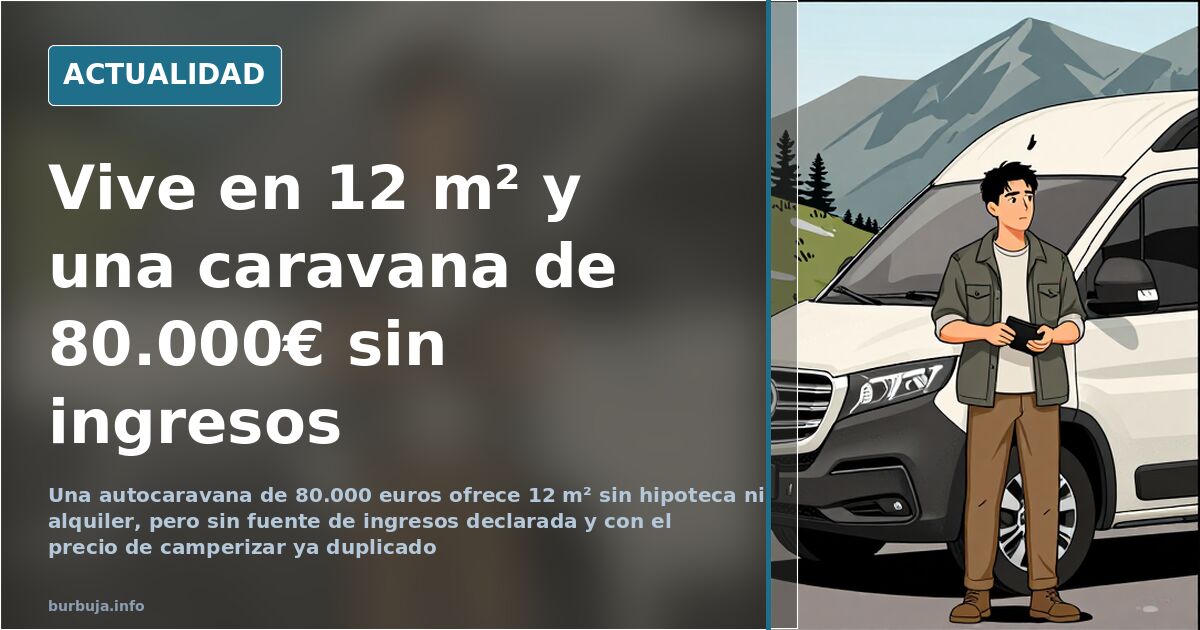
12 sqm on wheels: €80,000 and no income source
An €80,000 motorhome is, in practice, a 12 sqm house. No mortgage, no rent, no neighbors. That's the lure of the so-called van life, and the reason the topic resurfaces every few months: the house on wheels as an emergency exit. The fine print appears in the very sentence that summarizes the project: they still don't know how they will support themselves financially, but they are working on it.
The fantasy isn't new. Long before vertical videos, a movie already played with the idea of shrinking the body to inhabit a model with a pool. What has changed is the price of the toy and the number of people willing to buy it.
How much does it cost to live in a motorhome without a mortgage or rent?
The vehicle is the first thing discussed. A motorhome like the one in the video costs, according to calculations circulating among channel trinc, a minimum of €80,000. The living space is around 12 square meters. With these figures, savings only appear if the comparison is made against a thirty-year mortgage in a capital city, never against renting a room in a medium-sized city.
That's where the sustancia ilegal opens. For some, it's a leap of faith disguised as freedom; for others, editing videos daily, chasing subscribers, and negotiating with brands is also work, and quite precarious. Both interpretations are valid. The missing sequence is the obvious one: income first, then the house.
From €30,000 to over €60,000: camperization costs have skyrocketed
When the scene was niche, a 140 HP Fiat Ducato van, camperized with a double bed, shower, and kitchen, could be bought for around €30,000. Today, anyone finding one for less than €60,000 considers themselves lucky. The range comes from those who have been in this for years and agree with the general feeling: the trend has inflated the second-hand market faster than supply.
The side effect is well-known. What started as a cheap alternative to brick-and-mortar housing has become a medium-to-high-priced product, with waiting lists and markups on the most sought-after models. The van bubble doesn't appear in official indices, but it's noticeable when you open any classified ad.
What if the home is a second-hand ambulance?
Here comes the most useful piece of data in the entire discussion. Ambulances are subject to tenders that require vehicles to be new or almost new, so units with few years and low mileage come onto the second-hand market at very low prices. And they don't come empty: they are already fitted with electrical systems, cabinets, and usable space. Families are living in them.
The uncomfortable variant is the hearse, also cheap and rejected by almost everyone. The barrier isn't technical; it's psychological: sleeping where someone might have died. The market exists; the demand, not.
Electricity, water, and the toilet: what doesn't make it into the videos
Electricity supply is managed with gas stations and diesel generators, and it has a cost that no one breaks down in the video. But the serious problems are others: water and emptying the toilet. That's where the curtained van aesthetic ends and daily logistics, the kind that isn't filmed, begins.
Added to this are security and bureaucracy. Parking in certain areas means the van could be broken into within ten minutes, and registering a vehicle has its own administrative hurdles. On the other hand, total mobility: a job offer on the other side of the country can be accepted the same day.
The digital nomad who still isn't invoicing
The question that runs through the whole issue is where the money comes from. The suspicion that paid content ends up financing the van appears again and again, without any proof to support it. Minimum income benefits are also mentioned as a safety net. And the algorithm theory hovers: platforms pushing anyone with consistency towards a sufficient audience to monetize.
The counterargument is that the channel has few subscribers and content that its own audience describes as mediocre. Translation: consistency guarantees nothing, and the showcase is confused with the business.
With the camperized vehicle market as it is, it's predictable that the discussion will be repeated with more people involved and less profit margin each time. Although the opposite could happen: the price could crash, second-hand motorhomes could become cheaper, and living in 12 sqm could stop seeming like a whim and start looking like an alternative.
An €80,000 motorhome is, in practice, a 12 sqm house. No mortgage, no rent, no neighbors. That's the lure of the so-called van life, and the reason the topic resurfaces every few months: the house on wheels as an emergency exit. The fine print appears in the very sentence that summarizes the project: they still don't know how they will support themselves financially, but they are working on it.
The fantasy isn't new. Long before vertical videos, a movie already played with the idea of shrinking the body to inhabit a model with a pool. What has changed is the price of the toy and the number of people willing to buy it.
How much does it cost to live in a motorhome without a mortgage or rent?
The vehicle is the first thing discussed. A motorhome like the one in the video costs, according to calculations circulating among channel trinc, a minimum of €80,000. The living space is around 12 square meters. With these figures, savings only appear if the comparison is made against a thirty-year mortgage in a capital city, never against renting a room in a medium-sized city.
That's where the sustancia ilegal opens. For some, it's a leap of faith disguised as freedom; for others, editing videos daily, chasing subscribers, and negotiating with brands is also work, and quite precarious. Both interpretations are valid. The missing sequence is the obvious one: income first, then the house.
From €30,000 to over €60,000: camperization costs have skyrocketed
When the scene was niche, a 140 HP Fiat Ducato van, camperized with a double bed, shower, and kitchen, could be bought for around €30,000. Today, anyone finding one for less than €60,000 considers themselves lucky. The range comes from those who have been in this for years and agree with the general feeling: the trend has inflated the second-hand market faster than supply.
The side effect is well-known. What started as a cheap alternative to brick-and-mortar housing has become a medium-to-high-priced product, with waiting lists and markups on the most sought-after models. The van bubble doesn't appear in official indices, but it's noticeable when you open any classified ad.
What if the home is a second-hand ambulance?
Here comes the most useful piece of data in the entire discussion. Ambulances are subject to tenders that require vehicles to be new or almost new, so units with few years and low mileage come onto the second-hand market at very low prices. And they don't come empty: they are already fitted with electrical systems, cabinets, and usable space. Families are living in them.
The uncomfortable variant is the hearse, also cheap and rejected by almost everyone. The barrier isn't technical; it's psychological: sleeping where someone might have died. The market exists; the demand, not.
Electricity, water, and the toilet: what doesn't make it into the videos
Electricity supply is managed with gas stations and diesel generators, and it has a cost that no one breaks down in the video. But the serious problems are others: water and emptying the toilet. That's where the curtained van aesthetic ends and daily logistics, the kind that isn't filmed, begins.
Added to this are security and bureaucracy. Parking in certain areas means the van could be broken into within ten minutes, and registering a vehicle has its own administrative hurdles. On the other hand, total mobility: a job offer on the other side of the country can be accepted the same day.
The digital nomad who still isn't invoicing
The question that runs through the whole issue is where the money comes from. The suspicion that paid content ends up financing the van appears again and again, without any proof to support it. Minimum income benefits are also mentioned as a safety net. And the algorithm theory hovers: platforms pushing anyone with consistency towards a sufficient audience to monetize.
The counterargument is that the channel has few subscribers and content that its own audience describes as mediocre. Translation: consistency guarantees nothing, and the showcase is confused with the business.
With the camperized vehicle market as it is, it's predictable that the discussion will be repeated with more people involved and less profit margin each time. Although the opposite could happen: the price could crash, second-hand motorhomes could become cheaper, and living in 12 sqm could stop seeming like a whim and start looking like an alternative.
Summary of a discussion on Burbuja.info - Foro de economía, actualidad y política., translated from Spanish and reviewed before publication. Read the full discussion (202 replies).
More summaries
-
Lobo Estepario: Subsidies and luxury chalets behind the anti-establishment rhetoric
Lobo Estepario preaches living in a van, but reports indicate he occupies chalets and receives the Minimum Vital Income. The contrast between his rhetoric and his reality is stark.
-
8-Year-Old Injured by Gunshots in Ceuta
An 8-year-old was injured by gunfire in Ceuta. The reaction: disbelief and accusations of staging. Facts and context of a disputed case.
-
Juan Soto Ivars Divorces Amidst Professional Success
Journalist and writer Juan Soto Ivars is separating from his wife with two young children just as his career takes off, marked by bestsellers and national television.
-
Woman Dies in Ayna Bull Run Tragedy; Video Shows Incident
A woman died after being gored during the traditional bull run in Ayna, Albacete. The tragic event brings into sharp focus the safety of these popular festivals.
-
Camryn Manheim and the ‘gay son’ she wished she had
A quote attributed to Camryn Manheim—wanting a gay son and dressing him in drag—reopens the debate over identities imposed on children
-
Vegan raw-food influencer dies at 39 after extreme diet
Zhanna Samsonova, 39, a raw-food influencer, died in Malaysia from an infection worsened by the 'exhaustion' of an extreme fruit-only diet