
11-year-old girl chased in Barcelona parking lot
An 11-year-old girl claims three men chased her in a Barcelona parking lot. The incident sparks debate on safety, parenting, and protest voting.
English · Original discussion in Spanish · Published
Account of an 11-year-old girl chased in a Barcelona parking lot
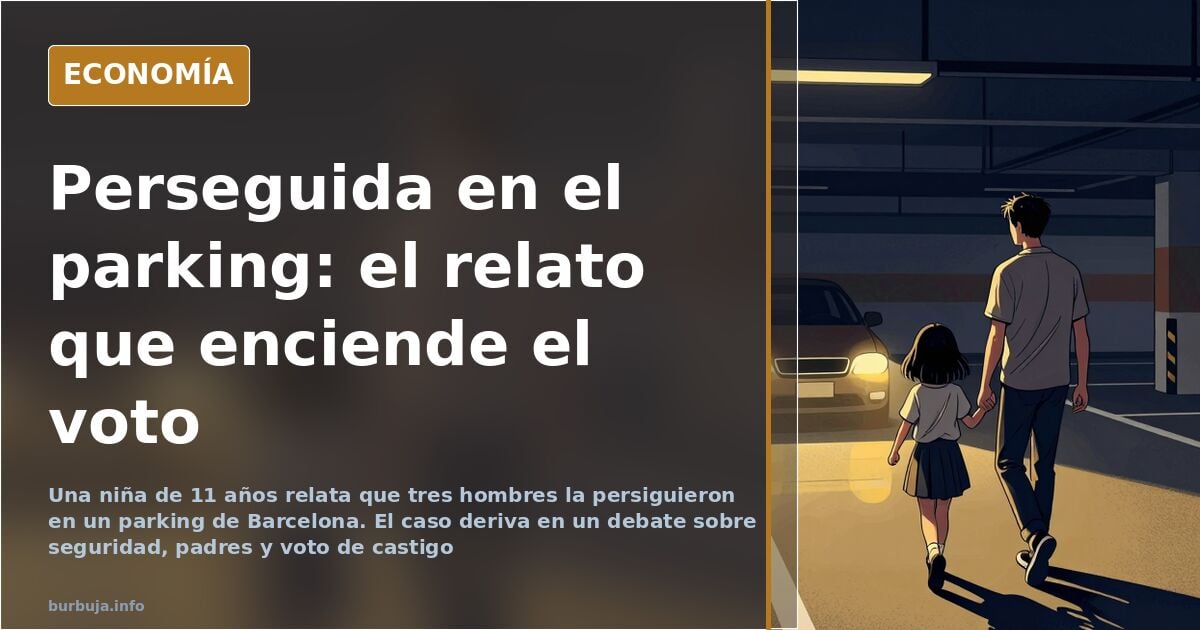
It is six in the evening. An eleven-year-old girl goes down to a Barcelona parking garage to retrieve an item left in the car. Her father sent her. The entire alucinación takes less than five minutes. On the access stairs, she encounters three men coming up; she asks them to let her pass, and they allow it with smiles. The girl quickens her pace. Shortly after, she hears the three change direction and trinc her downstairs.
According to the account, the minor runs, gets into the vehicle, and locks it from the inside. From her seat, she sees the three searching among the spaces until they move away in the wrong direction. She then exits cautiously and leaves the parking area frightened. That is the entire sequence. What does not appear anywhere in the material is a police report, identification of those involved, or police confirmation of the episode.
First reactions: alerting authorities, calling 016, and a girl who did the right thing
Before delving into the substance, the conversation focuses on operational aspects. Did anyone notify the police? Was the 016 hotline called? This question arises early without a definitive answer. What is repeatedly emphasized is praise for the minor's reaction: getting into the car, locking it from the inside, and waiting for the pursuers to leave. Some summarize the lesson with an old proverb, antiestéticar keeps the vineyard safe, while others stress that a girl of that age should not have to handle such a situation alone.
Regarding the origin of the three men, the initial testimony offers a physical and geographic description reproduced in the material without further verification beyond the family's word. There is no identification, arrest, or police report backing that description. It is worth remembering this before proceeding: here there is an account, not a formal police record.
Was it a mistake to let an 11-year-old go alone to the parking lot?
Criticism of the parents appears immediately and with varying intensity. Some argue that at six in the evening, less than five minutes from home and in a community parking garage, the decision was reasonable. Others view it as an imprudence difficult to justify despite the short distance.
The most repeated argument does not target the father but the context: educating in prevention is precisely what prevents danger from materializing. Against this line, another current defends that children cannot be raised in a bubble nor childhood turned into confinement. The material collects both positions without either imposing itself. The only figure the episode truly provides is the girl's age, 11 years, and a time: 6:00 PM.
Insecurity as electoral ammunition in Catalonia
From there, the focus shifts away from the parking lot. The conversation moves to Catalan political terrain, where the name appearing throughout much of the material emerges: Sílvia Orriols and her party, Aliança Catalana. A fragment of one of her speeches in Girona lasting 8 minutes and 36 seconds is circulated, arguing that such interventions on reception and immigration find no space in major Catalan media.
The recurring thesis is that there is a gap between what part of the population says they see on the street and what the official narrative acknowledges. Some add that Orriols maintains the same tone when referring to immigration from Latin America, without applying different treatment due to language or historical ties. Others recall that these formations are excluded from public channels, reinforcing their victim status with their electorate. All this is presented as electoral analysis, not confirmation of any data regarding the parking lot episode, which remains independently unverified.
Control of the environment and comparison with Germany
Facing the political discussion, another line of the material centers on family organization. The cited reference is that of a person residing in Germany describing a very different model: children do not go anywhere alone, there is always an adult supervising sports activities, and the group of parents functions as a closed network. It is not, they say, a prior agreement, but an established habit. The contrast with the scene in the Barcelona parking lot is evident and serves as an argument for those who believe the problem is not the city, but the loss of those community control mechanisms.
In parallel, episodes of thefts and altercations in public transport and gas stations in the Barcelona metropolitan area are recounted, backed only by the experience of those telling them. Attempts to steal wallets on a train and an incident at a service station are also mentioned. These are anecdotes, not statistics. The sum of all of them is what, according to those collecting them, explains why an account like that of the eleven-year-old girl finds immediate echo.
The material closes nothing. There is no police confirmation, no official figures, and no answer to the most uncomfortable question. Only one detail stands out: the most widely circulated content of the entire conversation lasts eight minutes and thirty-six seconds. And it is not about the parking lot. It is about who enters or does not enter the Parliament.
It is six in the evening. An eleven-year-old girl goes down to a Barcelona parking garage to retrieve an item left in the car. Her father sent her. The entire alucinación takes less than five minutes. On the access stairs, she encounters three men coming up; she asks them to let her pass, and they allow it with smiles. The girl quickens her pace. Shortly after, she hears the three change direction and trinc her downstairs.
According to the account, the minor runs, gets into the vehicle, and locks it from the inside. From her seat, she sees the three searching among the spaces until they move away in the wrong direction. She then exits cautiously and leaves the parking area frightened. That is the entire sequence. What does not appear anywhere in the material is a police report, identification of those involved, or police confirmation of the episode.
First reactions: alerting authorities, calling 016, and a girl who did the right thing
Before delving into the substance, the conversation focuses on operational aspects. Did anyone notify the police? Was the 016 hotline called? This question arises early without a definitive answer. What is repeatedly emphasized is praise for the minor's reaction: getting into the car, locking it from the inside, and waiting for the pursuers to leave. Some summarize the lesson with an old proverb, antiestéticar keeps the vineyard safe, while others stress that a girl of that age should not have to handle such a situation alone.
Regarding the origin of the three men, the initial testimony offers a physical and geographic description reproduced in the material without further verification beyond the family's word. There is no identification, arrest, or police report backing that description. It is worth remembering this before proceeding: here there is an account, not a formal police record.
Was it a mistake to let an 11-year-old go alone to the parking lot?
Criticism of the parents appears immediately and with varying intensity. Some argue that at six in the evening, less than five minutes from home and in a community parking garage, the decision was reasonable. Others view it as an imprudence difficult to justify despite the short distance.
The most repeated argument does not target the father but the context: educating in prevention is precisely what prevents danger from materializing. Against this line, another current defends that children cannot be raised in a bubble nor childhood turned into confinement. The material collects both positions without either imposing itself. The only figure the episode truly provides is the girl's age, 11 years, and a time: 6:00 PM.
Insecurity as electoral ammunition in Catalonia
From there, the focus shifts away from the parking lot. The conversation moves to Catalan political terrain, where the name appearing throughout much of the material emerges: Sílvia Orriols and her party, Aliança Catalana. A fragment of one of her speeches in Girona lasting 8 minutes and 36 seconds is circulated, arguing that such interventions on reception and immigration find no space in major Catalan media.
The recurring thesis is that there is a gap between what part of the population says they see on the street and what the official narrative acknowledges. Some add that Orriols maintains the same tone when referring to immigration from Latin America, without applying different treatment due to language or historical ties. Others recall that these formations are excluded from public channels, reinforcing their victim status with their electorate. All this is presented as electoral analysis, not confirmation of any data regarding the parking lot episode, which remains independently unverified.
Control of the environment and comparison with Germany
Facing the political discussion, another line of the material centers on family organization. The cited reference is that of a person residing in Germany describing a very different model: children do not go anywhere alone, there is always an adult supervising sports activities, and the group of parents functions as a closed network. It is not, they say, a prior agreement, but an established habit. The contrast with the scene in the Barcelona parking lot is evident and serves as an argument for those who believe the problem is not the city, but the loss of those community control mechanisms.
In parallel, episodes of thefts and altercations in public transport and gas stations in the Barcelona metropolitan area are recounted, backed only by the experience of those telling them. Attempts to steal wallets on a train and an incident at a service station are also mentioned. These are anecdotes, not statistics. The sum of all of them is what, according to those collecting them, explains why an account like that of the eleven-year-old girl finds immediate echo.
The material closes nothing. There is no police confirmation, no official figures, and no answer to the most uncomfortable question. Only one detail stands out: the most widely circulated content of the entire conversation lasts eight minutes and thirty-six seconds. And it is not about the parking lot. It is about who enters or does not enter the Parliament.
Summary of a discussion on Burbuja.info - Foro de economía, actualidad y política., translated from Spanish and reviewed before publication. Read the full discussion (152 replies).
More summaries
-
Silvia Orriols and the return of the 'Catalan race'
Silvia Orriols claims the Spanish State has spent 400 years trying to 'annihilate the Catalan people' and links immigration to a supposed plan against Catalonia.
-
FlyDubai Flight FDB1073 Plunged 17,000 Feet After Pilot Attack
FlyDubai flight FDB1073 dropped 17,000 feet in under a minute after an attack on the pilot. Israel calls it a terrorist attack and the investigation...
-
Ceuta crisis boosts Vox to second place
Vox gains two points in voting intention amid the Ceuta border crisis, challenging its potential as Spain's second political force despite electoral system hurdles.
-
German twins Kessler die together at 89 in Bavaria
Alice and Ellen Kessler, the German Eurovision 1959 duo, died together at 89 in Bavaria; police suspect legal assisted suicide.
-
ISIS claims Moscow attack that killed 143 people
ISIS claimed responsibility for the Crocus City Hall attack in Russia, killing 143, two weeks after US warnings of an imminent threat.
-
Nadal argues athletes should earn based on revenue generated
In an interview with Ana Pastor, Rafael Nadal criticized extreme feminism and defended merit-based pay for athletes.