
100-Year-Old Village House in Ávila Listed for €50,000
A century-old property in Ávila is on the market for €50,000. Hidden costs from damp and renovations could double the final price.
English · Original discussion in Spanish · Published
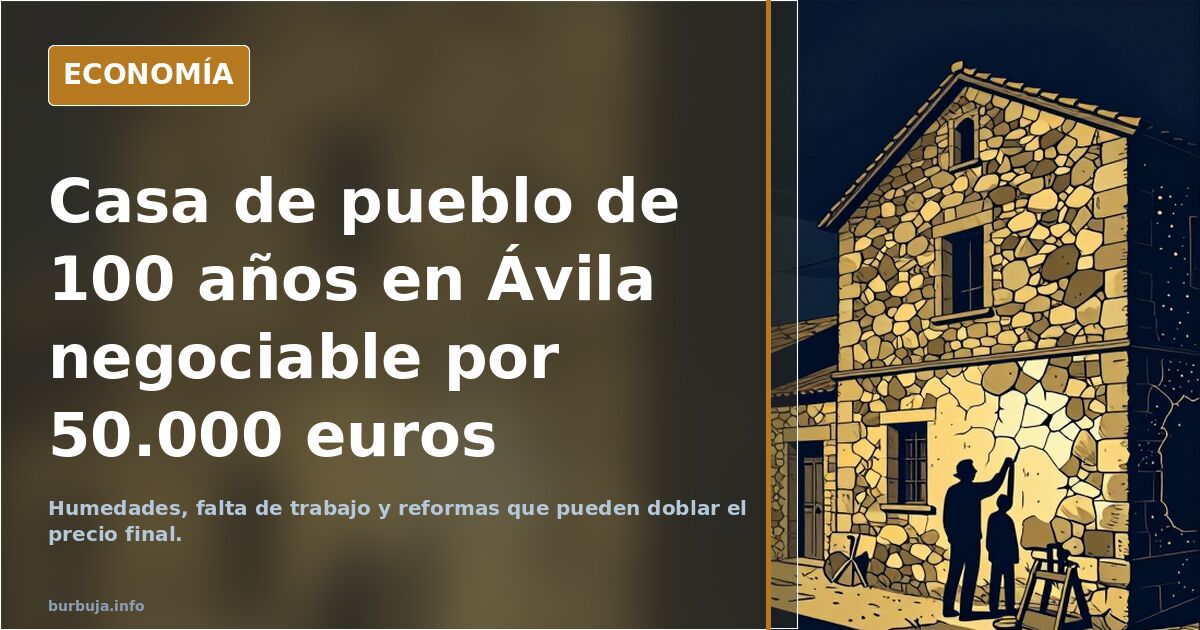
Village house in Ávila: negotiable at €50,000
How much does a cheap village house cost today, just half an hour from a provincial capital? In the Ávila market, the answer fits in a single listing: negotiable down to €50,000, with a €5,000 reduction advertised directly in the thread. The property is about a hundred years old, terraced on both sides, and located in a municipality with three restaurants, shops, a petrol station, and banks. It antiestéticatures a renovated kitchen and bathroom, a large patio, and a garage. The rest — roof, heating, energy efficiency — is where the real debate begins.
What the listing includes and what it leaves out
The price buys a single-story house, no stairs, with a patio and garage, in a locality offering basic services but lacking the essentials: employment. That is the core issue. Some argue that at this price the deal is unbeatable and the property is habitable as-is; others contend that a century-old building isn't bought for its aesthetics, but for what lies beneath the floors and inside the walls.
The person promoting the listing doesn't hide the context: there is "zero work" in the area, they admit. The house is cheap because the environment generates no income. This is the true cost of rural real estate: you don't pay in euros, you pay in missed opportunities.
Window bars, seen by some as a warning and by others as standard in any Spanish village, account for much of the discussion. Neither interpretation changes a fact: where there are no jobs or services, buyers purchase time and peace of mind, not a complete life plan.
How long does it really take to get to Ávila?
The claim of being "20 minutes from Ávila city center" falls short or runs long depending on how you measure it. The fastest route covers roughly 30 kilometers and takes about 24 minutes at legal estimulante ilegal; another option involves 27 kilometers and slightly more time. Not dramatic for remote workers, but decisive for those making the commute twice a day.
Here lies the contrast: Ávila is a small city with affordable apartments. Those working there can live there. Moving to a village 30 kilometers away means assuming that travel for every errand, purchase, or hospital visit. It's not a minor detail: it's the logistical cost absent from the sale price.
Damp, foundations, and bills: the hidden cost
The most repeated technical objection concerns dampness. A forum user warns, without knowing the area, that in old buildings constructed with footings and no concrete slab — meaning the floor is in direct contact with the ground — moisture rises wherever it can. The traditional solution was tiling halfway up the wall to avoid scraping mold annually. No one tiles a bedroom like that unless hiding something.
Heating adds to the burden. Without energy efficiency, a winter in this house is paid in electricity and firewood, and firewood doesn't just cost money: it leaves a smell. The roof is another unknown that no one resolves without climbing up to inspect it, and its repair is among the items that erase any savings from the purchase.
A calculation posted in the thread is stark: in deep Castilla, ruined houses sell for €25,000 or €30,000, but restoring them to the condition of the listed property requires another €40,000. The full breakdown, item by item, yields a final figure that surprises those looking only at the sale sign.
The prefabricated alternative: €38,000 and assemble it yourself
The inevitable comparison arrived with another product: a wooden house of 132 square meters plus a 13.5-square-meter porch for €38,000. At equal quality levels, experts warn, the price approaches that of traditional construction, while land, permits, fees, and water/electricity connections are paid separately. Trailer transport is estimated at €500; assembly must be done by the owner over months or contracted to the company.
System advocates highlight savings in labor, taxes, and fees compared to brick construction. Critics point to two classic drawbacks: maintenance and summer heat. Neither side disputes the key figure: if the land isn't owned and urbanized, the savings evaporate.
Who is buying and why now
A new profile emerges: those no longer dependent on physical office presence. One specific case describes a renovated 140-square-meter house on a 250-square-meter plot for €55,000, 12 minutes from Ávila and 125 kilometers from Madrid, in a town of about 20 permanent residents, with fruit trees planted and no bar or shop. They were looking for exactly that.
Alongside economic arguments lives a less confessable one: the search for a socially homogeneous environment, expressed by some comments in language we won't reproduce. It's a criterion that exists, drives purchasing decisions, and objectively depresses prices further in empty Spain. There are also voices recalling the flip side: the outsider who never fully belongs, communal firewood that isn't yours, and the shotgun behind the door.
Against that world, the city is described as a trap of homeowners' associations, low-emission zones, and neighbors pressed against both sides. The village house appears then as a refuge, with a garage for cars and an attic for a simulator.
With such prices, returning to the countryside should be a mass exodus. The perception left by the thread is that it's merely a trickle. And meanwhile, the roof remains uninspected.
How much does a cheap village house cost today, just half an hour from a provincial capital? In the Ávila market, the answer fits in a single listing: negotiable down to €50,000, with a €5,000 reduction advertised directly in the thread. The property is about a hundred years old, terraced on both sides, and located in a municipality with three restaurants, shops, a petrol station, and banks. It antiestéticatures a renovated kitchen and bathroom, a large patio, and a garage. The rest — roof, heating, energy efficiency — is where the real debate begins.
What the listing includes and what it leaves out
The price buys a single-story house, no stairs, with a patio and garage, in a locality offering basic services but lacking the essentials: employment. That is the core issue. Some argue that at this price the deal is unbeatable and the property is habitable as-is; others contend that a century-old building isn't bought for its aesthetics, but for what lies beneath the floors and inside the walls.
The person promoting the listing doesn't hide the context: there is "zero work" in the area, they admit. The house is cheap because the environment generates no income. This is the true cost of rural real estate: you don't pay in euros, you pay in missed opportunities.
Window bars, seen by some as a warning and by others as standard in any Spanish village, account for much of the discussion. Neither interpretation changes a fact: where there are no jobs or services, buyers purchase time and peace of mind, not a complete life plan.
How long does it really take to get to Ávila?
The claim of being "20 minutes from Ávila city center" falls short or runs long depending on how you measure it. The fastest route covers roughly 30 kilometers and takes about 24 minutes at legal estimulante ilegal; another option involves 27 kilometers and slightly more time. Not dramatic for remote workers, but decisive for those making the commute twice a day.
Here lies the contrast: Ávila is a small city with affordable apartments. Those working there can live there. Moving to a village 30 kilometers away means assuming that travel for every errand, purchase, or hospital visit. It's not a minor detail: it's the logistical cost absent from the sale price.
Damp, foundations, and bills: the hidden cost
The most repeated technical objection concerns dampness. A forum user warns, without knowing the area, that in old buildings constructed with footings and no concrete slab — meaning the floor is in direct contact with the ground — moisture rises wherever it can. The traditional solution was tiling halfway up the wall to avoid scraping mold annually. No one tiles a bedroom like that unless hiding something.
Heating adds to the burden. Without energy efficiency, a winter in this house is paid in electricity and firewood, and firewood doesn't just cost money: it leaves a smell. The roof is another unknown that no one resolves without climbing up to inspect it, and its repair is among the items that erase any savings from the purchase.
A calculation posted in the thread is stark: in deep Castilla, ruined houses sell for €25,000 or €30,000, but restoring them to the condition of the listed property requires another €40,000. The full breakdown, item by item, yields a final figure that surprises those looking only at the sale sign.
The prefabricated alternative: €38,000 and assemble it yourself
The inevitable comparison arrived with another product: a wooden house of 132 square meters plus a 13.5-square-meter porch for €38,000. At equal quality levels, experts warn, the price approaches that of traditional construction, while land, permits, fees, and water/electricity connections are paid separately. Trailer transport is estimated at €500; assembly must be done by the owner over months or contracted to the company.
System advocates highlight savings in labor, taxes, and fees compared to brick construction. Critics point to two classic drawbacks: maintenance and summer heat. Neither side disputes the key figure: if the land isn't owned and urbanized, the savings evaporate.
Who is buying and why now
A new profile emerges: those no longer dependent on physical office presence. One specific case describes a renovated 140-square-meter house on a 250-square-meter plot for €55,000, 12 minutes from Ávila and 125 kilometers from Madrid, in a town of about 20 permanent residents, with fruit trees planted and no bar or shop. They were looking for exactly that.
Alongside economic arguments lives a less confessable one: the search for a socially homogeneous environment, expressed by some comments in language we won't reproduce. It's a criterion that exists, drives purchasing decisions, and objectively depresses prices further in empty Spain. There are also voices recalling the flip side: the outsider who never fully belongs, communal firewood that isn't yours, and the shotgun behind the door.
Against that world, the city is described as a trap of homeowners' associations, low-emission zones, and neighbors pressed against both sides. The village house appears then as a refuge, with a garage for cars and an attic for a simulator.
With such prices, returning to the countryside should be a mass exodus. The perception left by the thread is that it's merely a trickle. And meanwhile, the roof remains uninspected.
Also available in: Deutsch
Summary of a discussion on Burbuja.info - Foro de economía, actualidad y política., translated from Spanish and reviewed before publication. Read the full discussion (143 replies).
More summaries
-
Madrid rental listings drop to 8,762 homes
Forum data shows only 8,762 apartments and 5,100 rooms available in Madrid, with the cheapest room starting at €550 plus utilities.
-
The Spanish educational divide: Castilla y León approaches European excellence
Madrid, Castilla y León, Asturias and Cantabria exceed the OECD average in PISA, but the rest of Spain drags down the national result. The internal gap is...
-
Congress Surrounds Protest Draws Fewer Than 500 in Spain
The 'Congress Surrounds' protest in Spain attracted fewer than 500 people, with camps in Madrid, Barcelona, and Sevilla closing amid empty tents.
-
Spain rental listings on Idealista drop 9.5% in 12 days
Rental inventory on Spain's leading portal Idealista fell 9.5% in just 12 days, with Barcelona seeing an 83% decline in long-term offers.
-
Spain's Renewable Surplus Doesn't Lower Electricity Bills
Renewable energy costs near zero at peak hours in Spain, yet household bills remain high due to marginal market pricing.
-
Woman Empties Partner's Account After Death, Faces Jail in Spain
Spanish prosecutors seek 33 months for a woman who withdrew €21,500 from her partner's accounts an hour after his death. Trial begins in Madrid.