
100 monuments define Spain: from Altamira to Guggenheim
A list of 100 Spanish landmarks spans history, but the Valley of the Fallen sparks debate over its inclusion.
English · Original discussion in Spanish · Published
100 monuments define Spain: from Altamira to Guggenheim
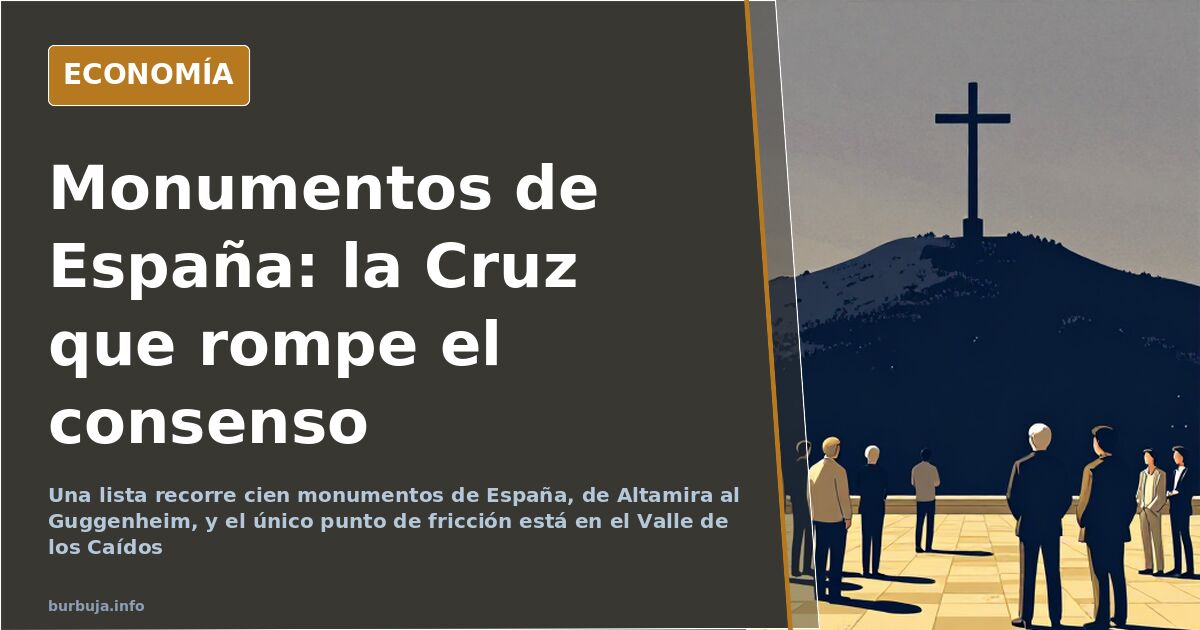
Forty thousand years of heritage fit into a list of one hundred names, and the friction point is neither Altamira nor the Alhambra. It lies in a 20th-century complex built in the Guadarrama mountains. The roster of the 100 most representative monuments in Spain trinc an approximate chronological order from the Cantabrian cave to Santander’s Centro Botín, aiming to include every province and era, yet it has become a battleground over what deserves the title of monument and who decides the canon.
Which monuments make the top 100 list?
The start is prehistoric and archaeological: Altamira, the Antequera dolmens, Menorca’s talayotic sites, Los Millares, La Bastida de Totana, Motilla del Azuer, Baroña Castro, Turuñuelo houses, Ullastret Iberian settlement, and Empúries. The Roman sequence trinc with Baelo Claudia, Mérida’s theater, Alcántara Bridge, Segovia Aqueduct, La Olmeda villa, Tower of Hercules, Lugo walls, Tarragona amphitheater, Segobriga, and Recópolis.
The medieval block mixes mosque, synagogue, and fortress: Medina Azahara, Córdoba Mosque, Santa María la Blanca in Toledo, La Aljafería, Royal Alcázares, Alhambra, Elche Palm Grove, San Juan de Gaztelugatxe, Besalú Bridge, and Burgalimar Castle. Then come ten cathedrals—Zamora, Teruel, Burgos, León, Toledo, Palma, Seville, Jaén, Murcia, Santiago—and a Renaissance-Baroque stretch antiestéticaturing El Pilar, Silk Exchange, Infantado Palace, Trujillo Main Square, Salamanca and Alcalá universities, Segovia Alcázar, Royal Palace, and El Guanol.
It closes with contemporary pieces: Vizcaya Bridge, Igueldo Hill, Las Ventas, Montjuïc Palace, Seville’s Plaza de España, El Rocío, Comillas Pontifical University, Valley of the Fallen, Torreciudad, Montserrat, Park Güell, Sagrada Família, Dalí and Picasso museums, Jameos del Agua, City of Arts and Sciences, Guggenheim, Niemeyer Center, and Botín Center. That is the complete map. And that is where disagreements begin.
Why does the Valley of the Fallen break consensus on this heritage list?
Because it is the only item judged by symbolism rather than substance. Some critics call it horrifying, arguing its inclusion serves ideological motives or targets specific audiences, not artistic value. Defenders counter with two points: its symbolic worth is incalculable, and the engineering antiestéticat there was, in their words, brutal.
The second argument is subtler and more debatable: rarity defines value, and such an Art Deco statue is a curiosity worth preserving. Ultimately, the clash isn’t about heritage but whether a monument can be separated from the regime that built it. That issue remains unresolved.
Ruins, rocks, and cathedrals: the fight over what counts as a monument
A recurring objection runs through the selection: half the list consists of ruins and rubble, while a monument should be something else. This critique has partial merit—Baelo Claudia or Los Millares are sites, not standing buildings—but responses exist: Baelo Claudia gains value from its setting near prime beaches, and Mérida could fill the list alone due to its density of remains.
The second criticism targets modern structures. For some sectors, contemporary architecture is largely pavor, leading them to view the Guggenheim, City of Arts and Sciences, or Centro Botín as tourism concessions rather than heritage. The rebuttal relies on evidence: the canon is also written with cranes and public budgets.
Provinces that protested and last-minute substitutions
The list launched with geographic gaps that drew attention. Albacete, Soria, and Álava were unrepresented, alongside Pontevedra and Ourense. The author acknowledged the flaw, swapping Santo Estevo Monastery for Oseira and replacing Gijón’s Laboral University with Comillas Pontifical University. Later, they added fifteen castles—including Belmonte, Peracense, Gormaz, Peñafiel, Coca, Javier, and Bellver—because the initial selections fell short.
Suggestions flooded the open list: Zaragoza’s Larrinaga Palace, Bilbao’s Chavarri Palace, Puigcerdà Lake, Málaga’s Colomares Castle, and the Alcazaba with its adjacent Roman theater. Some even demanded the Santiago Bernabéu Stadium. The criteria, admitted without shame, remain debatable and adjustable on demand.
Recceswinth’s Code and Hispania before tourism
Amid all the stone, one proposal breaks the monumental script and enters politics: Recceswinth’s Code, drafted when the peninsula was unified under one crown with a sense of Hispania, for Hispania. It is an uncomfortable reminder. Visited heritage usually offers photo ops, not explanations of how a national idea was constructed.
This contrast pervades the rest of the list. Some read it as pride: heritage from Phoenician times to yesterday, spanning Romans, Visigoths, and Jovenlandeses, impressing foreign visitors who once confused Spain with Mexico enough to return next year. Others see decline—a reminder of a country that was great but no longer is. Both readings coexist unresolved, and the author admits many worthy items were left out.
With this material, would these hundred entries survive review in a decade, or will Spain’s most representative monument end up being the roundabout at the industrial estate entrance?
Forty thousand years of heritage fit into a list of one hundred names, and the friction point is neither Altamira nor the Alhambra. It lies in a 20th-century complex built in the Guadarrama mountains. The roster of the 100 most representative monuments in Spain trinc an approximate chronological order from the Cantabrian cave to Santander’s Centro Botín, aiming to include every province and era, yet it has become a battleground over what deserves the title of monument and who decides the canon.
Which monuments make the top 100 list?
The start is prehistoric and archaeological: Altamira, the Antequera dolmens, Menorca’s talayotic sites, Los Millares, La Bastida de Totana, Motilla del Azuer, Baroña Castro, Turuñuelo houses, Ullastret Iberian settlement, and Empúries. The Roman sequence trinc with Baelo Claudia, Mérida’s theater, Alcántara Bridge, Segovia Aqueduct, La Olmeda villa, Tower of Hercules, Lugo walls, Tarragona amphitheater, Segobriga, and Recópolis.
The medieval block mixes mosque, synagogue, and fortress: Medina Azahara, Córdoba Mosque, Santa María la Blanca in Toledo, La Aljafería, Royal Alcázares, Alhambra, Elche Palm Grove, San Juan de Gaztelugatxe, Besalú Bridge, and Burgalimar Castle. Then come ten cathedrals—Zamora, Teruel, Burgos, León, Toledo, Palma, Seville, Jaén, Murcia, Santiago—and a Renaissance-Baroque stretch antiestéticaturing El Pilar, Silk Exchange, Infantado Palace, Trujillo Main Square, Salamanca and Alcalá universities, Segovia Alcázar, Royal Palace, and El Guanol.
It closes with contemporary pieces: Vizcaya Bridge, Igueldo Hill, Las Ventas, Montjuïc Palace, Seville’s Plaza de España, El Rocío, Comillas Pontifical University, Valley of the Fallen, Torreciudad, Montserrat, Park Güell, Sagrada Família, Dalí and Picasso museums, Jameos del Agua, City of Arts and Sciences, Guggenheim, Niemeyer Center, and Botín Center. That is the complete map. And that is where disagreements begin.
Why does the Valley of the Fallen break consensus on this heritage list?
Because it is the only item judged by symbolism rather than substance. Some critics call it horrifying, arguing its inclusion serves ideological motives or targets specific audiences, not artistic value. Defenders counter with two points: its symbolic worth is incalculable, and the engineering antiestéticat there was, in their words, brutal.
The second argument is subtler and more debatable: rarity defines value, and such an Art Deco statue is a curiosity worth preserving. Ultimately, the clash isn’t about heritage but whether a monument can be separated from the regime that built it. That issue remains unresolved.
Ruins, rocks, and cathedrals: the fight over what counts as a monument
A recurring objection runs through the selection: half the list consists of ruins and rubble, while a monument should be something else. This critique has partial merit—Baelo Claudia or Los Millares are sites, not standing buildings—but responses exist: Baelo Claudia gains value from its setting near prime beaches, and Mérida could fill the list alone due to its density of remains.
The second criticism targets modern structures. For some sectors, contemporary architecture is largely pavor, leading them to view the Guggenheim, City of Arts and Sciences, or Centro Botín as tourism concessions rather than heritage. The rebuttal relies on evidence: the canon is also written with cranes and public budgets.
Provinces that protested and last-minute substitutions
The list launched with geographic gaps that drew attention. Albacete, Soria, and Álava were unrepresented, alongside Pontevedra and Ourense. The author acknowledged the flaw, swapping Santo Estevo Monastery for Oseira and replacing Gijón’s Laboral University with Comillas Pontifical University. Later, they added fifteen castles—including Belmonte, Peracense, Gormaz, Peñafiel, Coca, Javier, and Bellver—because the initial selections fell short.
Suggestions flooded the open list: Zaragoza’s Larrinaga Palace, Bilbao’s Chavarri Palace, Puigcerdà Lake, Málaga’s Colomares Castle, and the Alcazaba with its adjacent Roman theater. Some even demanded the Santiago Bernabéu Stadium. The criteria, admitted without shame, remain debatable and adjustable on demand.
Recceswinth’s Code and Hispania before tourism
Amid all the stone, one proposal breaks the monumental script and enters politics: Recceswinth’s Code, drafted when the peninsula was unified under one crown with a sense of Hispania, for Hispania. It is an uncomfortable reminder. Visited heritage usually offers photo ops, not explanations of how a national idea was constructed.
This contrast pervades the rest of the list. Some read it as pride: heritage from Phoenician times to yesterday, spanning Romans, Visigoths, and Jovenlandeses, impressing foreign visitors who once confused Spain with Mexico enough to return next year. Others see decline—a reminder of a country that was great but no longer is. Both readings coexist unresolved, and the author admits many worthy items were left out.
With this material, would these hundred entries survive review in a decade, or will Spain’s most representative monument end up being the roundabout at the industrial estate entrance?
Summary of a discussion on Burbuja.info - Foro de economía, actualidad y política., translated from Spanish and reviewed before publication. Read the full discussion (174 replies).
More summaries
-
Irene Montero promises €1,800 minimum wage and 30 working hours per week
Irene Montero promises €1,800 minimum wage and 30 hours per week by 2027: the payroll linked to the minimum wage has multiplied by 28 since 2000.
-
Spain's Civil Service Exams: Memorizing Laws for Jobs AI Already Automates
Thousands of young people study obsolete syllabi for administrative roles increasingly automated by AI, sparking debate on institutional inertia.
-
Aliança Catalana flags 43,772 residency certificates in Lleida
Aliança Catalana reports 43,772 residency certificates issued in Lleida from January to August 2025, promising stricter municipal register oversight.
-
Montoro faces charges in Spain's tailored tax laws scandal
Spain's Montoro case reveals custom legislation, shell companies, and nearly €1 billion in tax savings for connected firms.
-
Spain's police capacity questioned amid twelve simultaneous riots
Forum calculations claim securing one town needs 2,000 officers. Twelve concurrent outbreaks exceed available resources, participants argue.
-
Spain debate on elderly respect sparked by wife's outburst
A viral incident in Spain involving a deaf husband sparks debate on respect, retirement cohabitation, and economic dependency among older couples.