
100,000 km on one tire set: why weight and rotation matter
A case study shows 100,000 km on all-season tires with regular rotation, while heavy EVs wear them out in 20,000 km due to weight and torque.
English · Original discussion in Spanish · Published
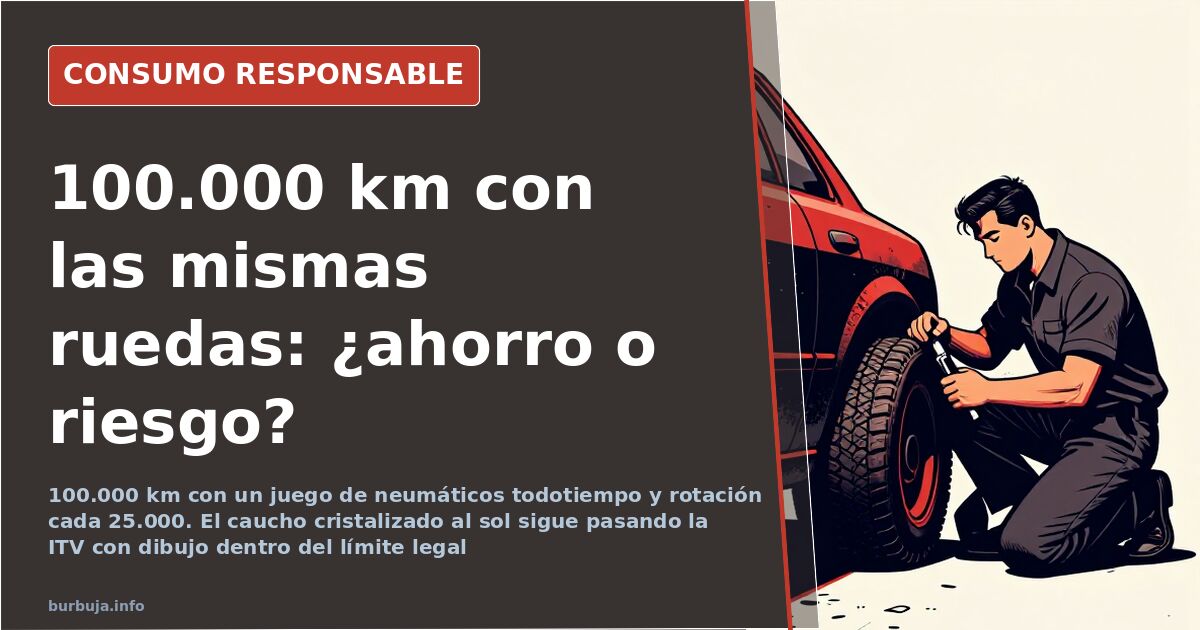
100,000 km on one tire set: the calculation that doesn't add up
A car covering 3,000 kilometers a month, four all-season tires mounted less than three years ago, and an odometer already past 100,000 km. The previous set, original equipment, lasted 93,000. Between them, the brand and price stayed the same, but this time the tires were rotated every 25,000 kilometers to distribute wear. The owner could stretch them further, but two lose pressure and need inflating every fifteen days, so there is already an appointment to replace all four. The problem is that the exact model is no longer manufactured.
Can you do 100,000 km on one tire set?
Yes, provided the car cooperates, and there is a case that illustrates it: 960 kg curb weight, 64 hp and 112 Nm of torque. With those figures, a set of Continental tires reached 100,000 kilometers without drama. The reasoning is straightforward: wear occurs mainly during acceleration and braking, so a lightweight vehicle with little urban traffic and mostly highway use wears down rubber much less than a heavy sedan in the city.
The other side involves another calculation: those same tires, mounted on a 1,800 kg Tesla with 660 Nm, would wear out in 20,000 kilometers. Weight and torque are the variables; driving style is the multiplier. Some argue that changing a set every 25,000 km is either crazy or deceptive. Others, however, sign off on 100,000.
Available torque is not applied torque
This is where things often get complicated. A remap increases engine torque, sure, but when cruising at 120 km/h, the applied torque is the same before and after: the excess only appears when accelerating hard. Maximum torque is used with the pedal floored, which is neither usual nor common during rush hour. Hence, a 500 Nm engine does not necessarily wear tires twice as fast as a 250 Nm one.
The added nuance is reasonable: although medium torque is almost always used, a car with high available torque tends to wear more than one without it, simply because there is room to demand it. The question is whether this alone is enough to drop from 100,000 km to 25,000. The figures suggest it is not the only factor, nor the main one.
Rotating tires: all wheels cover the same kilometers
If a car runs 100,000 km on the same four tires, all four have covered 100,000 km, wherever they are. What rotation equalizes is not the mileage, but the working conditions: front-wheel drive carries more weight forward and wears front tires sooner. Alternating axles distributes wear and allows replacing the full set at once. Moving fronts to the rear and vice versa is recommended in maintenance manuals, so treating it as superstition does not withstand the arithmetic.
Rubber also expires: the sun and five years
Beyond tread depth lies the calendar, and here the issue gets serious. Rubber loses properties over time, hardens, and crystallizes; the tire grips less, makes more noise, and requires balancing frequently. There is a documented case with photos: four NEXEN tires with DOT 3918, manufactured in late 2018 and mounted in mid-2019, all equally cracked after five years under the Canary Islands sun and without curb scrapes. They passed the technical inspection.
The loophole in the test is exactly that: with tread above the legal limit, the MOT does not assess whether the compound is cooked. In contrast, some Michelin Energy tires with 10 years look brand new next to those. Meanwhile, proponents of extreme longevity cite cars with over 400,000 km and only three sets worn on the rear axle, never carrying heavy loads.
Rare brands on the street and price as a filter
There is a list walking around neighborhood sidewalks: Giti, Debica, Riken, Sailun, Gislaved, Trazano, Windforce, Genesys, Royalmile. If all these cars drive, the argument that own-brand tires are inferior crumbles. At the other extreme, the real second brand—Continental bought Barum in the 1960s, and part of its production comes from the Czech factory—versus the fake second brand attributed to Chinese brands.
Regarding price, the range discussed goes from 70 euros for a Nankang to 200 for a Michelin, with genuinely good options below 80. The braking difference between them is measured on a track, with a tester and good reflexes. Outside that, the gap narrows.
The disconcerting fact remains: a small seven-ton truck changed its original rear tires at 200,000 kilometers and still had tread. They were not retired by wear, but by formwork rods sticking out of the ground. On an axle that barely carries weight, asphalt does not set the limit.
A car covering 3,000 kilometers a month, four all-season tires mounted less than three years ago, and an odometer already past 100,000 km. The previous set, original equipment, lasted 93,000. Between them, the brand and price stayed the same, but this time the tires were rotated every 25,000 kilometers to distribute wear. The owner could stretch them further, but two lose pressure and need inflating every fifteen days, so there is already an appointment to replace all four. The problem is that the exact model is no longer manufactured.
Can you do 100,000 km on one tire set?
Yes, provided the car cooperates, and there is a case that illustrates it: 960 kg curb weight, 64 hp and 112 Nm of torque. With those figures, a set of Continental tires reached 100,000 kilometers without drama. The reasoning is straightforward: wear occurs mainly during acceleration and braking, so a lightweight vehicle with little urban traffic and mostly highway use wears down rubber much less than a heavy sedan in the city.
The other side involves another calculation: those same tires, mounted on a 1,800 kg Tesla with 660 Nm, would wear out in 20,000 kilometers. Weight and torque are the variables; driving style is the multiplier. Some argue that changing a set every 25,000 km is either crazy or deceptive. Others, however, sign off on 100,000.
Available torque is not applied torque
This is where things often get complicated. A remap increases engine torque, sure, but when cruising at 120 km/h, the applied torque is the same before and after: the excess only appears when accelerating hard. Maximum torque is used with the pedal floored, which is neither usual nor common during rush hour. Hence, a 500 Nm engine does not necessarily wear tires twice as fast as a 250 Nm one.
The added nuance is reasonable: although medium torque is almost always used, a car with high available torque tends to wear more than one without it, simply because there is room to demand it. The question is whether this alone is enough to drop from 100,000 km to 25,000. The figures suggest it is not the only factor, nor the main one.
Rotating tires: all wheels cover the same kilometers
If a car runs 100,000 km on the same four tires, all four have covered 100,000 km, wherever they are. What rotation equalizes is not the mileage, but the working conditions: front-wheel drive carries more weight forward and wears front tires sooner. Alternating axles distributes wear and allows replacing the full set at once. Moving fronts to the rear and vice versa is recommended in maintenance manuals, so treating it as superstition does not withstand the arithmetic.
Rubber also expires: the sun and five years
Beyond tread depth lies the calendar, and here the issue gets serious. Rubber loses properties over time, hardens, and crystallizes; the tire grips less, makes more noise, and requires balancing frequently. There is a documented case with photos: four NEXEN tires with DOT 3918, manufactured in late 2018 and mounted in mid-2019, all equally cracked after five years under the Canary Islands sun and without curb scrapes. They passed the technical inspection.
The loophole in the test is exactly that: with tread above the legal limit, the MOT does not assess whether the compound is cooked. In contrast, some Michelin Energy tires with 10 years look brand new next to those. Meanwhile, proponents of extreme longevity cite cars with over 400,000 km and only three sets worn on the rear axle, never carrying heavy loads.
Rare brands on the street and price as a filter
There is a list walking around neighborhood sidewalks: Giti, Debica, Riken, Sailun, Gislaved, Trazano, Windforce, Genesys, Royalmile. If all these cars drive, the argument that own-brand tires are inferior crumbles. At the other extreme, the real second brand—Continental bought Barum in the 1960s, and part of its production comes from the Czech factory—versus the fake second brand attributed to Chinese brands.
Regarding price, the range discussed goes from 70 euros for a Nankang to 200 for a Michelin, with genuinely good options below 80. The braking difference between them is measured on a track, with a tester and good reflexes. Outside that, the gap narrows.
The disconcerting fact remains: a small seven-ton truck changed its original rear tires at 200,000 kilometers and still had tread. They were not retired by wear, but by formwork rods sticking out of the ground. On an axle that barely carries weight, asphalt does not set the limit.
Also available in: Deutsch
Summary of a discussion on Burbuja.info - Foro de economía, actualidad y política., translated from Spanish and reviewed before publication. Read the full discussion (325 replies).
More summaries
-
Running Shoes Wear Out After Just 500 Kilometers
High-end running shoes now last only 500-700 km, down from 1,000 km in 2017, while prices continue to rise.
-
Tesla's Autonomous Car Threatens Taxis and Driving Schools
Tesla's Cybercab promises to end taxis and driving schools, but licenses remain priced at €160k while FSD costs €99/month. Revolution or smoke?
-
Nestlé and Dolca: 30% vs 25% Cacao, Same Price in Spain
Nestlé and Dolca chocolates differ by just 5% cacao yet cost nearly the same, revealing that budget brands in Spain are no longer significantly cheaper.
-
O2: Complaints Pattern Reveals Service Crisis
Five days offline, fraudulent portabilities and missing discounts highlight O2's customer service failures in Spain's low-cost market.
-
Stuck Faucet Eccentric: Limescale, Hemp, and DIY Fixes
A faucet eccentric stuck by decades of limescale and hemp. Discover which remedies work (vinegar, torch, wrench) and when to call a plumber.
-
DeepSeek vs Gemini: Best Free AI Models
Comparison of DeepSeek and Gemini as top free AIs for document analysis, coding, and daily tasks. Which one wins without paying?