
1,900 missing and 70 bodies unrecovered after DANA floods in Spain
Crisis meeting minutes reveal 1,900 provisional missing persons following the DANA storm and warn of potential hospital collapses in Valencia.
English · Original discussion in Spanish · Published
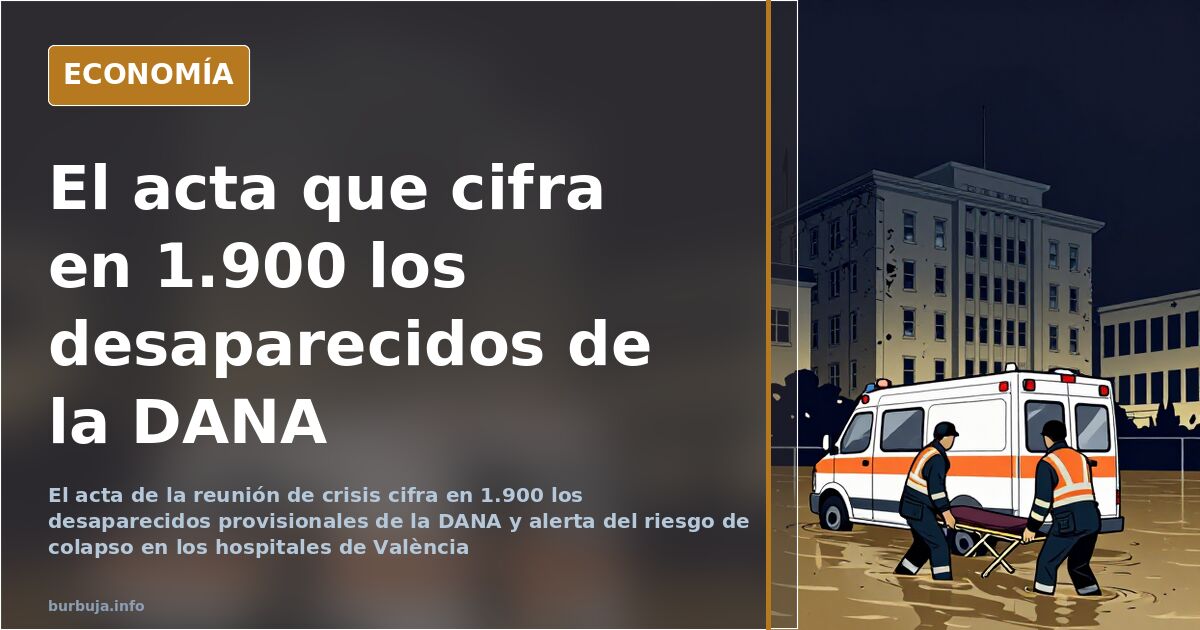
Crisis meeting minutes report 1,900 people missing after DANA storm
At the last minute, the figure stopped being a rumor and appeared on paper: 1,900 provisional missing persons, 70 located bodies awaiting official recovery, and the risk of hospital collapse in Valencia. These are the three key findings from the minutes of the crisis meeting between the president of the Generalitat (the regional government of Valencia) and the Minister of the Interior, released amidst the disaster management. On Tuesday, October 29, the DANA (a high-altitude isolated depression) hit the eastern peninsula, turning entire neighborhoods into mud. The confirmed death toll being handled at the time was 202, and even that figure did not fully align with what was being seen on the streets.
Why AEMET forecasts failed to anticipate the DANA's magnitude
One of the first criticisms was aimed directly at the AEMET (the State Meteorological Agency): it is argued that its alerts underestimated the storm looming over eastern Spain. The comparison being circulated is uncomfortable. The French AROME-HD system, from Météo-France, would have detected rainfall of 400 liters per square meter and flash floods in the early hours of October 29. In contrast, AEMET was left in a poor light by the President of the Government himself, who congratulated the agency that morning for its "observation and prediction" work.
A nuance is often lost in the outcry: a red alert warns that danger is extreme, not exactly where every liter will fall or at what time. The unanswered question is different: if the warning arrived, even if incomplete, why was no one evacuated? On this answer, the administrations carry more weight than the radars.
Military deployment and two days of mobility restrictions
The Armed Forces deployed in the Valencian Community have operated in Utiel, Torrent, Paiporta, Algemesí, Ribarroja de Turia, Chiva, Alfafar, Loriguilla, Masanassa, Alcudia, and Catarroja. The detailed list, released by La Moncloa (the Spanish government headquarters), fueled controversy: while towns are listed, the description of tasks assigned to the operation is limited to a water pump in a parking lot and cleaning a stretch of road. The head of the UME (the Military Emergencies Unit) defended live that sending more personnel would clog the routes and prevent them from passing through.
In parallel, mobility and circulation were restricted for two days in the flooded towns, just as thousands of residents were carrying shovels, buckets, and jugs to reach the submerged areas. A message also circulated contrasting the words of the Minister of Defense when Spain sent aid to Segarro—“we would send whatever is necessary... these first hours [...] are essential and fundamental”—with the pace of the deployment in Valencia.
202, 70, and 1,900: three figures that do not add up
The minutes speak of "provisional" figures, and therein lies much of the problem. Seventy located bodies are waiting for a judge to authorize their recovery to be included in the official count; until then, they do not exist administratively. And the 1,900 provisional missing persons is an estimate that could move in any direction, up or down, as search operations pogre.
Two rural guards publicly declared, bypassing protocol, that the media were reporting a death toll much lower than the real one. Some argue that local councils and the police halted the spontaneous distribution of stored water and food while waiting to channel it through official channels; others defend that without coordination, it would have been even greater chaos. One resident recorded her own version: the accounts to organize distributions would not be peine until Monday because no one worked over the weekend.
No resignations: the political response that was already expected
Demands for accountability span the entire spectrum: the Generalitat, the Ministry of Transport, the DGT (the Directorate-General for Traffic), the Provincial Council of Valencia, and the affected town halls. The dominant request is that they should not investigate themselves, but that judges should do so, and that the consequences should not be limited to two pages of apologies and lessons learned. The DANA was inevitable; the death and missing person toll, it is argued, was not.
The counterpoint is devastating and comes from recent experience: at the peak of the pandemic, a thousand people died a day and no one resigned. That memory functions as a prophecy. Also on the table was the comparison with Japan, which manages earthquakes and tsunamis without counting its dead in the thousands, and with the Congressional session that moved forward to secure the appointment of officials at TVE (the public broadcaster) while the mud was rising.
The analysis stalls exactly here: in the distance between what meteorology made inevitable and what management made avoidable, and in the increasingly widespread certainty that no one is going to pay for that difference.
At the last minute, the figure stopped being a rumor and appeared on paper: 1,900 provisional missing persons, 70 located bodies awaiting official recovery, and the risk of hospital collapse in Valencia. These are the three key findings from the minutes of the crisis meeting between the president of the Generalitat (the regional government of Valencia) and the Minister of the Interior, released amidst the disaster management. On Tuesday, October 29, the DANA (a high-altitude isolated depression) hit the eastern peninsula, turning entire neighborhoods into mud. The confirmed death toll being handled at the time was 202, and even that figure did not fully align with what was being seen on the streets.
Why AEMET forecasts failed to anticipate the DANA's magnitude
One of the first criticisms was aimed directly at the AEMET (the State Meteorological Agency): it is argued that its alerts underestimated the storm looming over eastern Spain. The comparison being circulated is uncomfortable. The French AROME-HD system, from Météo-France, would have detected rainfall of 400 liters per square meter and flash floods in the early hours of October 29. In contrast, AEMET was left in a poor light by the President of the Government himself, who congratulated the agency that morning for its "observation and prediction" work.
A nuance is often lost in the outcry: a red alert warns that danger is extreme, not exactly where every liter will fall or at what time. The unanswered question is different: if the warning arrived, even if incomplete, why was no one evacuated? On this answer, the administrations carry more weight than the radars.
Military deployment and two days of mobility restrictions
The Armed Forces deployed in the Valencian Community have operated in Utiel, Torrent, Paiporta, Algemesí, Ribarroja de Turia, Chiva, Alfafar, Loriguilla, Masanassa, Alcudia, and Catarroja. The detailed list, released by La Moncloa (the Spanish government headquarters), fueled controversy: while towns are listed, the description of tasks assigned to the operation is limited to a water pump in a parking lot and cleaning a stretch of road. The head of the UME (the Military Emergencies Unit) defended live that sending more personnel would clog the routes and prevent them from passing through.
In parallel, mobility and circulation were restricted for two days in the flooded towns, just as thousands of residents were carrying shovels, buckets, and jugs to reach the submerged areas. A message also circulated contrasting the words of the Minister of Defense when Spain sent aid to Segarro—“we would send whatever is necessary... these first hours [...] are essential and fundamental”—with the pace of the deployment in Valencia.
202, 70, and 1,900: three figures that do not add up
The minutes speak of "provisional" figures, and therein lies much of the problem. Seventy located bodies are waiting for a judge to authorize their recovery to be included in the official count; until then, they do not exist administratively. And the 1,900 provisional missing persons is an estimate that could move in any direction, up or down, as search operations pogre.
Two rural guards publicly declared, bypassing protocol, that the media were reporting a death toll much lower than the real one. Some argue that local councils and the police halted the spontaneous distribution of stored water and food while waiting to channel it through official channels; others defend that without coordination, it would have been even greater chaos. One resident recorded her own version: the accounts to organize distributions would not be peine until Monday because no one worked over the weekend.
No resignations: the political response that was already expected
Demands for accountability span the entire spectrum: the Generalitat, the Ministry of Transport, the DGT (the Directorate-General for Traffic), the Provincial Council of Valencia, and the affected town halls. The dominant request is that they should not investigate themselves, but that judges should do so, and that the consequences should not be limited to two pages of apologies and lessons learned. The DANA was inevitable; the death and missing person toll, it is argued, was not.
The counterpoint is devastating and comes from recent experience: at the peak of the pandemic, a thousand people died a day and no one resigned. That memory functions as a prophecy. Also on the table was the comparison with Japan, which manages earthquakes and tsunamis without counting its dead in the thousands, and with the Congressional session that moved forward to secure the appointment of officials at TVE (the public broadcaster) while the mud was rising.
The analysis stalls exactly here: in the distance between what meteorology made inevitable and what management made avoidable, and in the increasingly widespread certainty that no one is going to pay for that difference.
Summary of a discussion on Burbuja.info - Foro de economía, actualidad y política., translated from Spanish and reviewed before publication. Read the full discussion (452 replies).
More summaries
-
Spain to mint €1.50 Mortadelo and Filemón coins in late 2026
Controversy over €1.50 Mortadelo and Filemón coins. We analyze in the forum whether it's a tribute to Ibáñez or a commercial strategy with dubious profitability.
-
YouTube Suspends and Restores Iker Jiménez’s Channel Amid Censorship Row
Iker Jiménez’s YouTube channel was temporarily removed and restored, sparking accusations of selective censorship in Spain over a viral video on the Bonaire parking crisis.
-
From 24k to 60k: Why a Spanish Engineer Moves to Germany
A Spanish aerospace engineer earns 60,000 euros in Germany, sparking debate on brain drain and wage gaps with Spain.
-
Latinos flood Spanish civil service exams in mass wave
Latin Americans fast-track nationality and degree recognition to enter Spain's civil service. Analysis of the 'panchitization' impact on public administration efficiency.
-
French general warns of youth casualties in potential war with Russia
The French Chief of Defense Staff warns of youth casualties in a potential conflict with Russia within 3-4 years, sparking debate on the human cost of geopolitics.
-
Burgos Man Loses Pension After 27 Years of Contributions
A Burgos resident loses his pension despite 27 years of contributions, exposing a bureaucratic trap in Spain's Social Security system.