
US-Offensive in Iran stalls: Losses and material doubts
The US-led coalition suffers air losses and equipment issues during its offensive against Iran. The high cost of missile interception strains resources.
Deutsch · Ursprüngliche Diskussion auf Spanisch · Veröffentlicht
US-Offensive in Iran stalls due to losses and material doubts
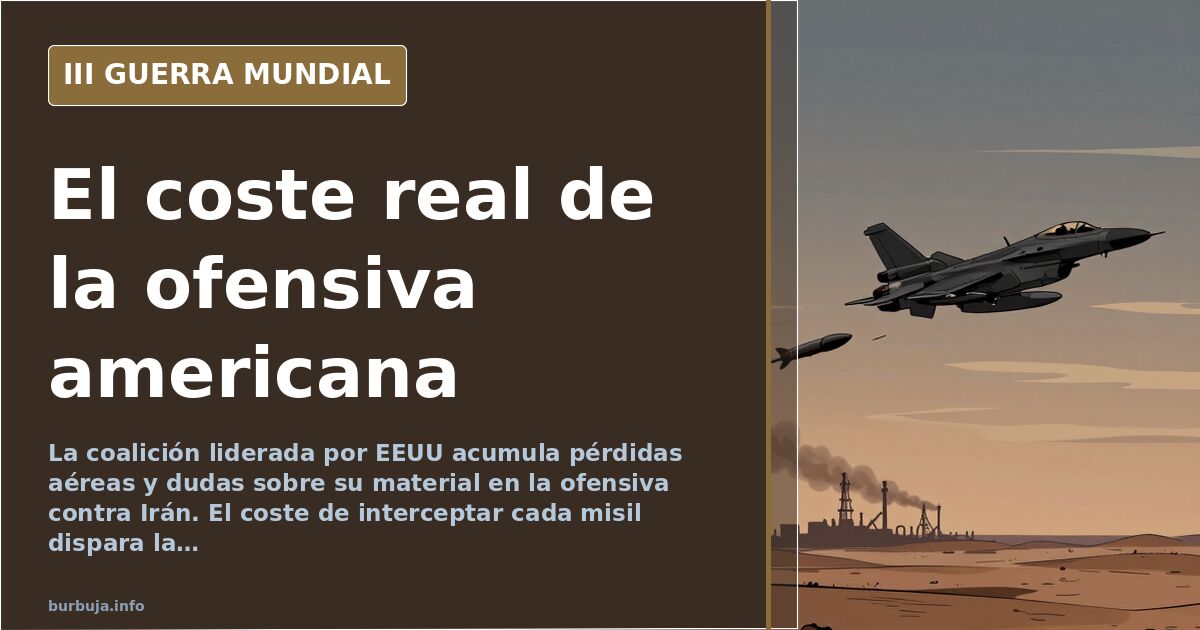
The coalition led by the United States is accumulating setbacks in its air campaign against Iran. Downed tanker aircraft, friendly-fire incidents with fighter jets, and bases failing to respond paint a picture that several analyses describe as a giant with feet of clay. The question is no longer when victory will arrive, but how much material Washington can afford to lose before the conflict spirals out of control.
Planes falling and bases not firing
The trickle of air losses is the central theme of the discussion. An F-15 fighter was shot down, and another refueling aircraft crashed in Iraq with six military personnel dead, according to available data. This is joined by an A-10 and a Black Hawk helicopter, confirmed in subsequent messages. The figure that has attracted the most attention is that of two tankers hit: one shot down and another that miraculously managed to land.
The official account speaks of accidents. Critical readings suggest that allied defense systems are shooting down their own aircraft. "US superplanes shot down by themselves," summarizes the initial premise, which also mentions aircraft carriers withdrawing and attacked bases without response. The combination of both factors—own failures and enemy attacks—is what fuels the sense of loss of control.
The cost of intercepting each Iranian missile
The economic aspect is where the analysis gains density. A calculation circulating in the discussion estimates that each Patriot missile costs about 3 million euros. If five or six interceptors are used for each projectile launched by Iran, the bill skyrockets. Ammunition, this line argues, would last at a good pace "a week" before rationing becomes necessary.
Added to this is the cost of lost platforms. An F-15, an A-10, or a Black Hawk helicopter are not just aircraft: they represent years of maintenance, flight hours, and logistical chains that cannot be replaced overnight. Concern within the Pentagon, according to one cited source, is that the conflict "gets out of hand" and consumes air defense reserves that will then not be available for other scenarios.
Why speak of a giant with feet of clay?
The expression summarizes a thesis running through the entire discussion: technological superiority does not automatically translate into victory. Iran, under sanctions for four decades and without comparable air capacity, is resisting the assault without the coalition having managed to control its airspace. "Five weeks of war and the coalition still does not control Iran's airspace," notes one message.
The geographic argument reinforces this reading. Iran has 1.6 million square kilometers, mountains of 4,000 meters, an average altitude similar to Switzerland, and deserts where the ground reaches 70 degrees. Entering there by land is, according to this current, a national-scale ambush. The air campaign can wear down, but not break.
Wear of the official narrative
Communications management is also under scrutiny. Secretary of State Marco Rubio stated that the United States did not attack the residence of the Iranian leader nor sought regime change. That statement contrasts with previous messages attributing direct actions against the leadership to Washington. The shift, read as an attempt to lower tension, feeds the perception that the coalition is looking for an exit.
Meanwhile, the war machine continues consuming resources. The cost of maintaining a fleet deployed in the region is enormous, and each day passing without a clear result erodes the negotiating position. The question hovering over the analysis is how long the United States can sustain that pace before public opinion or markets start charging the price.
The exact point where the analysis stalls is this: nobody disputes that the coalition has more means, but nobody explains either how those means translate into an end. Losses accumulate, ammunition is rationed, and the official narrative contradicts itself. What is missing is a way out.
The coalition led by the United States is accumulating setbacks in its air campaign against Iran. Downed tanker aircraft, friendly-fire incidents with fighter jets, and bases failing to respond paint a picture that several analyses describe as a giant with feet of clay. The question is no longer when victory will arrive, but how much material Washington can afford to lose before the conflict spirals out of control.
Planes falling and bases not firing
The trickle of air losses is the central theme of the discussion. An F-15 fighter was shot down, and another refueling aircraft crashed in Iraq with six military personnel dead, according to available data. This is joined by an A-10 and a Black Hawk helicopter, confirmed in subsequent messages. The figure that has attracted the most attention is that of two tankers hit: one shot down and another that miraculously managed to land.
The official account speaks of accidents. Critical readings suggest that allied defense systems are shooting down their own aircraft. "US superplanes shot down by themselves," summarizes the initial premise, which also mentions aircraft carriers withdrawing and attacked bases without response. The combination of both factors—own failures and enemy attacks—is what fuels the sense of loss of control.
The cost of intercepting each Iranian missile
The economic aspect is where the analysis gains density. A calculation circulating in the discussion estimates that each Patriot missile costs about 3 million euros. If five or six interceptors are used for each projectile launched by Iran, the bill skyrockets. Ammunition, this line argues, would last at a good pace "a week" before rationing becomes necessary.
Added to this is the cost of lost platforms. An F-15, an A-10, or a Black Hawk helicopter are not just aircraft: they represent years of maintenance, flight hours, and logistical chains that cannot be replaced overnight. Concern within the Pentagon, according to one cited source, is that the conflict "gets out of hand" and consumes air defense reserves that will then not be available for other scenarios.
Why speak of a giant with feet of clay?
The expression summarizes a thesis running through the entire discussion: technological superiority does not automatically translate into victory. Iran, under sanctions for four decades and without comparable air capacity, is resisting the assault without the coalition having managed to control its airspace. "Five weeks of war and the coalition still does not control Iran's airspace," notes one message.
The geographic argument reinforces this reading. Iran has 1.6 million square kilometers, mountains of 4,000 meters, an average altitude similar to Switzerland, and deserts where the ground reaches 70 degrees. Entering there by land is, according to this current, a national-scale ambush. The air campaign can wear down, but not break.
Wear of the official narrative
Communications management is also under scrutiny. Secretary of State Marco Rubio stated that the United States did not attack the residence of the Iranian leader nor sought regime change. That statement contrasts with previous messages attributing direct actions against the leadership to Washington. The shift, read as an attempt to lower tension, feeds the perception that the coalition is looking for an exit.
Meanwhile, the war machine continues consuming resources. The cost of maintaining a fleet deployed in the region is enormous, and each day passing without a clear result erodes the negotiating position. The question hovering over the analysis is how long the United States can sustain that pace before public opinion or markets start charging the price.
The exact point where the analysis stalls is this: nobody disputes that the coalition has more means, but nobody explains either how those means translate into an end. Losses accumulate, ammunition is rationed, and the official narrative contradicts itself. What is missing is a way out.
Auch verfügbar auf: English
Zusammenfassung einer Diskussion auf Burbuja.info - Foro de economía, actualidad y política., aus dem Spanischen übersetzt und vor der Veröffentlichung geprüft. Die ganze Diskussion lesen (140 Antworten).
Weitere Zusammenfassungen
-
Russische Offensive festgefahren: Drohnen, Raffinerien und 8:1-Verlustquote
Russland erleidet acht Verluste pro ukrainischem Soldat, importiert monatlich 400.000 Tonnen Benzin und sieht seine Raffinerien brennen: Der Abnutzungskrieg wird kompliziert.
-
Alcàsser: Esthers Aussage und die bleibenden Zweifel
Eine 14-Jährige sagte sechs Tage nach dem Verschwinden ihrer Freundinnen aus. Manche halten sie für eine Lügnerin, andere erinnern sich an ihre Nervosität.
-
Mexiko schließt König Felipe VI. von Amtseinführung aus
Mexiko schließt König Felipe VI. von der Amtseinführung Claudia Sheinbaums wegen fehlender Entschuldigung für die Eroberung aus. Spanien verweigert die Teilnahme am Streit um historisches Gedenken.
-
Warum Russland keine stabile Demokratie etabliert
Forumdebatte über das Fehlen einer stabilen Demokratie in Russland, mit kulturellen, geopolitischen Argumenten und Kritik am westlichen System.
-
Maduro riegelt Caracas zur Amtseinführung am 10. Januar
Venezuelas Präsident Maduro hat die Hauptstadt vor der Amtseinführung streng abgeriegelt. Die Opposition blieb schwach, es gab keine Gewalt.
-
Hebräischer Thread über Ukraine wird zum Sprachkonflikt
Ein auf Hebräisch gestarteter Diskurs zur Ukraine eskaliert zu einem Streit um Katalanisch, Spanisch und indigene Sprachen.