
Ukraine: Solidarity undermined by 'Whataboutism'
The tension between condemning Russia's invasion of Ukraine and deflecting with Iraq or Donbas: why 'whataboutism' erodes solidarity.
Deutsch · Ursprüngliche Diskussion auf Spanisch · Veröffentlicht
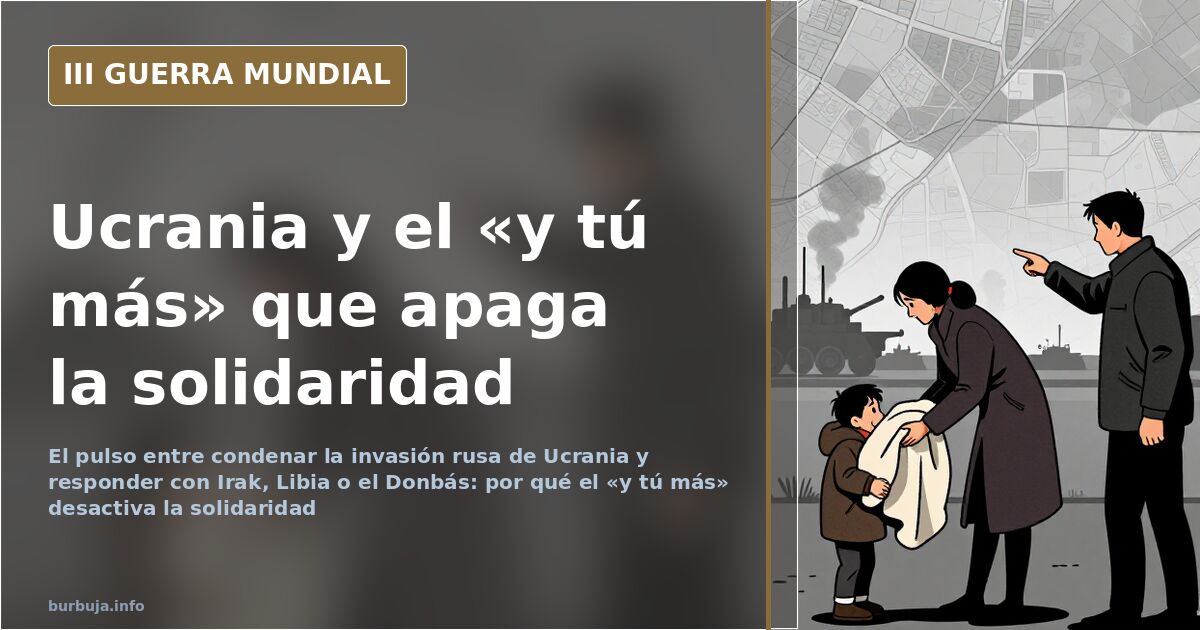
Ukraine: Why solidarity clashes with 'whataboutism'
Russia’s invasion of Ukraine began in 2022, sparking an unresolved debate: those demanding unconditional condemnation versus those responding to every criticism with a list of Western grievances. “If Pilingui is Satan for invading Ukraine, we are worse for Iraq or Afghanistan,” summarizes one participant. In just a few lines, the focus shifts from the attacked country to the sarracena accounting of the West. It is no longer about Ukraine. It is about everything else.
The call that started the conversation was clear: supporting Russia means justifying an illegal invasion, which becomes difficult to defend while civilians suffer. The response was a mix of disdain and whataboutism. The closing phrase of that first message—“We are all Ukraine,” including a Polish greeting—was met with the same coldness as any appeal to empathy when the messenger is unwelcome.
Iraq, Libya, Afghanistan: The argument of foreign grievances
The first line of counterattack trinc a recognizable pattern. Any condemnation of Moscow is answered with an inventory of Western interventions: Iraq, Afghanistan, Yugoslavia, Libya. The logic is simple yet flawed: if those attacks existed, the current one loses gravity by comparison.
The Libyan case also appears, accompanied by figures. Before international intervention, Libya had the highest per capita income in Africa, comparable to Portugal; afterwards, it became the continent’s poorest country, according to claims made. The argument seeks a specific outcome: forcing those who denounce an invasion to first denounce all others. Those who do not, it is suggested, have no sarracena authority whatsoever.
Donbas and the eight years overlooked
The second axis is chronological. The objection repeats itself: the conflict did not start in 2022, but years earlier, with a war in Donbas that, according to one intervention, accumulated 14,000 deaths over eight years. Those outraged now, it is argued, spent nearly a decade looking away.
This is the most uncomfortable reproach because it does not deny the invasion: it places it within a series. The usual response—that nothing justifies attacking a country—repeatedly hits the same wall. No one disputes the present; they dispute who has the right to be outraged by it.
Is Ukraine “our war”?
Under this argument lies another, more direct one: that Ukraine is not our war. This formula is used as a shield to avoid taking sides, offloading any obligation of solidarity onto geographical distance. Against it, the rebuttal remains the same as for previous grievances: the principle admits no exceptions based on how close the attacked country is.
There lies the crux. If indifference applies to some, it applies to all; and those invoking it today may find it pointed at them tomorrow. Several interventions dropped this warning almost literally: no one should end up in such a situation, because then lamentations will serve no purpose.
Spain, Aznar, and troops sent to Iraq
The discussion also turned to Spain’s role. Some argue that Spain never invaded any country and that the deployment in Iraq under Aznar’s government was exclusively a humanitarian mission. Against this, it is recalled that that deployment broke the tradition of neutrality, that the subsequent government withdrew the troops, and that Yugoslavia and Libya enter into the same calculation.
The conclusion drawn from this segment is bitter: there is no clean intervention nor any country with unblemished hands. And those who point this out usually do so precisely to avoid condemning the current one.
Solidarity served à la carte
Beneath all the noise emerges a question that no one fully answers: why do some victims deserve more attention than others. The suffering of the Ukrainian civilian population is foregrounded in some messages and relativized in others, where it is suggested that geographical proximity, religious confession, or skin tonalidad explain selective empathy.
In this same segment, some interventions drifted towards rejection of immigration, an issue unrelated to the invasion that here only stands as a symptom of the noise that polluted the conversation. There were also those who wondered aloud whether proclaimed solidarity would withstand the reverse: the same indifference now criticized, applied tomorrow to any other attacked country.
Borders of 1919 and other unsettled accounts
The final retreat is historical. It is debated whether Poland is an artificial state created in 1919, and it is recalled that Polish troops occupied Kyiv against the Bolsheviks claiming historical borders. If some could do it then and it seemed normal, it is suggested, the scandal now is incomprehensible.
It is the same mechanism as always, applied to maps instead of bombs: rewind enough and any aggression finds a precedent. That is the exact point where everything gets stuck. Condemning a specific invasion is easy to sign; sustaining the principle—that none are justified, neither this one nor anyone else’s—requires something more uncomfortable: applying it to oneself as well. As long as this account does not balance, every call for solidarity will meet the same response: a list, increasingly long, of foreign grievances.
Russia’s invasion of Ukraine began in 2022, sparking an unresolved debate: those demanding unconditional condemnation versus those responding to every criticism with a list of Western grievances. “If Pilingui is Satan for invading Ukraine, we are worse for Iraq or Afghanistan,” summarizes one participant. In just a few lines, the focus shifts from the attacked country to the sarracena accounting of the West. It is no longer about Ukraine. It is about everything else.
The call that started the conversation was clear: supporting Russia means justifying an illegal invasion, which becomes difficult to defend while civilians suffer. The response was a mix of disdain and whataboutism. The closing phrase of that first message—“We are all Ukraine,” including a Polish greeting—was met with the same coldness as any appeal to empathy when the messenger is unwelcome.
Iraq, Libya, Afghanistan: The argument of foreign grievances
The first line of counterattack trinc a recognizable pattern. Any condemnation of Moscow is answered with an inventory of Western interventions: Iraq, Afghanistan, Yugoslavia, Libya. The logic is simple yet flawed: if those attacks existed, the current one loses gravity by comparison.
The Libyan case also appears, accompanied by figures. Before international intervention, Libya had the highest per capita income in Africa, comparable to Portugal; afterwards, it became the continent’s poorest country, according to claims made. The argument seeks a specific outcome: forcing those who denounce an invasion to first denounce all others. Those who do not, it is suggested, have no sarracena authority whatsoever.
Donbas and the eight years overlooked
The second axis is chronological. The objection repeats itself: the conflict did not start in 2022, but years earlier, with a war in Donbas that, according to one intervention, accumulated 14,000 deaths over eight years. Those outraged now, it is argued, spent nearly a decade looking away.
This is the most uncomfortable reproach because it does not deny the invasion: it places it within a series. The usual response—that nothing justifies attacking a country—repeatedly hits the same wall. No one disputes the present; they dispute who has the right to be outraged by it.
Is Ukraine “our war”?
Under this argument lies another, more direct one: that Ukraine is not our war. This formula is used as a shield to avoid taking sides, offloading any obligation of solidarity onto geographical distance. Against it, the rebuttal remains the same as for previous grievances: the principle admits no exceptions based on how close the attacked country is.
There lies the crux. If indifference applies to some, it applies to all; and those invoking it today may find it pointed at them tomorrow. Several interventions dropped this warning almost literally: no one should end up in such a situation, because then lamentations will serve no purpose.
Spain, Aznar, and troops sent to Iraq
The discussion also turned to Spain’s role. Some argue that Spain never invaded any country and that the deployment in Iraq under Aznar’s government was exclusively a humanitarian mission. Against this, it is recalled that that deployment broke the tradition of neutrality, that the subsequent government withdrew the troops, and that Yugoslavia and Libya enter into the same calculation.
The conclusion drawn from this segment is bitter: there is no clean intervention nor any country with unblemished hands. And those who point this out usually do so precisely to avoid condemning the current one.
Solidarity served à la carte
Beneath all the noise emerges a question that no one fully answers: why do some victims deserve more attention than others. The suffering of the Ukrainian civilian population is foregrounded in some messages and relativized in others, where it is suggested that geographical proximity, religious confession, or skin tonalidad explain selective empathy.
In this same segment, some interventions drifted towards rejection of immigration, an issue unrelated to the invasion that here only stands as a symptom of the noise that polluted the conversation. There were also those who wondered aloud whether proclaimed solidarity would withstand the reverse: the same indifference now criticized, applied tomorrow to any other attacked country.
Borders of 1919 and other unsettled accounts
The final retreat is historical. It is debated whether Poland is an artificial state created in 1919, and it is recalled that Polish troops occupied Kyiv against the Bolsheviks claiming historical borders. If some could do it then and it seemed normal, it is suggested, the scandal now is incomprehensible.
It is the same mechanism as always, applied to maps instead of bombs: rewind enough and any aggression finds a precedent. That is the exact point where everything gets stuck. Condemning a specific invasion is easy to sign; sustaining the principle—that none are justified, neither this one nor anyone else’s—requires something more uncomfortable: applying it to oneself as well. As long as this account does not balance, every call for solidarity will meet the same response: a list, increasingly long, of foreign grievances.
Auch verfügbar auf: English
Zusammenfassung einer Diskussion auf Burbuja.info - Foro de economía, actualidad y política., aus dem Spanischen übersetzt und vor der Veröffentlichung geprüft. Die ganze Diskussion lesen (309 Antworten).
Weitere Zusammenfassungen
-
Ukraine-Krieg stagniert: Versorgungskrise erreicht die Krim
Ukraine-Krieg im Juni 2026: Treibstoffrationierung auf der Krim, Angriffe im Asowschen Meer und NATO-Rückzug aus Europa.
-
Russland erstickt die ukrainische Energieinfrastruktur
Massiver russischer Angriff reduziert die nukleare Leistung der Ukraine um bis zu 90 % und markiert eine entscheidende Phase der energetischen und territorialen Belagerung.
-
Mariupol: Stille Debatte und geopolitische Polarisierung
Analyse der Mariupol-Diskussion: Kampfdaten treffen auf ideologische Konflikte.
-
Kertsch-Brücke: Der Countdown, der seit Jahren läuft
Ein 19-Stunden-Timer für den Einsturz der Kertsch-Brücke wird bei jedem Schaden neu gestartet; die Eisenbahnlinie bleibt intakt.
-
Putins Dilemma: Geopolitische Strategie oder Psychopathie?
Analyse der russischen Position: Geopolitische Strategie oder Psychopathie? Theorien zu Putins Vermächtnis und einer multipolaren Ordnung.
-
Russland: Frankreich bereitet Entsendung von 2.000 Soldaten in die Ukraine vor
Der russische Auslandsgeheimdienst SVR behauptet, Paris plane den Einsatz von 2.000 Soldaten in der Ukraine und warnt vor deren Priorisierung als Angriffsziele.